




I was a toddler in the first grade; wait a minute, not quite, because I had been ferried into first grade on the strength of the fact that I was fast friends with my maternal first cousin, Master Vincent Assiseh, Jr., who was a few months older than I was (and still is a few months older than I am), and who could not be torn away from me and vice-versa. His mother was my late mother's immediate younger sister and, interestingly, a lot of folks who saw us together thought we were either a set of twins or somebody and his immediate younger sibling. I was a bit taller, so I was almost always perceived to be the older sibling.
February 24, 1966 must have been quite a momentous occasion, because school was out on that day and masses of mature adults, as well as young adults, were marching through the principal streets of “Akyem”-Suhum, where I resided with my aunt, Teacher Theodosia Sintim-Assiseh, and my cousin, Yaw Kafui Assiseh, as well as two of his younger siblings, Akosua and Kuukuwaa; the third one, Kwasi Assiseh, would be born several years later. Yes, throngs of adult Ghanaians were marching through the principal streets of Suhum as many of them had done during the Independence parades just the year before, except that this time around they were shouting profanities at the top of their voices.
Some of the songs, which do not bear repeating herein, alluded to Kwame Nkrumah, the deposed President, being possessed of a jumbo water-cannon and who had been deservedly driven into exile in faraway Guinea, where he was supposed to be tapping palm-wine, the choice profession of societal failures, I suppose.
The song about the deposed President's wife, Madam Fathia Nkrumah, was even more vulgar and downright disgusting, and it was not clear to me exactly why some adult Ghanaians wanted us children to hear such songs and even sing along with them, particularly since in the Reverend T. H. Sintim's household none was allowed to use any graphic words, or expressions, for the human genitalia, be it male or female. We called them “My Pee-Thing,” or urinary object. And for the girls, it sounded something like “My Cocoa-pod” or “Me Kookoo.” Both expressions never quite made any sense to me but, of course, we were given no choice in this matter. It would be several years before I heard some of my playmates at school use different and supposedly more graphic terms for the same objects. Even so, our parents and grandparents insisted that we, the Sintim Grandchildren, not behave like those heathens – or “Maamufo” – who were possessed of no good manners, anyway, and who were not worth our associating with them.
Over the years, though, February 24 has not meant that much to me, besides the fact that I routinely call my immediate older sister, Abena Yeboaa, to wish her “Happy Birthday,” which is exactly what I shall be doing first thing tomorrow morning.
In terms of postcolonial Ghanaian political history, however, increasingly I have come to revere those yeomen and noblemen who confronted thoroughgoing tyranny and uprooted it and blessed the rest of us their countrymen and women with the sort of Freedom and Justice that had been the sacred promise of Independence but which, tragically, had swiftly been reduced to a veritable culture of abject misery and utter deprivation shortly after Independence in March 1957.
But that February 24 was to open the sluice-gates to a pathological and perennial culture of wanton stratocracy – as Mr. Abdul Rahman Harruna-Atta, editor-publisher of the Accra Daily Mail recently noted (see Accra Daily Mail 2/23/07) – does not, in any way, shape, form or manner, negate the imperative necessity to drive our pseudo-monarchical tyrant into exile and make certain that he ended the rest of his days in exile, where he belonged.
Over the years, I have come to appreciate the turbulent post-February 24 era as a necessary transitional period in the political growth and maturity of postcolonial Ghana, particularly when one also recognizes the fact that Ghana has been integral to the norm of the morally and psychologically daunting era of stratocracy rather than the exception, as one would have had it. Interestingly, though, it is now equally true that Ghana has also become a trailblazer in this new era of salutary democratic culture.
But whether anyone ought to feel elated or dolorous with regard to February 24, 1966, pretty much depends on one's personal and familial circumstances on the eve of the landmark overthrow of the so-called Convention People's Party. Thus, for instance, those who envisaged the CPP era as one of a veritable and fabulous gravy-train fiesta are, of course, likely to bemoan its radical passing; whereas those of us who envisaged the era as one of insufferable tyranny, human-resource wastage and rank corruption are wont to be ineffably thankful for its auspicious passing.
For a toddler of the period like this writer, though, it was the violent passing of Lt.-General E. K. Kotoka, the man who almost singularly proffered Ghanaians that indubitably necessary respite from Life-Presidential Dictatorship a year later that constituted the greatest tragedy, of apocalyptic proportions, during the 1960s. How, for instance, was one to explain the brutal assassination of the man who almost singularly instructed Ghanaians about the auspicious possibility and availability of a more benign political alternative to one's children?
Shortly after the assassination of Gen. Kotoka, Mr. Vincent Assiseh, my uncle-in-law, read the news: I don't quite remember whether it was, indeed, the six o'clock in the morning news or the major one in the evening. Now, though, I am also recalling the fact that it could just as well have been Mr. Kwame Amamo (later Rev. Kwame Amamo), or perhaps Mrs. Emelia Cromwell Adama, or Ms. Vida Koranteng-Asante, or Ms. Genevieve Nylander (perhaps the most feminine of them all) or even somebody altogether different. But really, does it matter who?
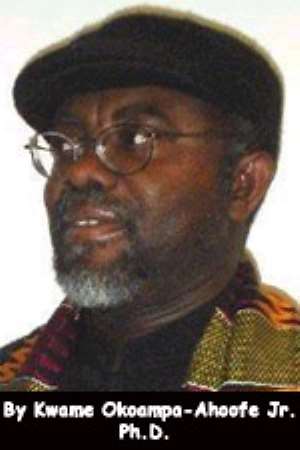
*Kwame Okoampa-Ahoofe, Jr., Ph.D., Department of English, Nassau Community College of the State University of New York, Garden City. E-mail: [email protected].

 One dead, fire officer hospitalised after bee attack at Quarry Site in Sokode Gb...
 Israel and Iran step back from further strikes after renewed clashes
 Patients stranded as doctors, nurses refuse to see new patients over KATH CEO su...
 Avenor Rural Bank CEO’s house destroyed by fire
 Three arrested in Winneba for illegal mining near GWL water lines
 Two pupils of Alice Elite Academy laid to rest after fatal school bus crash
 Here are areas to be affected by ECG's planned maintenance on Tuesday
 Family of civil engineer killed in alleged military shooting demands justice
 SHS teacher allegedly beats female student over unpaid hostel fees
 Blow to EU defence cooperation as France, Germany abandon joint fighter jet prog...


