




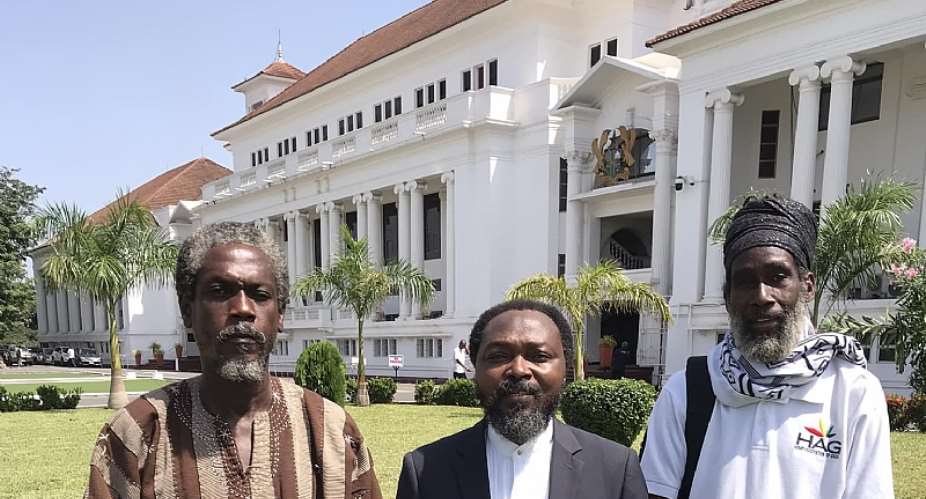
The Accra Human Rights Court One on Friday dismissed the application by Food Sovereignty Ghana (FSG), a civil society organisation, challenging the commercialisation of Genetically Modified Organisms (GMOs) in Ghana.
The Court’s decision was based on the fact that the plaintiff’s evidence failed to convince the Court presided over by Justice Barbara Tetteh Charwey.
The Court ordered the National Biosafety Authority (NBA) that all GMOs on the market should be labelled for the public to make informed choices.
The National Biosafety Authority was also asked to sensitise and educate the citizens on GMOs.
The FSG, together with Vegetarians’ Association and the Convention People’s Party in an application at the Court, sought whether required processes and laws had been adhered to in the ongoing plans to commercialise GMOs.
Plaintiffs also sought a declaration whether the defendants- NBA, Ministry of Food and Agriculture, Attorney General’s Office and Ghana National Farmers and Fishers’ Association, had proper and detailed documentation in relation to the area of risk assessment and management in relation to the intention to release and commercialize cowpea and rice in the Ghanaian ecosystem and if they met the accepted legal requirements in the handling of GMOs activities.
Plaintiffs again applied for interlocutory injunction to restrain defendants, their agents, servants and assigns from approving, releasing and commercialising GMO rice and cowpea until final determination of the case by the Court.
Mr Eric Okoree Amaning, Chief Executive Officer of NBA, after the judgement, told the media that there were no GMOs on the market as claimed during the nine year trial.
He said it was rather on a point of research.
He however said there were no data on GMOs from Nigeria on the Ghanaian market, thus, his outfit could not publish any data on it as ordered by the Court.
Mr Wayo Ghanamanti, counsel for plaintiff, also on the sidelines of Court’s proceedings, though not happy with the decision said, it was a victory for Ghana.
He pledged that National Biosafety Authority would be monitored to ensure it followed the Court’s direction.
He said consuming GMOs was not the way to go as Ghana had fertile lands for the conventional food products.
GNA

 Govt releases GH¢9.1 billion covering six quarters of DACF to MMDAs - Ayariga
 Manhyia South MP charged over alleged GH¢9.85m loss to SIC Life
 'I didn’t know the process would be that fast' – Nana B explains missing NPP swe...
 'Who is Karbo to defy my orders?' – Buttey fumes over NPP conference clash
 'Kojo Bamba can’t stop NDC' – Gbande warns NPP against shielding anyone from arr...
 Fire destroys property building in Koforidua
 Mahama pardons 863 convicted persons, 11 from death sentence
 National Cathedral site reverts to government as Attorney-General reviews audit
 NDC confirms Dzifa Gunu’s disqualification from La Dadekotopon constituency secr...
 Nigeria's Tinubu confirms 32 dead after military plane crash



Comments
Why does Africa need genetically modified foods ? Besides misleaders following the commands of their slavemasters ! We have the best land and thousands of years of continuous indigenous seeds. Are they just puppets or payees of monsanto and cargill, bill gates et Al?