




Following US President Donald Trump’s inauguration, George Orwell’s classic dystopia 1984 jumped to number one on Amazon’s list of best-selling books, just the latest sign of the genre’s current popularity.
But Nigerian-American World Fantasy Award winner Nnedi Okorafor said 1984 is not the dystopia that feels most relevant to her at this point in history. “After everything that happened, I’m not reading 1984, I’m not reading Fahrenheit 451, I’m not reading A Handmaid’s Tale. I’m reading Parable of the Sower by Octavia Butler. I feel like if we’re looking for any answers or where we’re going, it’s definitely in Octavia’s work.”
Speaking to The Stream on Al Jazeera, Okorafor read from the African-American novelist’s 1998 sequel, the Nebula-winningParable of the Talents, which features a presidential candidate, Andrew Steele Jarret, who rises to power by promising, like Trump, to “make America great again,” and whose supporters are known to form mobs to burn and feather and tar those who don’t “quite match Jarret’s version of Christianity.”
Okorafor added that “the definition of dystopia depends on the group of people.” The Stream host, Femi Oke, used the regular power cuts in Nigeria as an example, saying, “Not having regular power could be the end of civilisation if you live in Brooklyn but not if you live in Abuja.”
New York Times bestselling Chinese-American author Marie Lu agrees. She lived in Beijing at the time of the Tiananmen Square protests, a period most in the West would have described as dystopian, but says during her time there it felt “like that’s just everyday life.”
Utopias for some are normally dystopias for others. Ron Charles, the fiction editor for The Washington Post, recounts a conversation with a professor of American-American literature. “She said what’s so interesting to her is that white people always think of dystopias as looking forward into this scary future, but black Americans can look back. They’ve already come through their dystopia. They had 200 years of horror and slavery. All the kinds of things we imagine the future dystopia being like are what black Americans already went through.”
Lu takes this further, saying, “There has never been a time in which we have not been living through a dystopia.”
Okorafor’s novels have been described as both dystopian and Afrofuturism, but she doesn’t see a contradiction in the terms. “Afrofuturism isn’t always upbeat,” she says. “A lot of it is in response to the darkness and trying to show the light but a lot of it goes dark… Afrofuturism is very diverse, so pinning it down to being focused on upliftment and being positive is a little short-sighted.”
Asked about what she’s currently working on, Okorafor said she is editing a “not so dark” novel called Remote Control,set in the future in Ghana, dealing with both technology and mysticism.
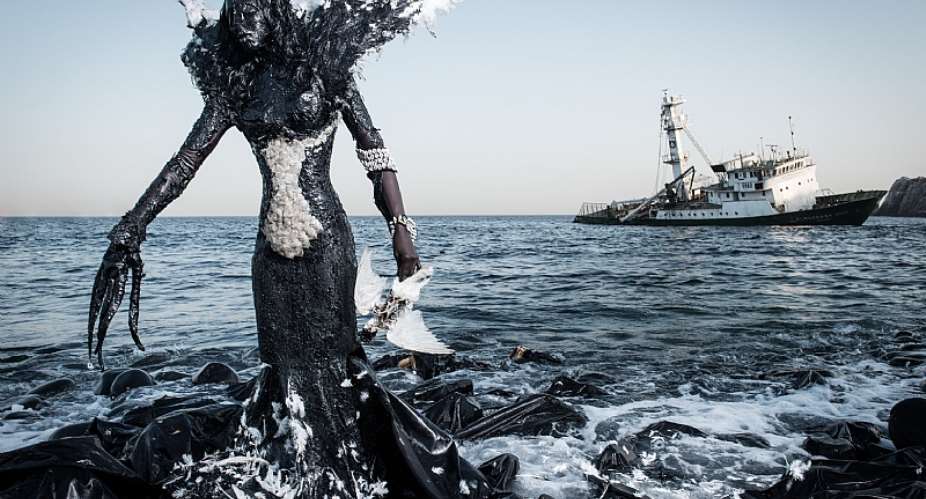
Watch the full discussion, which also features Dakar-based photographer Fabrice Monteiro, at
.

 Allow the law to deal with defilement perpetrators - Director tells families
 Gov’t to develop policy for Ghanaian sign language in education
 Two Ada SHS students plead guilty to assault, slapped with 12-month bond
 Enlistment: GAF begins documentation, body selection from September 28
 Violent rainstorm rips off roofs, displaces residents in Krachi Nchumuru
 Ghana risks EU gas market access over methane emissions
 Tumu landlord gives road encroachers 2-week ultimatum to relocate for road const...
 Serbian President Aleksandar Vucic resigns
 Tigray TV station hit by drone, rebels advance in north Ethiopia
 Swiss reject plan to toughen neutrality



Comments
200 years? whoever wrote this is an ignorant fuck and may know american history which we learned in fucking highschool but not world history....200 years...the Arab involvement in the slave trade which involved mostly conquered african black slaves has lasted fourteen centuries, and in some parts of the Muslim world is still continuing to this day. Get the fuck out of here with this anti white american propoganda.