A large number of Muslims the world over have begun their annual journeys to the Kingdom of Saudi Arabia to begin the processes of this year’s hajj pilgrimage to Mecca and Madina. Muslims in Asian nations of India, Pakistan and some African countries like Nigeria with large contingents have already begun traveling to the holy land. According to sources close to the hajj committee in Ghana some 5,400 Ghanaian pilgrims would begin travelling by air to Saudi Arabia from September 3.
The Saudi Arabia airliner, Nas Air which has been engaged to convey the Ghanaian pilgrims would embark on a daily flight to be able to carry all the pilgrims on time to the holy land As Per The estimates of the Fiqh Council of North America, Hajj 2015 will fall between September 20 and September 25, insha-Allaah.
The Hajj takes place from the 8th to the 12th of Zul-Hijjah which is the last month of the Hijri calendar. As part of the hajj program in Ghana , a seminar would be held by the hajj committee to sensitize the pilgrims especially the ‘first timers’ on the rudiments of the hajj pilgrimage. All intending pilgrims who need to know more about the hajj and to have access to their hajj travelling bags and other items are being advised to attend the seminar. All their agents would be available to attend to them.
The Hajj is an annual Islamic pilgrimage to Mecca , and a mandatory religious duty for Muslims that must be carried out at least once in their lifetime by all adult Muslims who are physically and financially capable of undertaking the journey, and can support their family during their absence. It is one of the five pillars of Islam , alongside Shahadah , Salat , Zakat , and Sawm . The gathering during Hajj is considered the largest annual gathering of people in the world. The state of being physically and financially capable of performing the Hajj is called istita'ah, and a Muslim who fulfills this condition is called a mustati. The Hajj is a demonstration of the solidarity of the Muslim people, and their submission to God ( Allah ). The word Hajj means "to intend a journey", which connotes both the outward act of a journey and the inward act of intentions.
The pilgrimage occurs from the 8th to 12th (or in some cases 13th) of Dhu al-Hijjah , the last month of the Islamic calendar . Because the Islamic calendar is lunar and the Islamic year is about eleven days shorter than the Gregorian year, the Gregorian date of Hajj changes from year to year. Ihram is the name given to the special spiritual state in which pilgrims wear two white sheets of seamless cloth and abstain from certain things.
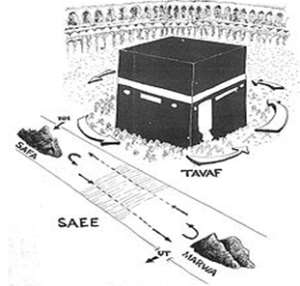
The Hajj is associated with the life of Islamic prophet Muhammad from the 7th century, but the ritual of pilgrimage to Mecca is considered by Muslims to stretch back thousands of years to the time of Abraham . During Hajj, pilgrims join processions of hundreds of thousands of people, who simultaneously converge on Mecca for the week of the Hajj, and perform a series of rituals: each person walks counter-clockwise seven times around the Ka'aba (the cube-shaped building and the direction of prayer for the Muslims), runs back and forth between the hills of Al-Safa and Al-Marwah , drinks from the Zamzam Well , goes to the plains of Mount Arafat to stand in vigil, spends a night in the plain of Muzdalifa , and performs symbolic stoning of the devil by throwing stones at three pillars. The pilgrims then shave their heads, perform a ritual of animal sacrifice, and celebrate the three day global festival of Eid al-Adha .
Pilgrims can also go to Mecca to perform the rituals at other times of the year. This is sometimes called the "lesser pilgrimage", or Umrah . However, even if they choose to perform the Umrah, they are still obligated to perform the Hajj at some other point in their lifetime if they have the means to do so.
The present pattern of Hajj was established by Muhammad . However, according to the Quran, elements of Hajj trace back to the time of Abraham , around 2000 BCE. According to Islamic tradition, Abraham was ordered by God to leave his wife Hagar ( Hagar ) and his son Ishmael alone in the desert of ancient Mecca. In search of water, Hagar desperately ran seven times between the two hills of Safa and Marwah but found none. Returning in despair to Ishmael, she saw the baby scratching the ground with his leg and a water fountain sprang forth underneath his foot. [18] Later, Abraham was commanded to build Kaaba (which he did with the help of Ishmael) and to invite people to perform pilgrimage there. [19] The Quran refers to these incidents in verses 2:124-127 and 22:27-30 . [n 1] It is said that the archangel Gabriel brought the Black Stone from Heaven to be attached to Kaaba.
In pre-Islamic Arabia, a time known as jahiliyyah , Kaaba became surrounded by pagan idols . [20] In 630 CE, Muhammad led his followers from Medina to Mecca, cleansed the Kaaba by destroying all the pagan idols, and then reconsecrated the building to Allah. In 632 CE, Muhammad performed his only and last pilgrimage with a large number of followers, and instructed them on the rites of Hajj. [22] It was from this point that Hajj became one of the five pillars of Islam.
During the medieval times, pilgrims would gather in big cities of Syria, Egypt, and Iraq to go to Mecca in groups and caravans comprising tens of thousands of pilgrims, [23] often under state patronage. [24] Hajj caravans, particularly with the advent of the Mamluk Sultanate and its successor, the Ottoman Empire , were escorted by a military force accompanied by physicians under the command of an hajj. This was done in order to protect the caravan from Bedouin robbers or natural hazards, and to ensure that the pilgrims were supplied with the necessary provisions. Muslim travelers like Ibn Jubayr and Ibn Battuta have recorded detailed accounts of Hajj-travels of medieval time. The caravans followed well-established routes called in Arabic darb al-hajj, lit. "Pilgrimage road", which usually followed ancient routes such as the King's Highway .
Timing of Hajj
The date of Hajj is determined by Islamic calendar (known as Hijri calendar or AH), which is a lunar year . Every year, the events of Hajj take place in a five-day period, starting on 8 and ending on 12 Dhul-Hijjah , the twelfth and last month of the Islamic calendar. Among these five days, the 9th Dhul-Hijjah is known as Day of Arafah , and this day is called the day of Hajj. Because the Islamic calendar is lunar and the Islamic year is about eleven days shorter than the Gregorian year, the Gregorian date for Hajj changes from year to year. Thus, each year in the Gregorian calendar, the pilgrimage starts eleven days (sometimes ten days) earlier than the preceding year. This makes it possible for the Hajj season to fall twice in one Gregorian year, and it does so every 33 years. The last time this phenomenon occurred was 2006. [31] The table below shows the Gregorian dates of Hajj of recent years (the dates correspond to 9 Dhul-Hijjah of Hijri calendars):
Ihram
When the pilgrims are about 6 miles (10 km) from Mecca, they enter into a state of holiness – known as Ihram – that consists of wearing two white seamless cloths for the male, with the one wrapped around the waist reaching below the knee and the other draped over the left shoulder and tied at the right side; wearing ordinary dress for the female that fulfills the Islamic condition of public dress with hands or face uncovered;] taking ablution; declaring the intention (niyah) to perform pilgrimage and to refraining from certain activities such as clipping the nails, shaving any part of the body, having sexual relations; using perfumes, damaging plants, killing animals, covering head (for men) or the face and hands (for women); getting married; or carrying weapons. A place designated for changing into Ihram is called a Miqat . The ihram is meant to show equality of all pilgrims in front of God : there is no difference between the rich and the poor.
Mount Safa near Kaaba inside Masjid al-Haram
Tawaf means walking seven times counterclockwise around the Kaaba. Upon arriving at Masjid al-Haram, pilgrims perform an arrival tawaf either as part of Umrah or as a welcome tawaf. During tawaf, pilgrims also include Hateem – an area at the north side of Kaaba – inside their path. Each circuit starts with the kissing or touching of the Black Stone (Hajar al- Aswad). If kissing the stone is not possible because of the crowds, they may simply point towards the stone with their hand on each circuit. Eating is not permitted but the drinking of water is allowed, because of the risk of dehydration due to the often low humidity in Mecca. Men are encouraged to perform the first three circuits at a hurried pace, known as Ramal, and the following four at a leisurely pace.
The completion of Tawaf is followed by two Rakaat prayers at the Place of Abraham (Muqam Ibrahim), a site near Kaaba inside the mosque. However, again because of large crowds during the days of Hajj, they may instead pray anywhere in the mosque. After prayer, pilgrims also drink water from the Zamzam well, which is made available in coolers throughout the Mosque. [43]
Although the circuits around the Kaaba are traditionally done on the ground level, tawaf is now also performed on the first floor and roof of the mosque because of the large crowd.
Tawaf is followed by sa'ay, running or walking seven times between the hills of Safa and Marwah, located near Kaaba. Previously in open air, the place is now entirely enclosed by the Masjid al-Haram mosque, and can be accessed via air-conditioned tunnels.[ Pilgrims are advised to walk the circuit, though two green pillars mark a short section of the path where they are allowed to run. There is also an internal "express lane" for the disabled. After sayee, the male pilgrims shave their heads and women generally clip a portion of their hair, which completes the Umrah.
After narrating all that needs to be known about the hajj pilgrimage an experienced hajj agent had a word of advice to all those who are preparing to travel to the holy land for the hajj pilgrimage
Alhaji Gariba Ibrahim, Managing Director, Al-Balad Travel and Tours Limited, the official travel agent for Hajj, warned hajj pilgrims to adhere to the rules governing the hajj pilgrimage. He advised the pilgrims to stay clear from iniquities that include trading in narcotics and other dangerous drugs .
According to him, ‘engaging in narcotics or even having the illegal substance in your possession is a grievous crime in Saudi Arabia, that could result in the culprit being beheaded or hanged to death.
To avoid this painful death and its accompanying embarrassment to the country, Alhaji Gariba admonished Ghanaian pilgrims to sustain Ghana's good image and reputation by doing away with narcotics as they travel for the Hajj.
To the best of his knowledge, he stated that Ghanaian pilgrims to Mecca over the years have comported themselves well and this had boosted the image of the country, so he expected the positive trend to be sustained.
He had the opportunity to address about 1,500 Muslim pilgrims drawn from the Ashanti, Brong Ahafo and some parts of the Northern regions during a day's seminar held at the Prempeh Assembly Hall in Kumasi, during which he announced that that 5,400 pilgrims, mostly women, from Ghana, would emplane to Mecca to perform the annual Hajj this year, noting that the figure falls short of the 7,000 pilgrims that made the trip last year.
Executive Director
EANFOWORLD FOR SUSTAINABLE DEVELOPMENT
P.O.BOX 17070AN 233244370345/23326370345/ 233208844791
[email protected] /[email protected]
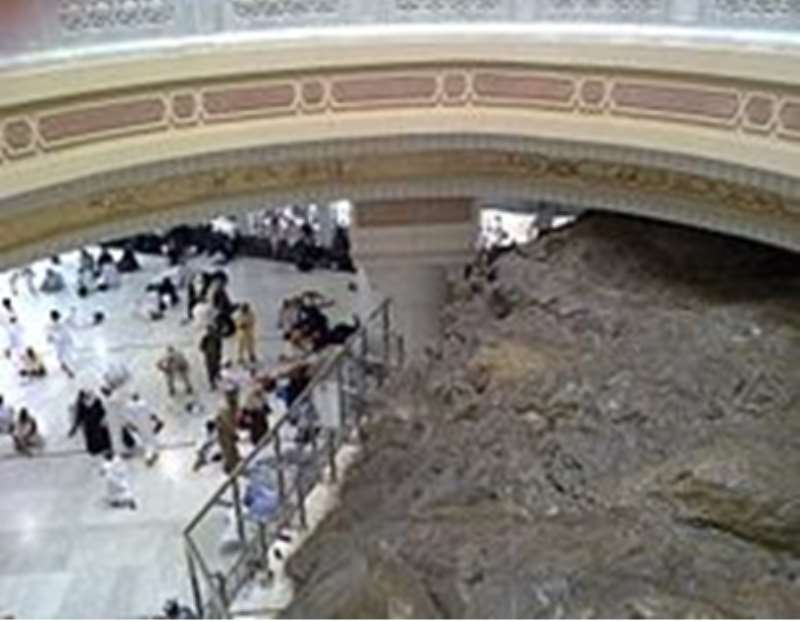 Mount Safa Near Kaaba Inside Masjid Al-Haram

 NDC behaving as if they will stay in government forever — NPP’s Alfred Thompson
 Residents protest at NEDCo office in Kpandai over power disconnections
 Toxic fumes from generator during dumsor kills three individuals at Manhean
 Police arrest 11 suspects over AI deepfake videos impersonating president Mahama
 Election 2028: Bawumia appoints all four NPP presidential aspirants as co-chairm...
 Ghanaians in US romance scam case: Jamal caged, Kamal set free
 How father allegedly dragged his son with quad bike on tarred road at North Lego...
 May 8: Cedi sells at GHS12.10 on forex market, drops to GHS11.28 on BoG interban...
 Health Committee Chair tells health professionals to resign if they are tired of...
 GTEC orders Bolgatanga Technical University Vice Chancellor to resume duties