




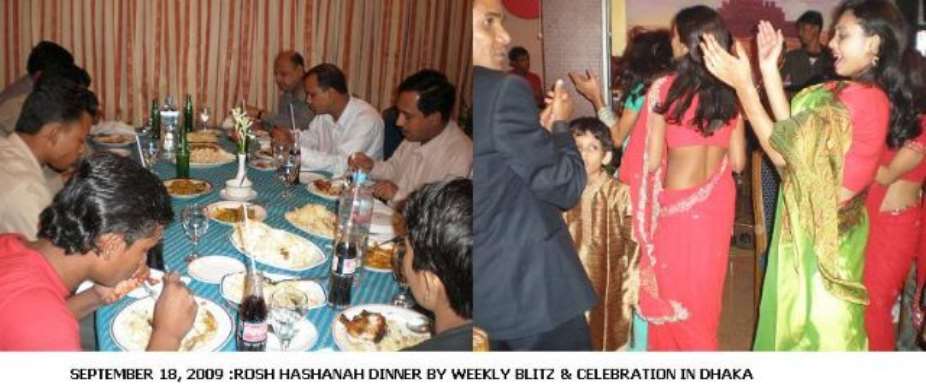
Month of September has brough together religious festivals of Jews, Muslims and Hindus in the world. On September 18, 2009 Jewish population around the world celebrated Rosh Hashanah, while Muslims celebrated Eid Ul Fitr on September 20 and 21. For Hindus, one of the biggest religious festivals, Durga Puja is from September 26, 2009.
Rosh Hashanah:
Rosh Hashanah [literally "head of the year"] is a Jewish holiday commonly referred to as the "Jewish New Year." It is observed on the first day of Tishrei, the seventh month of the Hebrew calendar, as ordained in the Torah, in Leviticus 23:24. Rosh Hashanah is the first of the High Holidays or Yamim Noraim ["Days of Awe"], or Asseret Yemei Teshuva [Ten Days of Repentance] which are days specifically set aside to focus on repentance that conclude with the holiday of Yom Kippur.
Rosh Hashanah is the start of the civil year in the Hebrew calendar [one of four "new year" observances that define various legal "years" for different purposes as explained in the Mishnah and Talmud]. It is the new year for people, animals, and legal contracts. The Mishnah also sets this day aside as the new year for calculating calendar years and sabbatical [Shmita] and Jubilee [Yovel] years. Jews believe Rosh Hashanah represents either analogically or literally the creation of the World, or Universe. However, according to one view in the Talmud, that of R. Eleazar, Rosh Hashanah commemorates the creation of man, which entails that five days earlier, the 25 of Elul, was the first day of creation of the Universe.
The Mishnah, the core text of Judaism's oral Torah, contains the first known reference to Rosh Hashanah as the "day of judgment." In the Talmud tractate on Rosh Hashanah it states that three books of account are opened on Rosh Hashanah, wherein the fate of the wicked, the righteous, and those of an intermediate class are recorded. The names of the righteous are immediately inscribed in the book of life, and they are sealed "to live." The middle class are allowed a respite of ten days, until Yom Kippur, to repent and become righteous; the wicked are "blotted out of the book of the living."
Hebrew Calender:
The Hebrew calendar or Jewish calendar is a lunisolar calendar used by Jews, the followers of Judaism and in recent decades, by a growing number of Messianic Jews and Christians. Today, the calendar is predominantly used for religious observances, but is also employed by Jewish farmers in Israel as an agricultural framework.
The calendar is used to reckon the Jewish New Year and dates for Jewish holidays, and also to determine appropriate public reading of Torah portions, Yahzeits [dates to commemorate the death of a relative], and daily Psalm reading, among many ceremonial uses. Originally the Hebrew calendar was used by Jews for all daily purposes. Following the conquest of Jerusalem by Pompey in 63 BCE, Jews began additionally following the imperial civil calendar [which was decreed in 45 BCE] for civic matters such as the payment of taxes and dealings with government officials.
The principles of the Hebrew calendar are found in the Torah, which contains several calendar-related commandments, including God's commandment during the Exodus from Egypt to fix the month of Aviv as the first month of the year. The Babylonian exile in the 6th century BCE influenced the calendar, including the adoption of Babylonian names for the months.
During Temple times and through the Tannaitic period, the Hebrew calendar was observational, with the beginning of each month determined by the high court based on the testimony of witnesses who had observed a new crescent moon. Periodically, the court ordered an extra month added to keep Passover in the spring, again based on observation of natural events. Through the Amoraic period and into the Geonic period, the purely empirical calendar was displaced by calendrical rules, which finally became systematically arranged into a computed calendar. The principles and rules of the current calendar are fully described by Maimonides in the Mishneh Torah.
Because of the roughly eleven-day difference between twelve lunar months and one solar year, the year lengths of the Hebrew calendar vary in a repeating 19-year Metonic cycle of 235 lunar months, with an intercalary lunar month added according to defined rules every two or three years, for a total of 7 times per 19 years. Seasonal references in the Hebrew calendar reflect its development in the region east of the Mediterranean Sea and the times and climate of the Northern Hemisphere. The Hebrew calendar's year is longer by about 6 minutes and 25+25/57 seconds than the present-day mean solar year, so that every 224 years, the Hebrew calendar will fall a full day behind the modern fixed solar year, and about every 231 years it will fall a full day behind the Gregorian calendar year.
Years in the Hebrew calendar are labeled with the era designation Anno Mundi [Latin for "in the year of the world"], abbreviated AM and A.M., and are numbered from the epoch that, by Rabbinical reckoning, is a year before the date of Creation. Early 2009 corresponds to Hebrew year 5769; the Hebrew year 5770 began at sundown on the evening of 18 September 2009.
Eid Ul Fitr:
Eid ul-Fitr, often abbreviated to Eid, is a Muslim holiday that marks the end of Ramadan, the Islamic holy month of fasting. Eid is an Arabic word meaning "festivity", while Fiṭr means "to break fast"; and so the holiday symbolizes the breaking of the fasting period. It is celebrated after the end of the Islamic month of Ramadan, on the first day of Shawwal.
Eid ul-Fitr is a day long celebration and is sometimes also known as the "Smaller Eid" as compared to the Eid ul-Adha that lasts four days and is called the "Greater Eid" [Arabic: al-'īdu l-kabīr].
Typically, Muslims wake up early in the morning and have a small breakfast [as a sign of not being on a fast on that day] of preferably the date fruit, before attending a special Eid prayer that is performed in congregation at mosques or open areas like fields, squares etc. Muslims are encouraged to dress in their best clothes [new if possible] for the occasion. No adhan or iqama is to be pronounced for this Eid prayer, and it consists of only two raka'ahs. The Eid prayer is followed by the khutbah [sermon] and then a supplication [dua'] asking for forgiveness, mercy and help for all living beings across the world. The khutbah also instructs Muslims as to the performance of rituals of Eid, such as the zakat. It is then customary to embrace the persons sitting on either side of oneself, whilst greeting them. After the prayers, people also visit their relatives, friends and acquaintances and some people also pay visits to the graveyards.
Hijri Calender:
The Islamic calendar or Muslim calendar or Hijri calendar is a lunar calendar based on 12 lunar months in a year of 354 or 355 days, used to date events in many Muslim countries [concurrently with the Gregorian calendar], and used by Muslims everywhere to determine the proper day on which to celebrate Islamic holy days and festivals. Its first year was the year during which the Hijra, i.e. the emigration of the Prophet of Islam, Muhammad from Mecca to Medina, occurred. Each numbered year is designated either H for Hijra or AH for the Latin anno Hegirae [in the year of the Hijra]. A limited number of years before Hijra [BH] are used to date events related to Islam, such as the birth of Muhammad in 53 BH.
Some scholars, both Muslim and Western, think that the pre-Islamic calendar of central Arabia was a purely lunar calendar similar to the modern Islamic calendar, differing only when the sanctity of the four holy months were postponed by one month from time to time.
Other scholars, both Muslim and Western, concur that it was originally a lunar calendar, but about 200 years before the Hijra it was transformed into a lunisolar calendar containing an intercalary month added from time to time to keep the pilgrimage within the season of the year when merchandise was most abundant for Bedouin buyers. This intercalation was administered by the Nasa'a of the tribe Kinana, known as the Kalomis, the plural of Kalammas, who learned of it from Jews. The process was called Nasi or postponement because every third year the beginning of the year was postponed by one month. The intercalation doubled the month of the pilgrimage, that is, the month of the pilgrimage and the following month were given the same name, postponing the names and the sanctity of all subsequent months in the year by one. The first intercalation doubled the first month Muharram, then three years later the second month Safar was doubled, continuing until the intercalation had passed through all twelve months of the year and returned to Muharram, when it was repeated. Support for this view is provided by inscriptions from the south Arabian pre-Islamic kingdoms of Qataban [Kataban] and Sheba [Saba] [both in modern Yemen], whose lunisolar calendars featured an intercalary month obtained by repeating a normal month. The prohibition of Nasi was revealed when the intercalated month had returned to its position just before Nasi began.
If Nasi meant intercalation, then the number and the position of the intercalary months between 1 AH and 10 AH are uncertain, western calendar dates commonly cited for key events in early Islam such as the Hijra, the Battle of Badr, the Battle of Uhud and the Battle of the Trench, should be viewed with caution as they might be in error by one, two or even three lunar months.
The Islamic calendar is not to be confused with the lunar calendar. The latter is based on a year of 12 months adding up to 354.37 days. Each lunar month begins at the time of the monthly "conjunction", when the Moon is located on a straight line between the Earth and the Sun. The month is defined as the average duration of a rotation of the Moon around the Earth [29.53 days]. By convention, months of 30 days and 29 days succeed each other, adding up over two successive months to 59 full days. This leaves only a small monthly variation of 44 mn to account for, which adds up to a total of 24 hours [i.e. the equivalent of one full day] in 2.73 years. To settle accounts, it is sufficient to add one day every three years to the lunar calendar, in the same way that one adds one day to the Gregorian calendar, every four years. The technical details of the adjustment are described in Tabular Islamic Calendar.
The Islamic calendar, however, is based on a different set of conventions. Each month has either 29 or 30 days, but usually in no discernible order. Traditionally, the first day of each month is the day [beginning at sunset] of the first sighting of the hilal [moon] shortly after sunset. If the hilal is not observed immediately after the 29th day of a month [either because clouds block its view or because the western sky is still too bright when the moon sets...], then the day that begins at that sunset is the 30th. Such a sighting has to be made by one or more trustworthy men testifying before a committee of Muslim leaders. Determining the most likely day that the hilal could be observed was a motivation for Muslim interest in astronomy, which put Islam in the forefront of that science for many centuries.
This traditional practice is still followed in the overwhelming majority of Muslim countries. Each Islamic State proceeds with its own monthly observation of the new moon [or, failing that, awaits the completion of 30 days] before declaring the beginning of a new month on its territory. But, the lunar crescent becomes visible only some 15–18 hours after the conjunction, and only subject to the existence of a number of favourable conditions relative to weather, time, geographic location, as well as various astronomical parameters. Given the fact that the moon sets progressively later than the sun as one goes West, Western Muslim countries are likely to observe the new moon one day earlier than Eastern Muslim countries. Due to the interplay of all these factors, the beginning of each month differs from one Muslim country to another, and the information provided by the calendar in any country does not extend beyond the current month.
A number of Muslim countries try to overcome some of these difficulties by applying different astronomy-related rules to determine the beginning of months. Thus, Malaysia, Indonesia, and a few others begin each month at sunset on the first day that the moon sets after the sun [moonset after sunset]. In Egypt, the month begins at sunset on the first day that the moon sets at least five minutes after the sun...A detailed analysis of the available data shows, however, that there are major discrepancies between what countries say they do on this subject, and what they actually do.
Durga Puja:
Durga Puja ['Worship of Durga'], also referred as Durgotsab [ 'Festival of Durga'] is an annual Hindu festival that celebrates worship of Hindu goddess Durga. It refers to all the six days observed as Mahalaya, Shashthi , Maha Saptami, Maha Ashtami, Maha Nabami and Bijoya Dashami. The dates of Durga Puja celebrations are set according to traditional Hindu calendar and the fortnight corresponding the festival is called Debi Pokkho ['Fortnight of the Goddess']. Debi Pokkho is preceded by Mahalaya, the last day of the previous fortnight Pitri Pokkho ['Fortnight of the Forefathers'], and is ended on Kojagori Lokkhi Puja ['Worship of Goddess Lakshmi on Kojagori Full Moon Night'].
Durga Puja is widely celebrated in West Bengal, Assam , Bihar, Jharkhand, Orissa and Tripura where it is a five-day annual holiday. Not only it is the biggest Hindu festival celebrated throughout the State, but also the most significant socio-cultural event in Bengali society. Apart from Eastern part of India, Durga Puja is also celebrated in Delhi, Maharashtra, Gujarat, Punjab, Kashmir, Karnataka and Kerala. Durga Puja is also celebrated as a major festival in Nepal and Bangladesh. Nowadays, many non-residential Bengali cultural organizations arrange for Durgotsab in the countries like the United States, United Kingdom, Australia, Germany, France, Kuwait etc. In 2006, a grand Durga Puja ceremony was held in the Great Court of the British Museum.
University of Minnesota is the only University in the World to have patronized and allowed Durga Puja in its premises.
The prominence of Durga Puja increased gradually during the British rule in Bengal. After the Hindu reformists resemble Durga with India, she had become an icon for the Indian independence movement. On the first quarter of the 20th century, the tradition of Baroyari or Community Puja was popularised due to this. After independence, Durga Puja became one of the largest celebrated festivals in the whole world.
Durga Puja includes the worships of Shiva, Lakshmi, Ganesha, Saraswati and Kartikeya also. Modern tradition have come to include the display of decorated pandals and artistically depicted idols of Durga, exchange of Bijoya Greetings and publication of Puja Annuals.
The worship of Durga in the autumn is the year's largest Hindu festival of Bengal. Durga Puja is also celebrated in Nepal and Bhutan according to local traditions and variations. Puja means "worship," and Durga's Puja is celebrated from the sixth to tenth day of the waxing moon in the month of Ashwin, which is the sixth month in the Bengali calendar. Occasionally however, due to shifts in the lunar cycle relative to the solar months, it may also be held in the following month, Kartika. In the Gregorian calendar, these dates correspond to the months of September and October.
In the Krittibas Ramayana, Rama invokes the goddess Durga in his battle against Ravana. Although she was traditionally worshipped in the spring, due to contingencies of battle, Rama had to invoke her in the autumn akaal bodhan. Today it is this Rama's date for the puja that has gained ascendancy, although the spring puja, known as Basanti Puja [One of the oldest 'sabeki' Basanti Puja is held every year at spring in Barddhaman Pal Bari], is also present in the Hindu almanac. Since the season of the puja is autumn, it is also known in Bengali as Sharadiya Puja [Autumn Worship].
The pujas are held over a ten-day period, which is traditionally viewed as the coming of the married daughter, Durga, to her father, Himalaya's home. It is the most important festival in Bengal, and Bengalis celebrate with new clothes and other gifts, which are worn on the evenings when the family goes out to see the 'pandals' [temporary structures set up to venerate the goddess]. Although it is a Hindu festival, religion takes a back seat on these five days: Durga Puja in Bengal is a carnival, where people from all backgrounds, regardless of their religious beliefs, participate and enjoy themselves to the hilt.
Bengali Calender:
The Bengali calendar or Bangla calendar is a traditional solar calendar used in Bangladesh and India's eastern states of West Bengal, Assam and Tripura. The year begins on Pohela Baishakh [First day of Baishakh], which falls on 14 April in Bangladesh and 15 April in India. In Assam, this corresponds to Bhaskar Era, named after the Kamarupa king, Bhaskara Varman.
The current Bengali year is 1416. The Bengali year is always 593 less than the year in the Gregorian calendar of the Christian Era or Anno Domini era or Common Era or Current Era for the period after Pohela Boishakh. However, the Bengali year is 594 less than the Gregorian year if it is before Pohela Boishakh.
King Shashanka of Ancient Bengal, who ruled approximately between 590 AD and 625 AD, is credited with starting the Bengali era. Shashanka was the sovereign king of Bengal at the start of seventh century. Much of today's Indian states of Bengal, Bihar, and Orissa was under his kingdom. The starting point of the Bengali era is estimated to be on Monday, 12 April 594 in Julian Calendar and Monday, 14 April 594 in the proleptic Gregorian calendar. The Bengali calendar is derived from the Hindu solar calendar, which is itself based on the Surya Siddhanta.
Mughal Emperor Akbar, who ruled from 1556 AD until 1605 AD, and one of his councillor Fatehullah Shirazi are credited with modifying the new Bengali calendar for tax collection purposes. Before the introduction of the Bengali calendar, during Muslim rule in India agricultural and land taxes were collected according to the Islamic Hijri calendar. However, as the Hijri Calendar is a lunar calendar, the agricultural year did not always coincide with the fiscal year. Therefore, farmers were hard-pressed to pay taxes out of season. In order to streamline tax collection, Emperor Akbar ordered a reform of the calendar. Accordingly, Amir Fatehullah Shirazi, a renowned scholar of the time and the royal astronomer, formulated a new calendar based on the lunar Hijri and solar Hindu calendars. The resulting Bangla calendar was introduced following the harvesting season when the peasantry would be in a relatively sound financial position. In keeping with the harvesting season, this new calendar initially came to be known as the Harvest Calendar. During the reign of the Mughals, the Bengali Calendar was officially implemented throughout the empire. The name of the months continued to be in Sanskrit. Akbar did not start the Bengali calendar with a value 0, but instead jump-started it with the then existing hijri-calendar value.
During this September, Jews, Muslims and Hindus in the world, celebrated their religious festivals with the hope of seeing coming days filled with peace, prosperity and joy for all mankind. This is extremely important when people ignore the shackle of religious hatred and intollerance thus uniting under the same umbrella of Global Peace.
Although Christian festivals like Christmas are now a days extremely known and popular as well celebrated even by the non-Christian community, Jewish festivals such as Rosh Hashanah are yet to be known well amongst 99 per cent of the Muslim population in the Asian nations. According to a statitics, during 2008, more than five million Christmas cards were sold only in Bangladesh, which is a Muslim dominated country, while in Hindu dominated India, a total number of 310 million Christmas cards were sold. Christmas cards are even sold in huge volume in China. The reason behind such high volume sale of Christmas cards, is non-Christian population in the world, generally prefer printing or using a common cards, which combined both Christmas and English New year greeting cards.
Moreover, in most of the Asian nations, there is no special suupliment or article published in the newspaper or programs broadcast on electronic media on Rosh Hashanah or any of the Jewish festivals.
Life story of Jesus Christ is available as well sold in all the Asian countries in even mid level bookstores. This was especially made possible because of initiatives and efforts of Christian missionaries in the world. But, unfortunately, even copies of Torah are not available in many of the Asian nations, not to speak about any book on life of Prophet Moses.
In Bangladesh, Rosh Hashanah celebration was very much within the small Jewish population in the country through their Special Congregration on the day of Rosh Hashanah. But, since 2006, this Jewish festival is organized and celebrated by Dhaka's only anti Jihadist newspaper – Weekly Blitz. This newspaper also continues to publish articles, features and news items on Rosh Hashanah, thus at least bringing information on this important Jewish festival to its large number of readers in Asian countries.
For years, I have been suggesting that large Jewish business houses in the world should begin sending Rosh Hashanah greeting cards to its business counterparts and clients around the world, especially Muslim nations. But, till date, there is no such intiative taken by any of those organizations. It is my hope, from next year, every Jew in the world will at least send a few Rosh Hashanah greeting cards to someone they know in the Muslim world, where a short description of the festival will be incorporated.
SALAH UDDIN SHOAIB CHOUDHURY
Journalist, Columnist, Author & Peace Activist
Skype: shoaibnoca
Editor & Publisher, Weekly Blitz www.weeklyblitz.net
Director, FORCEFIELD NFP
PEN USA Freedom to Write Award 2005; AJC Moral Courage Award 2006
Key to the Englewood City, NJ, USA [Highest Honor] 2007; Monaco Media Award, 2007
Ghana / Africa / Modernghana.com
 NDC behaving as if they will stay in government forever — NPP’s Alfred Thompson
 Residents protest at NEDCo office in Kpandai over power disconnections
 Toxic fumes from generator during dumsor kills three individuals at Manhean
 Police arrest 11 suspects over AI deepfake videos impersonating president Mahama
 Election 2028: Bawumia appoints all four NPP presidential aspirants as co-chairm...
 Ghanaians in US romance scam case: Jamal caged, Kamal set free
 How father allegedly dragged his son with quad bike on tarred road at North Lego...
 May 8: Cedi sells at GHS12.10 on forex market, drops to GHS11.28 on BoG interban...
 Health Committee Chair tells health professionals to resign if they are tired of...
 GTEC orders Bolgatanga Technical University Vice Chancellor to resume duties


