




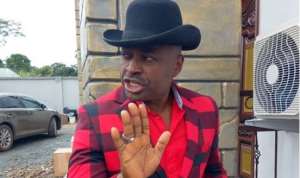
There is a peculiar strain of political debate in Nigeria that thrives not on ideas, but on insults. It is a lazy, bankrupt tradition that reduces governance to gossip, and leadership to laundry lists of personal inadequacies. The latest offender in this sad pantheon is Kenneth Okonkwo, the once-respected actor-turned-political spokesperson, who recently descended into the gutter of academic snobbery by mocking Peter Obi’s alleged third-class university degree. But before we go further, a more pertinent question arises: who is Kenneth Okonkwo to mock anyone’s academic qualifications? And more importantly, who is truly unqualified to speak on Nigeria’s future?
Let us be clear from the outset: even if the claim were true, and it remains unverified, bandied about by partisan trolls, so what? What exactly does a third-class degree from a Nigerian university in the 1980s have to do with the ability to steer a nation of over 200 million people out of poverty, insecurity, and institutional decay? Absolutely nothing. And by wallowing in this mockery, Okonkwo has not only revealed his own intellectual shallowness but has also insulted millions of hardworking Nigerians who graduated with lower classifications yet went on to build thriving careers, families, and communities. The real question is not about Peter Obi’s grade. The real question is: what gives Kenneth Okonkwo the moral or intellectual authority and justification to act as the gatekeeper of academic worthiness?
Let us examine the facts on the ground. Peter Obi, regardless of what one thinks of his politics, has been a remarkably successful figure in both the private and public sectors. He was a chairman of Fidelity Bank, an institution he helped steer through turbulent waters. As Governor of Anambra State for eight years, he was widely acknowledged, even by political foes, as frugal, disciplined, and development focused. He left savings, built infrastructure, and paid pensions. After his tenure, he returned to business and academia, teaching at reputable institutions like the School of Politics, Policy, and Governance. He became a vice-presidential candidate in 2019 and later the presidential candidate of the Labour Party in 2023, galvanizing a youth-led movement that shook the two-party duopoly to its core.
Now ask Okonkwo: does this sound like a man whose third-class degree (if it exists) held him back? Does a man who managed multi-billion-naira portfolios, who was entrusted by banks and investors, who was invited to speak at Oxford and Cambridge (yes, those Oxbridge institutions) on economics and governance, does such a man need Kenneth Okonkwo to validate his intelligence? The answer is a resounding no. If Obi truly graduated with a third class, then his post-graduation life is a testament to the fact that university grades are not destiny. They are a snapshot of a young person’s performance at a specific time, often under difficult circumstances, financial strain, personal challenges, even the quality of teaching. In Nigeria of the 1980s, many students faced strikes, poor libraries, and unstable academic calendars. Judging a 60-year-old man by his results at 22 is like judging a tree by its seed alone, ignoring the growth, the branches, and the fruit.
So again, who is really unqualified to speak? A man who has governed a state, built institutions, and commanded international respect? Or a man whose primary political qualification appears to be speaking for the party that he is affiliated to in a country where the ruling government is overseeing economic hardship and insecurity?
At this juncture, it is germane to remind Okonkwo that first class is not a constitutional requirement for Nigeria’s president. More fundamentally, Kenneth Okonkwo’s mockery exposes a dangerous elitism: the belief that only top academic performers deserve to lead. Let us state this plainly for the record: the Constitution of the Federal Republic of Nigeria (1999, as amended) does not require the President to hold a first-class degree. It does not even require a degree at all beyond basic school certificate or its equivalent. The requirements are minimal: being a citizen, at least 35 years old, educated up to at least secondary school level, and a member of a political party. That is it.
Why? Because the framers of the constitution understood that leadership is a different kind of intelligence. It is emotional, strategic, situational, and deeply rooted in empathy and judgment. Some of the world’s most transformative leaders were not academic superstars. Winston Churchill barely passed his entrance exams. Abraham Lincoln had less than a year of formal schooling. Thomas Edison was called “addled” by his teachers. Even in Nigeria, some of the most effective governors and ministers have come from modest academic backgrounds, while some first-class holders have run institutions into the ground.
If first-class degrees were the gold standard of governance, then Nigeria would be a paradise by now. After all, many of the country’s leaders, civilian and military, have possessed impressive credentials. Did that stop corruption? Did that fix the grid? Did that make the naira strong? Clearly not. Good governance is a product of vision, accountability, willpower, and listening skills, not a transcript. So when Okonkwo mocks Obi’s alleged grade, he is not defending standards. He is merely distracted from the failures of Obi’s opponents he aimed to impress.
The hypocrisy of Kenneth Okonkwo and his political camp is ironical as not a few politicians in the country have their academic records shrouded in mystery, yet he has refrained from throwing his outburst at them all the while. If Okonkwo truly believes that academic scrutiny is a legitimate political weapon, why does he not apply the same standard to them? Why raid Peter Obi’s alleged third-class while remaining mute in the case of other politicians whose educational histories are fogs of litigation and unanswered questions?
This hypocrisy reveals the truth: Okonkwo’s mockery is not about defending academic standards. It is not politics; it is pandering. And it begs the question once more: who is really unqualified to speak? The man who offers policy ideas, or the man who offers insults?
Let us, for a moment, imagine a president with a first-class degree in petroleum engineering but who cannot refine a single barrel of crude locally. Imagine a first-class lawyer who appoints unqualified cronies to the bench. Imagine a first-class economist who bankrupts the treasury. Now imagine a third-class graduate who builds schools, pays salaries on time, attracts investment, and unites the nation. Which one would you choose?
The answer is obvious. Leadership is a composite of character, courage, competence, and compassion. It is the ability to make hard decisions, to resist greed, to listen to the poor, and to plan beyond the next election. These are moral and experiential qualities. No university examination hall has ever tested them.
Peter Obi, whatever his flaws, has demonstrated fiscal discipline, private-sector success, and a relatively scandal-free public record. That is more than many first-class politicians can boast. If his worst sin is a hypothetical third-class degree from decades ago, then Nigeria would be blessed to have such “failures” in power. And if Kenneth Okonkwo believes that mocking that grade makes him qualified to speak, he has sadly mistaken noise for substance.
So let us return to the headline’s question: Kenneth Okonkwo mocked Obi’s grade, but who’s really unqualified to speak? The evidence points to the mocker, not the mocked. Peter Obi has sat in boardrooms, governed a state, addressed global forums, and inspired a movement. Kenneth Okonkwo has played memorable roles in Nollywood and now plays the role of a political attack dog. That is not a crime. But it is certainly not a qualification to lecture anyone on merit.
Kenneth Okonkwo should be ashamed. Not of his own academic record, but of his contribution to the dumbing down of political discourse. To mock someone for a grade earned in their youth, especially when that person has gone on to achieve far more than, most mockers ever will, is not wit. It is weakness. It is the last refuge of those who have no substantive argument to make.
Nigerians are tired of this shallowness. We are tired of certificate battles while hospitals lack drugs. We are tired of transcript wars while bandits kidnap schoolchildren. We are tired of elitist snobbery while the masses sink deeper into hunger.
Let this be the final word: a third-class degree does not downgrade a man; a petty spirit does. Peter Obi has thrived, succeeded, and earned respect across continents, not despite his alleged grade, but because of his drive. And if any political jobber thinks a first-class is required to become Nigeria’s president, let him read the constitution again. Better yet, let him read history. The greatest leaders were not always the best students. They were the best humans.
And on that score, Kenneth Okonkwo has just failed spectacularly. The question is not whether Peter Obi is qualified to speak. The question is: after such pettiness, who will take Kenneth Okonkwo seriously again?

 Accra Is Sinking Yet Again — Time to Be Truthful With Ourselves
 Fire guts rubber factory at Circle Odawna as flooding hampers firefighting effor...
 Flooding strands commuters on Winneba Cape Coast Highway
 Three feared dead after electrocution in Alajo flooding incident
 Nine missing after floods hit Awutu Senya East
 'Your mother, I should go to heaven and ask Nebuchadnezzar to stop the rain?' — ...
 Flood victim found dead along Alajo Railway track as rescue operations continue
 GMet warns more rain as flooding disrupts movement across Greater Accra
 'You sit on social media and talk nkwasiasem' — Nigel Gaisie blasts critics over...
 Osahen Afenyo-Markin accuses NDC of using GoldBod to promote illegal mining
