




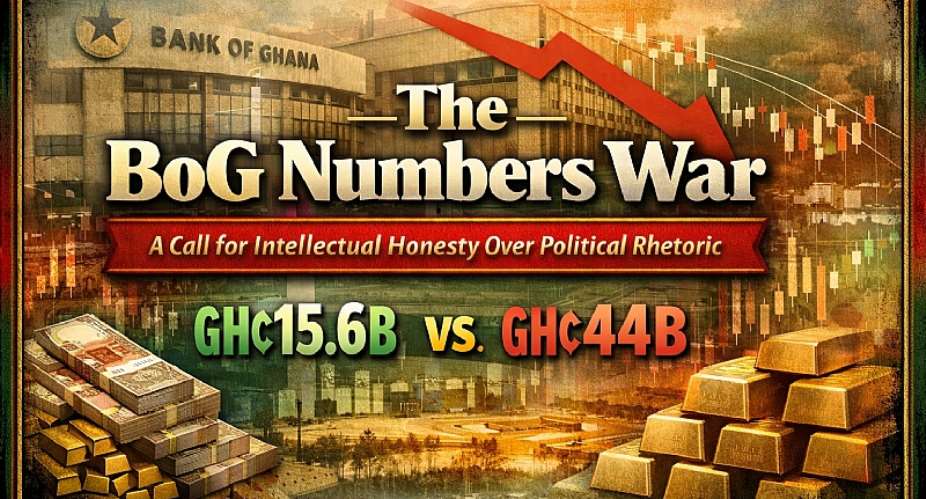
In the corridors of power and across the airwaves of our vibrant democracy, a fierce battle is raging—not over the future of our youth or the quality of our schools, but over the very ink on the Bank of Ghana’s balance sheet. The recent verbal sparring between Kojo Oppong Nkrumah and Sammy Gyamfi has transcended mere political banter, evolving into a fundamental dispute over national truth.
When seasoned politicians disagree on a single audited figure by a staggering GH¢19 billion, it is not just the politicians who are at a crossroads; it is the entire nation's financial literacy that is being tested. As Ghanaians, we must demand more than social media "rants" and Facebook rebuttals. When a man’s credentials—from law firms to executive titles—are touted as superior, yet he hesitates to "push the green button" for a live debate, it invites the public to wonder: is the truth being defended, or is a shadow being chased? We deserve a discourse rooted in data, not "voodoo mathematics."
The Core of the Dispute: Why the GH¢19 Billion Gap?
At the heart of the clash are two competing interpretations of the 2025 Bank of Ghana Audited Financial Statements:
- The NDC Position (Sammy Gyamfi): The National Democratic Congress maintains that the BoG recorded a GH¢15.6 billion operating loss. Gyamfi argues this is the headline loss verified by the audit and challenges the government to a face-to-face encounter to prove otherwise.
- The NPP Position (Kojo Oppong Nkrumah): The New Patriotic Party argues the "true" loss is actually GH¢34.9 billion. They claim the bank used "artificial revenue recognition" and moved losses into "Other Comprehensive Income" (OCI) to hide the true scale of the deficit.
- The Accountability Gap: Critics argue that if Oppong Nkrumah’s "refined" perspective is accurate, a live debate with Sammy Gyamfi should be welcomed as an opportunity to educate the masses, rather than an event to be avoided.
Institutional Oversight: The Role of International Auditors
To settle this dispute, we must return to the source. The Bank of Ghana's 2025 financial statements were audited by the international firm KPMG. It is essential that KPMG, as the independent professional audit firm, leads the technical presentations during this summit. Their role is to explain the nuances of IFRS standards and the specific accounting treatments used, providing a neutral, professional anchor to a sea of political spin.
Empowering Civil Society as Witnesses
For this discourse to remain credible and non-partisan, prominent Civil Society Organizations (CSOs) must be invited to witness the proceedings. Their presence will ensure that the technical explanations translate into public accountability. Key invitees should include:
- The Economic Governance Platform (EGP)
- IMANI Africa and the Centre for Democratic Development (CDD-Ghana)
- Ghana Integrity Initiative (GII)
- The Institute for Economic Affairs (IEA)
A Cross-Party Knowledge Gap?
The confusion isn't limited to the primary debaters. Current NPP Director of Communications Richard Ahiagbah, Finance Minister Dr. Mohammed Amin Adam, and the Minority Leader Dr. Cassiel Ato Forson have all been central to this narrative. This lack of consensus on basic accounting facts suggests a deep-seated need for institutional alignment across the political divide.
The Proposal: A High-Level Technical Workshop
To bridge this gap, we propose a mandatory One-Week Financial Literacy & Macroeconomic Workshop held at the Bank of Ghana’s Ultra-Modern Headquarters Executive Conference Room. This venue provides the perfect neutral yet authoritative ground for:
- Professional Led-Presentations: KPMG will walk participants through the audited figures line-by-line to clarify the "real" versus "operating" loss.
- Alignment: Ensuring communicators like Kojo Oppong Nkrumah and Sammy Gyamfi interpret the BoG Act and IFRS consistently to avoid misleading the public.
- The Peoples' Audit (Live Q&A): The final session should be a televised roundtable featuring a Live Q&A. This allows the Ghanaian public to send in questions via digital platforms directly to the KPMG auditors and the political communicators. This "green button" moment ensures the experts, not the politicians, have the final word on the data.
Leadership is not found in the loudest shout or the most polished certificate; it is found in the courage to be transparent when the numbers look grim. If the NPP believes their voodoo accusations are rooted in fact, the BoG’s own boardroom is the place to prove it. If the NDC’s figures are the absolute truth, let them stand the heat of a technical cross-examination led by the auditors themselves.
Ghana cannot build its future on a foundation of conflicting figures. It is time for our communicators to stop hiding behind social media posts and start respecting the intelligence of the Ghanaian taxpayer. Let the workshop begin at the BoG headquarters, and let the truth—however painful—finally be audited in the court of public opinion.
✍️ Retired Senior Citizen
For and on behalf of all Senior Citizens of the Republic of Ghana 🇬🇭
Teshie-Nungua
[email protected]

 Accra Is Sinking Yet Again — Time to Be Truthful With Ourselves
 Fire guts rubber factory at Circle Odawna as flooding hampers firefighting effor...
 Flooding strands commuters on Winneba Cape Coast Highway
 Three feared dead after electrocution in Alajo flooding incident
 Nine missing after floods hit Awutu Senya East
 'Your mother, I should go to heaven and ask Nebuchadnezzar to stop the rain?' — ...
 Flood victim found dead along Alajo Railway track as rescue operations continue
 GMet warns more rain as flooding disrupts movement across Greater Accra
 'You sit on social media and talk nkwasiasem' — Nigel Gaisie blasts critics over...
 Osahen Afenyo-Markin accuses NDC of using GoldBod to promote illegal mining



Comments
Mr Akpalu, you write knowledgeably and beautifully, but there is no NEED to call any conference to explain any figures to ANYBODY or to SELF-SEEKING, voodoo economist Kojo Oppong-Nkrumah! I do not know why Ghanaians cannot see it, but I see Kojo Oppong-Nkrumah as a self-seeking SCOUNDREL who desperately wants to be NOTICED! Let us assume for a moment that the voodoo economist is right, and that the operating loss of the BoG (Bank of Ghana) is GHc 34.9 billion, and not GHc 15.6 billion! The qu...