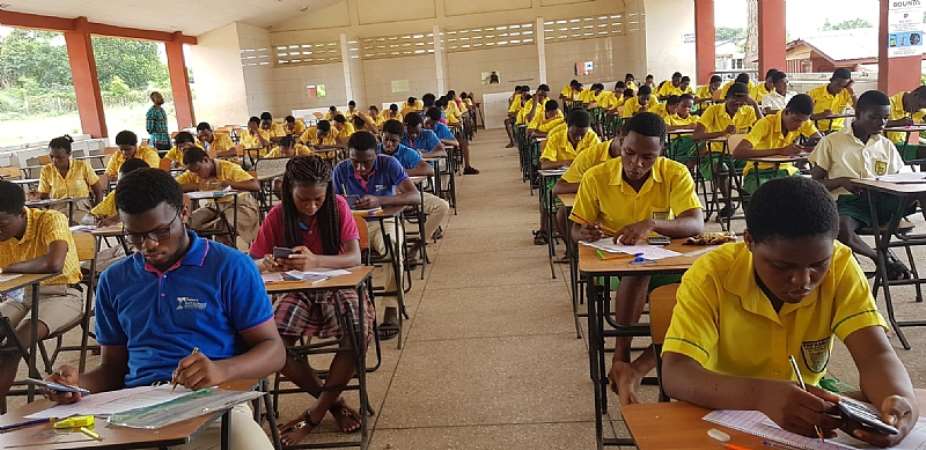
Social Studies is often described as the subject that “everyone passes,” yet the 2025 WASSCE results have shattered this long-held belief. At a time when Ghana faces complex civic, economic, and social challenges, the decline in Social Studies performance is more than an academic concern. It is a warning! When a nation’s young people struggle to understand governance, rights, responsibilities, environmental stewardship, conflict management, and community participation, the consequences echo far beyond examination halls. This article calls for a shift from blame to solution, from political rhetoric to educational renewal, and from treating Social Studies as an “easy subject” to recognizing it as the foundation of active citizenship.
Education plays a critical role in preparing students to engage in a constantly evolving and uncertain world with ongoing racial injustice, human rights violations, war, disease, poverty, inequality, and environmental crises. While education alone cannot solve global problems, it can prepare students for these ongoing challenges by instilling in them the knowledge and skills to work toward change and the efficacy to make a difference in their worlds. It is not surprising that, when students fail their examination, many people are worried, and it becomes a national debate because the future of the nation rests on the dreams of these students.
Following the release of the 2025 West African Senior School Certificate Examination (WASSCE) results, the ensuing political controversy reveals a deeper ailment in our education system. Almost immediately, a blame game began, the current government faulting the previous administration, and the previous government faulting the current one, while student performance shows a marked decline. Rather than trading accusations, parents, teachers, and stakeholders should confront the root causes. Multiple factors shape examination outcomes, teaching quality, curriculum alignment, resources, assessment practices, student well-being, and accountability, and addressing these systematically will do more for learners than partisan point-scoring.
The main focus of the discussion has been the decline in social studies, as reported by the West African Examinations Council: the percentage of students passing dropped from 71.53% in 2024 to 55.82% in 2025. As a high school social studies teacher with more than a decade of experience in teaching social studies in Ghana, I’m struck by how often the subject is dismissed, even by prominent journalists and influencers, as the “easiest” and “cheapest” paper. Many were therefore surprised by this year’s poor results and the notable decline in social studies performance. On social media, countless posts boast of passing social studies without studying, reinforcing the idea that it’s a subject everyone should sail through. That narrative is part of the problem: when a subject is framed as trivial, students prepare less, and results suffer. This perception also weakens institutional support for the subject; in many school, Social Studies receives fewer instructional resources, shorter contact hours and limited teacher development opportunities compared with other core subjects, further contributing to declining outcomes.
The goal of Social Studies
In Ghana, the goal of social studies education is to train citizens who are reflective, concerned, active, and participatory to be able to fit into the ever-changing world and contribute their quota to society. Specifically, social studies aims to produce reflective, concerned, and competent citizens who will make informed decisions for individual and public good. According to the National Council for Curriculum and Assessment in Ghana (NaCCA), the subject seeks to produce morally upright Ghanaians who are responsible and capable of maintaining healthy lifestyles and preserving their environment for sustainability (NaCCA, 2020). Around the world, social studies education broadly focuses on equipping students with the knowledge and skills to participate in society and be effective citizens. We need to re-educate the public about the value of social studies, not as a box to tick on an exam, but as a discipline for understanding our environment, making critical decisions, and solving real-life problems. Social studies build the habits we use every day: reading evidence, weighing trade-offs, spotting misinformation, listening across differences, and making decisions that affect our communities (from sanitation and land use to elections and budgets). When we treat it as “easy,” we quietly tell students that citizenship is easy, and we get shallow learning and weak civic outcomes in return. Therefore, making social studies a valuable subject depends on teaching and learning social studies with creativity, rigor, and seriousness. It is essential that we look at why students are failing social studies, identify the root cause, and determine what should be done. There are numerous reasons why students fail social studies; however, I wish to critically examine the primary reasons in relation to the Chief Examiner reports regarding why students fail social studies. Additionally, the shift toward a standards-based curriculum requires higher-order thinking, yet many schools continue to teach Social Studies through rote memorization. This mismatch between curriculum intentions and classroom practice widens the performance gap.
Understanding the real demands of the questions.
Most students struggle with reading questions carefully enough to understand their true requirements. Many lose marks not because of a lack of knowledge but because they don't grasp what the question is asking. The saying, understanding the question is part of the exam, still holds: success depends on correctly identifying the task, key concepts, and the scope of the prompt. Chief examiners often point out this problem; some candidates misinterpret the requirements and respond to a different question within the same subject. Hence, thorough analysis of the question is essential for achieving high results performance. Schools need to teach explicit instruction on command words such as explain, examine, assess and analyze, since many students cannot differentiate between them. Without command-word literacy, even well prepared candidates will continue to lose avoidable marks.
Social studies concepts must be clearly explained and applied to real-world situations.
Social studies concepts must be explained with clarity and then applied to real contexts, local governance, sanitation, resource management, elections, conflict resolution. That level of rigor demands coherent writing, precise vocabulary, and the use of evidence. Many students struggle here: they can recall definitions but falter when asked to translate theory into actionable measures. That level of rigor demands clear writing and expression, skills many students still struggle to demonstrate. Consistent with chief examiners’ reports, many candidates struggle to demonstrate how the theories they learn apply to practical, everyday solutions. Most examiners complain that students cannot construct meaningful sentences and mostly write in broken English (pidgin). One significant gap is the absence of structured writing practice in many classrooms. Students rarely engage in paragraph development, essay planning or use of transitional words, yet WASSCE demands extended writing. Integrating guided writing exercises into weekly instruction would greatly improve students’ ability to articulate arguments clearly.
Furthermore, teachers often lack updated teaching resources, especially case studies on contemporary civic issues in Ghana. Updating instructional materials to include recent examples such as sanitation reforms, district budget allocations, youth unemployment, and land disputes, makes application easier for learners.
Poor preparation
The quote by Benjamin Franklin, “By failing to prepare, you are preparing to fail.” It is relevant to how students prepare for social studies examinations and speaks directly to social studies exam prep: without steady reading, practice with command words, and application to real cases, students all but choose weak results. Consistent, deliberate preparation is the difference. Many students treat social studies as a “last-minute” subject: no dedicated notebook, no proper preparation for the textbook, and memorization a few days before WASSCE. This leads to shallow recall, weak writing, and poor application to real problems. Social studies rewards cumulative reading, source work, and practiced explanation, habits that can’t be built overnight. Treating social studies with steady, structured effort, rather than last-minute cramming, will raise both understanding and scores, and, more importantly, equip students to analyze and solve real civic problems. Teacher preparation also plays a role. Some teachers rely heavily on outdated notes or exam-focused pamphlets which limit students’ ability to think critically. Continuous professional development (CPD) in inquiry-based teaching, assessment literacy and contemporary civic issues is essential.
In conclusion, it’s time to re-examine social studies for the 21st century, both the content we teach and the pedagogies we use. Yes, the subject is “practical” because it speaks to everyday life, but practicality does not mean it requires no study, analysis, or disciplined application. If social studies is truly about civic responsibility, environmental stewardship, anti-corruption, and social cohesion, then our classrooms must cultivate the skills to address those issues: critical thinking, evidence use, clear writing, and informed action. We must retire the “easy subject” narrative and replace it with a culture of rigor. Doing so will lift exam performance, but more importantly, it will help build communities capable of diagnosing problems, debating trade-offs, and implementing solutions.
Government and educational authorities must also prioritize Social Studies within national policy by improving textbook quality, ensuring adequate teaching resources, strengthening assessment feedback loops and recognizing the subject as foundational to Ghana’s democratic and developmental agenda. Without systemic commitment, classroom-level improvements alone will not be enough.
Saviour Kitcher,
PhD Student, Curriculum, Instruction, and Teacher Education
Michigan State University
FIFA-Licensed Player agent
 NDC behaving as if they will stay in government forever — NPP’s Alfred Thompson
 Residents protest at NEDCo office in Kpandai over power disconnections
 Toxic fumes from generator during dumsor kills three individuals at Manhean
 Police arrest 11 suspects over AI deepfake videos impersonating president Mahama
 Election 2028: Bawumia appoints all four NPP presidential aspirants as co-chairm...
 Ghanaians in US romance scam case: Jamal caged, Kamal set free
 How father allegedly dragged his son with quad bike on tarred road at North Lego...
 May 8: Cedi sells at GHS12.10 on forex market, drops to GHS11.28 on BoG interban...
 Health Committee Chair tells health professionals to resign if they are tired of...
 GTEC orders Bolgatanga Technical University Vice Chancellor to resume duties