




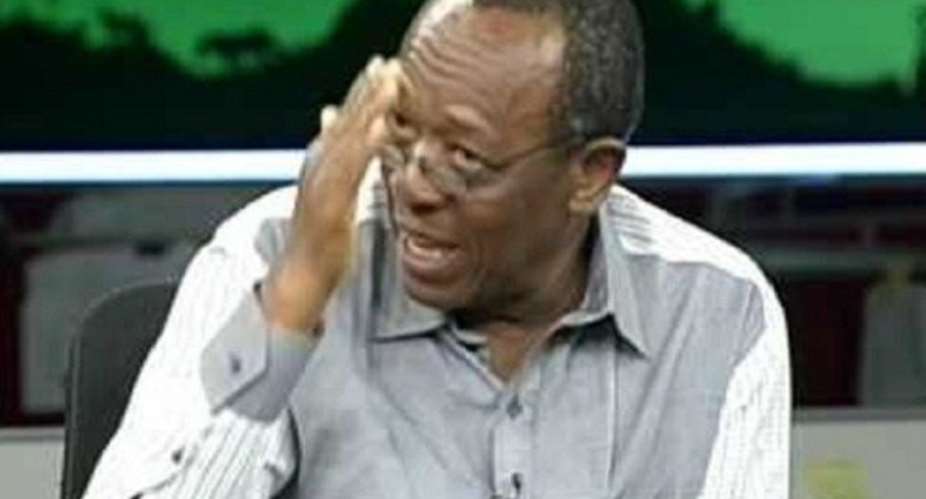
About three days ago, one of my brothers-in-law, Mr. Eric Kwabena Baning, whatsapped to me a videoclip on which a black funerary jumpers-clad Nigerian “professor” of English – as of this press preparation, I have also learned that our subject is a former Vice-Chancellor of the University of Lagos – claiming to be a faculty member of the country’s flagship academy, the University of Ghana, Legon, virulently accused the Ghanaian media of demonizing Nigerians resident in Ghana for heinous crimes – such as rapes, murders and kidnappings – committed by a few Ghanaian resident Nigerians. The “Professor,” Augustine Uzoma Nwagbara, made the foregoing comment at a gathering or rally heavily attended by Nigerians resident in Ghana.
You see, I put his title of “Professor” in quotation marks because Nigerians, generally, are globally notorious for craving for titles they do not have or deserve. For example, nearly every adult male in Nigeria with the equivalent of N 10 (10 Naira) in his wallet wants to be addressed as a “Chief.” Anyway, on the aforesaid videoclip, Prof. Nwagbara made the flagrantly scandalous claim that in nearly every human endeavor, including the continental African Liberation Struggle / Movement, it was the Nigerians who pointed the way to their “younger” relatively wet-eared Ghanaian leadership counterparts.
Maybe somebody ought to have enlightened the obnoxiously patronizing Prof. Nwagbara about the historical fact that when his own country’s flagship academy, the University of Ibadan was established in January 1948, by British colonial default, about 7 months before the University of Ghana was officially established, it was Ghana’s Dr. Robert (Kweku Atta) Gardner (1914-1994) – the maternal uncle of the recently deceased former United Nations’ Secretary-General, Mr. Kofi (Atta) Annan – who was invited to establish the first Adult-Education Department on both the campus of the University of Ibadan and Nigeria at large.
About 22 years ago, a former student of the great Nigerian novelist, Prof. Chinua Achebe, late, who had also been my African Literature professor at the City College of New York of the City University of New York (CCNY of CUNY), by the name of Ezenwa-Ohaeto, published a quite comprehensive biography of his former globally renowned professor, titled “Chinua Achebe: The Author of Things Fall Apart” (Indiana University P., 1997), in which Prof. Robert Gardner was erroneously described as one of the seminal or pioneering European professors of the then University College of Ibadan. I had to promptly rectify this egregious error in a review of the same book that was published in The New York Amsterdam News’ edition of October 1, 1998, during which period I was a freelance writer and the Book Review Editor of this famous and one of the oldest African-American weeklies here in the United States.
I make the foregoing observation to highlight the fact that Nigerian intellectuals and even their most erudite scholars tend to know much less about Ghanaian achievers and the political history of our country than vice-versa. Perhaps this may be the result of the subconscious or unintended arrogance of being the native of a relatively much bigger country. You see, years ago, a very brilliant classmate of mine from the Caribbean island nation of St. Kitts and Nevis by the name of Joseph Hughes – today, he is a bigtime attorney in the Michigan area – quizzed me about the geographical locations of several islands in the Caribbean and other parts of the world. When I could not come up with a single correct answer, Joe jovially accused me of having been severely afflicted with a deadly virus called “The Arrogance of the Denizens of Big Countries and Continents.”
What Mr. Hughes meant was that people who came from relatively big countries and continental landmasses, rather than islands or very small countries, tended to be subconsciously blinded to the fact that the little island nations were equally significant in the scheme of global political affairs and the general affairs of humanity. In his caustic tirade against the Ghanaian people and our media, Nigeria’s Prof. Nwagbara adopted a similar arrogant posture. You see, academically speaking, compared to Nigeria, Ghana is a giant of Shakespearean proportions. And on the latter count, of course, I am thinking of globally renowned and first-class and immortalized intellectuals and scholars like Professors Adum-Kwapong, the erudite classicist, first Ghanaian Vice-Chancellor of the University of Ghana and former Rector of the Tokyo-based United Nations’ University; Willie Abraham, philosopher, sometime Pro-Vice Chancellor of the University of Ghana, author of the seminal classic “The Mind of Africa,” and the first African to be inducted as a fellow of Oxford University’s All-Souls College; Ephraim Amu, the first African to compose chorale music in the standard four vocal pitches, and composer of “Yen Ara Asaase Ni” fame; Kwabena Nketia, the recently deceased foremost African musicologist of his generation…. The list goes on and on and on.
Indeed, there was a time, not quite 30 years ago, when The New York Times called the University of Ghana “The Harvard [University] of West Africa. The anti-Ghanaian rabble-rouser may need to use his sabbatical leave, or whatever academic status he was undeservedly enjoying prior to him getting, reportedly, fired by the administrators of the University of Education, Winneba (UEW), to study the general academic and cultural history of Ghana in the modern or Euro-Western-dominated era and compare the same with that of Nigeria coevally. Trust me, Prof. Nwagbara would be deeply humbled by the findings that he comes up with.
*Visit my blog at: kwameokoampaahoofe.wordpress.com Ghanaffairs
By Kwame Okoampa-Ahoofe, Jr., PhD
English Department, SUNY-Nassau
Garden City, New York
June 20, 2019
E-mail: [email protected]

 NPP protests over Miracles Aboagye's arrest misplaced — Akwatia MP
 I did not go to Kumasi to apologize on behalf of Okatakyie Afrifa — Jerry Ahmed ...
 BoG Governor's appearance: Minority, Majority clash over media coverage
 COCOBOD settles GH¢162 million owed to non-DDEP cocoa bill holders
 NPP annuls constituency elections in Adansi Asokwa, Bantama and Afigya Sekyere E...
 Mahama heads to Volta Region on Thursday for 'Resetting Ghana Tour'
 GoldBod honours NACOC with GH¢12.65m reward for anti-gold smuggling operation
 Miracles Aboagye's GH¢50 million bail conditions weren't impossible to meet — Kw...
 No forest reserve has been lost to illegal mining under Mahama government — Land...

