




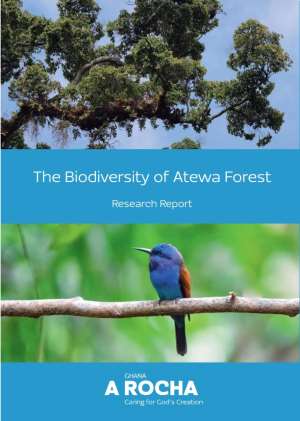
Environmental groups in Ghana are waging an eleventh hour battle to stop the government of Ghana from opening the Atewa Forest Reserve – a crown jewel of biodiversity and a source of three rivers - to commercial large-scale bauxite mining.
“We don’t want it,” said Chief Nana Larbikrum, 79, from a tiny settlement on the fringes of Atewa, in an interview with Equal Times, a website of social justice activists based in Belgium. He and other farmers who grow and sell cocoa and plantain are especially worried. “They will come and scrape off all the trees, and there won’t be any rainfall or windbreaks for us,” the chief says.
But a contract with the Chinese company is reportedly on the table. To secure a US$19 billion infrastructural loan from the Chinese government, the Chinese state-owned Sinohydro Group has been invited to build roads, bridges and rural electrification projects worth US$2 billion.
In exchange, the company will be paid back from the proceeds made from mining Ghana’s abundant bauxite reserves in Atewa and Nyinahin, another forest reserve in the Ashanti region.
A Rocha Ghana and Concerned Citizens of Atewa Landscape are fighting back, insisting the forest reserve should be designated a national park, which could generate additional income for the country.
The Atewa Forest is critical to the livelihood of humans and biodiversity, they say. Designated one of Ghana’s 30 Globally Significant Biodiversity Areas in 1999, it has the highest diversity of butterflies of any site in West Africa, at least 1100 plant species including 56 threatened with extinction, and thirteen threatened and near-threatened birds.
The U.S.-based Conservation International echoed their concerns.
“Atewa forest is unique,” wrote Okyeame Ampadu-Agyei, Conservation’s Country Director, on the group’s website. “It has excellent biological resources and distinctive upland forest vegetation which unfortunately is under threat by commercial bauxite mines.
The bauxite deposits will eventually be exhausted,” he signaled, “but the forest is a renewable resource which, if protected now, will be appreciated centuries hence long after all the bauxite has gone.”
Ghana has one of the fastest rates of deforestation in West Africa and lost 13 per cent of its forest cover between 2001 and 2017, according to Global Forest Watch. In 25 years, Ghana could lose all of its forests, scientists warn.

 Catholic Bishops' Conference calls for 20% SHS admission into Catholic schools f...
 Catholic Bishops' Conference calls for probe into SHS placement for sale allegat...
 Trump calls concerns over rogue AI a 'hoax' promoted by a ‘SICK conspiracy’
 US Space Force confirms weapons deployed in space for first time
 How IGP Yohuno led Police team to rescue victim, arrest four kidnappers in Assin...
 Akufo-Addo would have used Accra-Kumasi expressway for galamsey – Mahdi Gibrill
 Nigeria's Dangote refinery launches continent's biggest IPO
 'Our own money $2billion ready, we have not gone to borrow money from anywhere' ...
 Don't be a Bar that flips on principles but a Bar that is consistent — AG tells ...
 Prostate cancer may show no symptoms until advanced stage – Urologist warns



Comments
ETHICAL MINING KEY FO THIS AREA FUTURE OF GHANA