




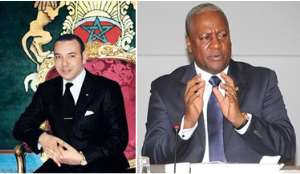
Ghana and Morocco now stand on the threshold of closer and greater economic cooperation in their long and unique bilateral relations.
But Ghana's stand on the Polisario issue continues to cast a dark cloud over the unfolding promise of the two countries' diplomatic trajectory.
Specifically, Morocco is set to make Ghana her strategic economic partner in the West African sub-region with investments in the textiles sector, tourism, airline industry, fishing, mining and other areas.
Both countries share mutual interests and benefits in trade, tradable goods and cultural exchanges for centuries; and, since Ghana's independence, Morocco continues to be an important partner of the country's in both political and trade relations, with the north African country being a consistent destination for Ghana's fresh fruit exports, particularly pineapples and bananas.
Also, Moroccan trade and investment in West Africa has risen to over half a billion dollars over the years, with Ghana being a major focus of many of them.
In bilateral ties, both traditionally friendly countries continue to explore new opportunities to further strengthen and deepen their mutual ties, with the latest being the Ghana-Morocco Permanent Joint-Commission for Cooperation (PJCC) the operational framework which is presently being firmed up by negotiators from both sister countries.
When adopted, the PJCC would provide avenues for mutual cooperation between the two countries in the areas of trade, commerce, agriculture, fisheries, tourism, energy and investment.
Ghana's imports from Morocco on average goods amount to 60 million dollars annually while its exports to the North African country averaged 3 million dollars. Obviously, both countries need to enhance the level of trade between them as well as identify the best ways through which to link up the business communities, facilitate efforts to develop and grow existing businesses and capacities as well as improve on the livelihoods of theirs peoples.
Morocco hosts more than 100 international companies, including The Boeing Company, Bombardier Inc. and United Technologies Corporation. In addition, the country's education system supports the burgeoning sector, with more than 10,000 engineers graduating every year.
This number is expected to grow dramatically following the establishment of the Moroccan Aerospace Institute. Thousands of Moroccans benefit directly from this success since they are employed by the country's aerospace industry, which has doubled in size in less than five years.
Morocco's success is also a result of the US aeronautical business shrinkage. Boeing, for example, could take future manufacturing out of America to either the Mideast or Africa after the International Association of Machinists rejected a proposal to start a pensions freeze and a reduction in starting salary for new workers.
Further, the social reforms undertaken by Morocco since the early 2000s have reduced poverty and increased human development. In turn, this has brought security into the region and a boom in foreign investment, which has risen by 25 per cent, the highest rate of increase in investment on the entire continent.
Morocco, unlike countries that were affected by the Arab Spring, continues to implement sweeping political and educational reforms. These reforms help secure the country's position as a desirable place to do business. King Mohammed VI recently, also, met with US President Barack Obama to discuss business links between both countries; and, to strengthen their partnership in the war against terror that has seeped into sub-Saharan Africa.
In addition to being in pole position to lead Africa in aeronautics, Morocco, along with South Africa, also looks set to emerge as a digital leader in Africa by 2025.
Morocco is not only determined to speed up the pace of its partnership with African countries, but it is also committed, at the highest level, to upgrade the economic integration of the African continent, which has evolved rapidly over the past few years in an area of strategic development.
Indeed, beyond the strong political ties binding Morocco to most African countries, the country has not waited for international economic powers to look towards Africa to show interest in the continent and spearhead mutually advantageous south–south cooperation. Having realized years ago that the genuine growth of its economy has to be sought southward, Morocco has multiplied initiatives to boost its economic relations with its southern partners.
But how soon and, indeed, whether Ghana and Morocco can realise the full potentials of their mutual relations, as well as reap the huge benefits thereof, however, largely depends on Ghana.
Ghana recognised the Sahrawi Arab Democratic Republic (Western Sahara) in 1979, eventhough both countries belonged to the Casablanca Group of nations that had played strategic roles in the founding of Organisation of African Unity (OAU, now African Unity or AU).
Ironically, Ghana's action then had forced relations between Ghana and Morocco into a period of lull, as both countries closed their respective embassies in the other's capital city.
Morocco also went on to leave the AU (then OAU) in November 1984 in anger when the 20th Assembly of Heads of State and Government of the continental body recognised the Saharawi Arab Democratic Republic (SADR) as an independent state and admitted it as a member.
In 2001, however, both brother countries re-opened their embassies following a two-day State visit to Morocco by then President John Kufuor at the invitation of King Mohammed VI.
With the resumption of exchange of embassies between the two countries, Ghana in 2001 also froze its recognition of the SADR.
But in 2011, Accra, again renewed recognition for the Sahrawi Arab Democratic Republic, again raising a question mark over its real intention towards its old friend, Morocco.
Ironically the Sahrawi republic, an entity strongly recommended by the Polisario and supported by Algeria, but which has never been recognized by the UN, neither by any European States or any state from North America, is fast losing the friendship of countries that had hitherto recognized it.
More and more aware that the Western Sahara problem is in fact a regional conflict, a result of the cold war friction, the countries, essentially African and Latin American ones which have recognized the so-called republic, have thus started withdrawing their recognition of an entity which does not exist in reality.
Truth is that the Sahrawi Arab Democratic Republic exists on paper only although thanks to Algerian largesse, which sees the Polisario as a useful wedge against rival Morocco and so bankrolls its diplomatic missions.
In reality, the Polisario controls little more than a series of small refugee camps in Tindouf, Algeria's Western-most province along the border of Morocco, Western Sahara, and Mauritania. While the Polisario Front claims more than 100,000 Sahwari refugees live in the camps and some journalists and short-term visitors parrot that figure, diplomats with long experience in the camps and in the region, as well as former refugees, estimate that no more than 40,000 reside in the camps. Only half of these are actual refugees from the portion of the Western Sahara that Morocco controls; the remainder has roots in Algeria, Mauritania, or Mali. Indeed, there is a reason why Algeria refuses to allow an independent census.
The danger is not that war is going to re-erupt between Algeria and Morocco, or that the Polisario will be able to renew its insurgency inside Morocco. Rather, the problem is smuggling. By inflating camp population and then pocketing the difference in aid allocations, the Polisario bolsters its militia and its leaders' profits. Polisario smuggling is evident in markets around Algeria, Mali, and Mauritania, where merchants sell aid supplies delivered to Tindouf.
Siphoned aid is only the tip of the iceberg: Polisario smugglers allegedly now transport African migrants northward toward Europe; and, weaponry southward from Libya, through Algeria, and across the increasingly unstable Sahel. Counterterror analysts say that AQIM (alQaeda in the Maghreb) now recruits in Polisario camps.
Adjunct to that, just in the last decade, more than 30 countries have suspended their recognition of the SADR. This haemorrhage is weakening more the Polisario, and Algeria is being confronted by pressure from the international community to act towards a political settlement proposed by Morocco.
That plan aims at putting an end to a conflict which has lasted too long and who the main victims are dozens of thousands of persons sequestrated in Tindouf camps, in the Algerian desert, and deprived of their fundamental rights to freedom of movement and expression.
The autonomy plan proposed by Morocco has prompted the UN to call repeatedly for a negotiated political settlement of a conflict that has lasted for almost four decades.
The plan has been acknowledged by the Obama Administration as “serious, realistic and credible” and representing a “potential approach that could fulfil the aspirations of the people of the Sahara to manage their own affairs in peace and dignity.”
Ghana cannot continue to swim against the groundswell of international re-think on the Polisario issue.
Doubtless, Ghana's foreign policy since independence has been characterized by a commitment to the principles and ideals of nonalignment and Pan-Africanism as first enunciated by its founding President Kwame Nkrumah in the early 1960s.
Under its current National Democratic Congress (NDC)-led government, Ghana remains committed to that same principle of nonalignment in world politics.
Also, the NDC government believes in the principle of self-determination, including the right to political independence and the right of people to pursue their economic and social development free from external interference.
But, diplomacy naturally seeks compromise; and, win-win situations only work when both sides to an issue sincerely seek a settlement.
Somalia, Afghanistan, Libya, Timor Leste and Syria are ready reminders that state failure is hard to reverse. The key is to prevent collapse in the first place before it happens.
Currently, Morocco is the only stable state in the north African sub-region.
As such, it behoves Ghana to support that country, work with it to rebuild the economies of the region; and, that way, help in the international effort to restore stability to countries like Mali, the Central African Republic, Tunisia, and Libya.
For Ghana, therefore, the choice is just clear: urgent formal recognition of Moroccan suzerainty over the Western Sahara, dismissal of Algerian claims, and support for the natural expiration of the U.N. Mission for the Referendum in Western Sahara (MINURSO).
But which side of history Ghana chooses to align with, only time will tell!


 Surrogacy: Supreme Court judge warns of citizenship and inheritance challenges f...
 Ghana has a surrogacy law, but… - Supreme Court Justice
 Ghana faces challenge to persuade Brics it deserves a seat at the table
 Stop the Sermon Before the Engine Starts: Why Ghana Regulates Preaching on Movin...
 Don’t let speed of information become your judgement — Chief Justice tells new l...
 ‘Big Push’: Government assures contractors of prompt payments
 GES to develop plan to recover teaching time lost during teachers’ strike – Clem...
 'All human emotions': French astronaut Sophie Adenot's first words since returni...
 French astronaut recounts 'astonishing' emotions after return to Earth
 India's 'cockroach' movement chief detained ahead of major protest



Comments
If politics is too important to be left to politicians alone, and warfare too important to be left to soldiers only, is it not also true that Ghana's foreign policy is too important to be left to the so-callled gurus at the Ministry of Foreign Affairs and Regional Integration? Let the Ghanaian people be allowed to debate who between Morocco and Sahrawi Arab Democratic Republc we want to relate with!