




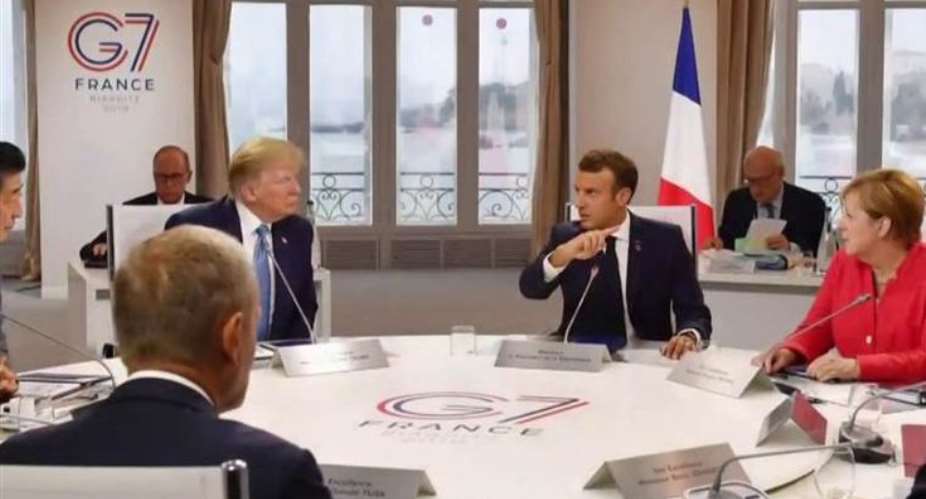
Picture this: seven of the world's most powerful leaders gather around a table in a luxury hotel overlooking Lake Geneva, smiling for the cameras — while privately, almost nobody at that table agrees on how to fix the world's biggest problems. That, in essence, is the scene playing out this week in Évian-les-Bains, France, as the Group of Seven (G7) summit opens under the shadow of war, energy anxiety, and quiet diplomatic friction.
For ordinary Ghanaians, a meeting of wealthy Western nations on the shores of a French lake might feel distant — but make no mistake, what happens in Évian this week will ripple all the way to the fuel pumps in Accra, the price of imported goods in Makola Market, and the broader question of how Africa is treated in the global development conversation.
A President Walking In With Leverage — For Once
US President Donald Trump arrives at this year's summit in a markedly different posture than his advisers had feared just weeks ago. For weeks, Trump and his team had looked ahead warily to this gathering, worried he might arrive without a deal and face heavy scrutiny from fellow leaders over a Middle East conflict stuck precariously between ceasefire and full-blown war.
Instead, he lands in France touting a weekend agreement that appears to ease hostilities with Iran and, in his words, reopen the Strait of Hormuz — one of the world's most critical oil shipping routes.
Why does this matter to us? Because the Strait of Hormuz isn't just a Middle Eastern concern — it's a global oil chokepoint. Its prolonged closure had already pushed energy prices higher worldwide, a pain felt acutely in countries like Ghana, where fuel costs ripple through transport fares, food prices, and the cost of doing business. Any move toward reopening it carries real consequences for African economies still recovering from years of economic shocks.
Behind closed doors at the Belle Époque Hôtel Royal, Trump is expected to press his fellow leaders — particularly France and Britain, who have pledged to help form a coalition to clear mines from the strait — to follow through now that an agreement is in place. Whether they do so, and how quickly, could determine how soon global energy markets begin to stabilize.
Arab Leaders Join the Conversation
Adding another layer to this week's discussions, the leaders of three Arab states — Egypt, Qatar, and the United Arab Emirates — have been invited by French President Emmanuel Macron to join talks focused specifically on the Middle East. Trump is expected to hold individual meetings with each of them as well, underscoring just how central the region has become to this year's summit, even as it was never meant to be the headline topic.
The Forgotten War: Ukraine Returns to the Table
While Iran dominates headlines, Macron has also invited Ukrainian President Volodymyr Zelensky to attend — a deliberate move to push the G7 toward a unified position on continued support for Kyiv as Russia's invasion grinds into its fifth year.
This is notable because Trump, who spent much of his first year back in office trying — and failing — to broker peace between Zelensky and Russian President Vladimir Putin, has largely stopped discussing the conflict publicly as Iran has consumed his attention. European officials, sources say, are eager to use this summit to gauge whether Trump still has any appetite to pressure Putin, or whether Ukraine has quietly slipped down his list of priorities.
The "Awkward Uncle at the Family Table"
One Washington analyst, Max Bergmann of the Center for Strategic and International Studies, captured the mood perfectly: the G7 summit, he said, feels like "an awkward family gathering... where you have to go to your in-laws and there's an uncle that you don't quite like." Nobody wants outright confrontation, he noted, even as things grow passive-aggressive — but there's always a risk it could "snap" and turn dramatic.
This isn't new for Trump. Every G7 he's attended has, in some form, ended in friction. He cut short his time at two separate summits in Canada — one during his first term in Quebec, and another last year in Alberta. At his first G7 in Sicily back in 2017, he reportedly felt other leaders were ganging up on him over the Paris climate accord, a pressure some aides believe pushed him toward withdrawing from the agreement even faster than planned.
Then there was Biarritz in 2019 — the last time Macron hosted the summit — where a dinner beneath the famous lighthouse grew heated after Trump demanded Russia be welcomed back into the G7, despite having been expelled in 2014 over the annexation of Crimea. His fellow leaders, over plates of Basque tuna, offered little support. Five years later, and with a full-scale war now raging in Ukraine, Trump reportedly opened last year's summit with the very same demand.
From UFC Scheduling to a Palace Dinner: How France Is Keeping Trump Engaged
Aware of this history — and determined to avoid a repeat of last year's abrupt Canadian exit — French organizers have gone to unusual lengths to keep Trump invested in this year's gathering. The summit's dates were reportedly shifted to accommodate Trump's plans to host a UFC fight at the White House around his birthday.
And in a gesture loaded with symbolism, Macron — whose relationship with Trump has swung between warm and frosty for nearly a decade — has invited the US president to a dinner at the gilded Palace of Versailles outside Paris as the summit wraps up on Wednesday evening. It's the kind of grand, ceremonial gesture diplomats often use when substance is thin but goodwill still needs to be maintained.
Low Expectations, Lower Ambitions
Perhaps the clearest sign of how little common ground exists this year: for the first time in recent memory, there will be no joint communiqué signed by all seven leaders — a break from longstanding G7 tradition. Instead, leaders are expected to endorse a handful of separate, narrower declarations on issues like critical minerals, health, and child safety online, while contentious topics such as Iran and Ukraine will be addressed only through a statement from the French presidency itself — a workaround first used by Canada at last year's summit.
Even American officials have been candid about the lack of ambition. "It's all really just a big photo op," one senior White House official admitted. "It's not like big things get done there. It's more about the meetings that come after."
French officials, for their part, have tried to reframe the narrative — insisting the summit is "already a success" simply because it manages to separate long-term structural issues from fast-moving crises that "cannot be fully anticipated in advance." Whether that framing convinces anyone outside the Élysée Palace remains to be seen.
A Town Under Siege
Beyond the diplomatic theatre, ordinary life in Évian has ground to a near halt. The lakeside resort town has been transformed into what residents describe as a fortress, with heavy police and military checkpoints making even routine errands difficult.
"We have a lot of people who come by car to buy their bread," said Delphine, a local bakery owner. "Buying bread is not essential, and to cross the roadblocks you need an essential reason. I don't think it's going to be very pleasant, honestly... You can't host seven presidents who are that important without security, but it's a very unusual situation."
It's a small but telling detail — a reminder that even symbolic gatherings of the powerful carry very real costs for the people living in their shadow.
A Lesson for Africa, and for Ghana
So what does any of this mean for us, here in Accra?
First, energy prices. As the world's major economies negotiate over the Strait of Hormuz and broader Middle East stability, the outcome will directly influence global oil prices — and by extension, fuel costs, transport fares, and the price of virtually everything transported by road across Ghana.
Second, development financing. With Trump signaling a desire to "reframe" development conversations around investment partnerships that benefit donor and recipient nations alike, African countries — including Ghana — need to be paying close attention to how these new frameworks are shaped. Will they offer genuine partnership, or simply repackage old dynamics in new language?
Third, and perhaps most importantly: visibility. Notice that Africa's Ebola crisis was mentioned only briefly, almost as an afterthought, among a long list of priorities dominated by the Middle East, Ukraine, AI, and immigration. This is the recurring story of global summits — Africa as a footnote, rarely a headline.
For Ghana, the lesson is the same one we've learned again and again: we cannot afford to wait passively for crumbs from these high tables. As the world's major economies negotiate around energy, artificial intelligence, and development financing — often without Africa meaningfully in the room — our own leaders must be proactive. We must build energy resilience, diversify our partnerships beyond traditional Western donors, and insist on a seat at tables where decisions affecting our economy are being made.
The G7 may call Évian "a family gathering." For Africa, it remains a reminder that we are still, far too often, waiting outside the door.
Brownsy Silva Company /FOUNDER-CHIEF TUTU BAFFOUR ASARE BROWNSY WILLIAMS— Storytelling Without Borders

 GES directs Ashanti regional, Obuasi East educational directors to step aside ov...
 Ghana's economy doing well; Bawumia's 'pocket economy’ theory will not fly – Apa...
 Obuasi SHTS headmaster resigns as Juaben NDC secretary, withdraws chairmanship b...
 NDC reverses decision, directs Obuasi SHTS headmaster to step aside from Juaben ...
 Africa must turn mineral wealth into jobs and shared prosperity – Mahama
 'Despicable!’ – Prof. Prempeh blasts GES, NDC over handling of Obuasi SHTS alleg...
 Police search for missing fishing canoe and seven crew members off Axim
 October 20: Cedi sells at GHS12.25 on forex market, GHS11.67 on BoG interbank
 'Very distasteful’ – Selorm Branttie blasts NDC for clearing Obuasi SHTS headmas...
 Power fluctuation destroys MTN mast power plant worth GH¢200,000 in Begoro


