




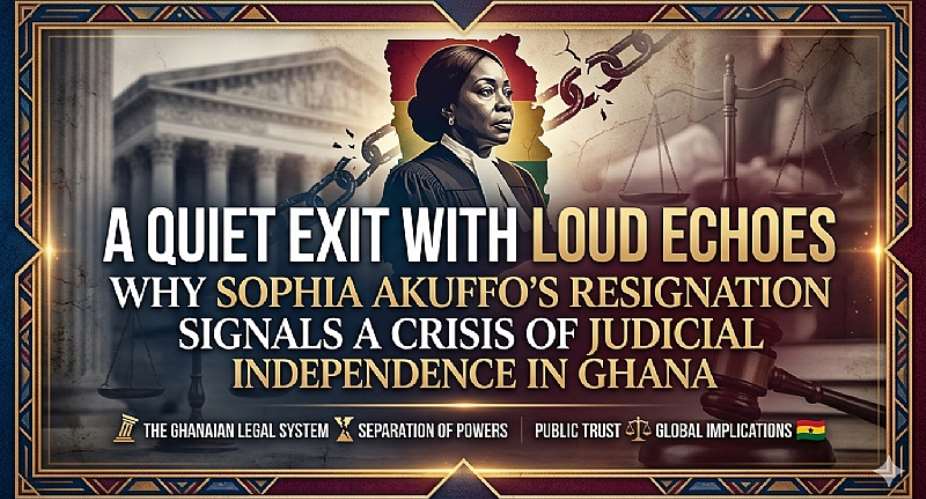
The news that trailblazing jurist and former Chief Justice Her Ladyship Justice Sophia Abena Boafoa Akuffo has officially resigned from the Council of State has sent shockwaves through Ghana's political and legal landscapes. While government spokespersons have carefully framed her departure as a personal decision with "no reasons disclosed", the timeline tells an entirely different story. Justice Akuffo quietly tendered her resignation back in September 2025, immediately following the historic and deeply polarizing removal of then-Chief Justice Gertrude Torkornoo. By refusing to remain a silent partner on the country’s highest advisory body, this legal titan has once again demonstrated her unyielding commitment to principle over political convenience.
For the Ghanaian public, this is not just a high-profile resignation; it is a profound alarm bell regarding the systematic erosion of checks and balances, the creeping politicization of the judiciary, and a dangerous trend where leadership's personal interest overrides national policies and good governance. As the old adage warns, "when elephants fight, the grass suffers." In this high-stakes political warfare, it is the ordinary Ghanaian citizen who stands to lose the most. Ghanaians, open your eyes lest we are taken for granted and a ride!
A History of Defiance: Her Fierce Independence and Clashes with the State
Justice Sophia Akuffo’s recent exit is not an isolated act of frustration, but the latest chapter in a long, uncompromising history of holding the state accountable. Time and again, she has refused to be a passive observer when state machinery inflicts harm on its citizens:
- The DDEP Picket Lines: In early 2023, she shocked the political establishment by physically joining aggrieved elderly citizens to picket outside the Ministry of Finance against the Domestic Debt Exchange Programme (DDEP). Standing shoulder-to-shoulder with vulnerable pensioners, she fiercely condemned the government's attempts to pickpocket the elderly, declaring that a state that targets the savings of its retirees is "callous and wicked."
- Slamming "Kwaku Ananse Mathematics": When the state attempted to implement highly controversial mineral royalty frameworks—which critics argued heavily disadvantaged the Ghanaian people—Akuffo did not mince her words. She publicly dismissed the state's financial justifications as nothing short of deceptive "Kwaku Ananse Mathematics," exposing how the nation’s wealth was being systematically signed away under the guise of complex legal jargon.
- The "Montie 3" Legacy: Even while serving on the Supreme Court, she consistently demonstrated that she bowed to no political party. She stood firm in convicting the notorious "Montie 3" political commentators for contempt of court, despite massive pressure from the ruling government of the time. When the sitting president subsequently used his prerogative of mercy to pardon them, Akuffo openly criticized the move, warning that it deeply undermined the authority and morale of the judiciary.
The Breaking Point: How We Got Here
The roots of Justice Akuffo's departure trace back to a turbulent judicial crisis that unfolded in mid-2025:
- The Torkornoo Cleansing: In April 2025, the 31-member Council of State voted on whether a prima facie case had been established against then-Chief Justice Gertrude Torkornoo following a citizen's petition alleging financial and administrative misbehavior.
- The Lone Dissenter: Out of 31 members, 30 voted in favor of the inquiry. Justice Sophia Akuffo was the sole abstention. She strongly voiced her concerns regarding the speed and nature of the proceedings, refusing to join the uniform political chorus.
- The Sacking and the Exit: On September 1, 2025, the President officially removed Torkornoo from office. Disgusted by what critics and legal scholars have termed an executive overreach and a "political witch-hunt," Justice Akuffo submitted her resignation that very same month and completely stopped attending Council meetings.
Deepening the Legal Crisis: The Sacking of Gertrude Torkornoo
To understand why Sophia Akuffo walked away, we must confront the dangerous legal precedent set by the removal of Chief Justice Gertrude Torkornoo. This was not a routine administrative transition; it was a devastating assault on the constitutional guardrails protecting the third branch of government:
- The Weaponization of Article 146: Under the 1992 Constitution, a Chief Justice can only be removed for "stated misbehavior or incompetence." In Torkornoo's case, the process was triggered by a highly contentious citizen’s petition alleging administrative lapses and financial mismanagement. Legal scholars argue that the state weaponized minor administrative procedural errors, treating them as fatal "stated misbehavior" to justify a swift political purge.
- Subverting Due Process: Justice Akuffo’s deep alarm stemmed from the terrifying speed and lack of transparency with which the investigative committee operated. The constitutional mandate requires an exhaustive, thoroughly objective fact-finding mission. Instead, the process was rushed through with unprecedented haste, denying the sitting Chief Justice a robust, fair hearing and violating the fundamental principles of natural justice.
- The Executive Capture of the Judiciary: By allowing a highly politicized petition to easily dismantle the head of the judiciary, the political establishment has effectively sent a chilling message to every judge in the country: if your rulings or administrative decisions do not align with the executive's agenda, you can be removed before your tenure is up. This entirely strips the courts of their neutral arbiter status.
The Red Flags of Modern Leadership: When Personal Interest Overrides National Policy
Justice Akuffo's presence on the DDEP picket lines and her subsequent exit from the Council of State offer a powerful case study for Ghanaians trying to distinguish between narrow personal interest and principled leadership. Her actions stand as a direct indictment of a growing political culture where leadership's personal gain supersedes good governance.
Ghanaians must wake up and watch out for these critical leadership warning signs:
- Shielding the Elite while Taxing the Grass: Personal interest drives leaders to protect their own fortunes and political privileges while forcing economic restructuring, debt haircuts, and heavy taxes onto vulnerable pensioners, small business owners, and regular workers. When leaders refuse to trim government size or cut lavish expenditures while demanding sacrifices from the public, good governance has failed.
- Selective vs. Collective Defense: True leadership does not seek a secret, backroom exemption just for its immediate circle. Justice Akuffo did not quietly secure her own bonds; she stood publicly for all individual bondholders. When policies are customized to favor a select political elite while the masses suffer, the country is being taken for a ride.
- The Sidelining of Independent Voices: A major sign of dangerous governance is when public officers who ask tough questions or voice dissent are systematically forced out, quieted down, or labeled as "saboteurs" to ensure total compliance. The moment independent arbiters are replaced by compliant rubber stamps, the ordinary citizen is left entirely defenseless against state tyranny.
The Road Ahead: Recommendations and Suggestions
Ghana cannot afford to treat this judicial impasse as business as usual. To restore public trust and protect our democratic institutional framework, the following urgent steps must be taken:
- Re-evaluate and Limit Executive Powers: The executive branch currently wields disproportionate leverage over the appointment, discipline, and removal of heads of independent constitutional bodies. Parliament must champion legislative updates to ensure these processes require strict, transparent, and higher cross-party consensus thresholds.
- Review Article 146 of the 1992 Constitution: The constitutional definitions surrounding "stated misbehavior" or "incompetence" for removing a Chief Justice remain dangerously vague. A clear, rigid, and objective legal framework must be codified to prevent future administrations from weaponizing administrative lapses into political tools for removal.
- Depoliticize the Council of State: If the Council of State is to remain relevant to the ordinary Ghanaian, it must transition away from being a reward mechanism for political loyalists. Structural reforms should ensure that independent civil society, traditional leaders, and professional bodies hold an unassailable majority on the council.
- Active Citizen Vigilance: Ghanaians must move past partisan lenses when assessing judicial and economic issues. A weakened judiciary leaves the ordinary citizen entirely defenseless against state tyranny. Civil society organizations and regular voters must vigorously resist any actions that compromise the neutrality of our courts.
Justice Sophia Akuffo has given Ghana a masterclass in institutional integrity. By choosing the cold discomfort of resignation over the warm prestige of a compromised advisory role, she has reminded us that positions of power are completely meaningless if they require the sacrifice of one’s principles. Her empty seat on the Council of State stands as a monument of quiet defiance against the gradual overreach of executive dominance.
The executive may find a replacement to fill her physical seat, but they will find it nearly impossible to replace the immense moral weight, legal brilliance, and independent courage she brought to the table. We cannot sit idly by as the grass that gets trampled while political elephants fight for control of our courts and our national economy. As a nation, we must now decide whether we will ignore her silent warning or do the hard, necessary work to rescue our democratic institutions before it is too late. Ghanaians, it is time to open our eyes.
A Prayer for Our Republic
Heavenly Father, Almighty God, and Sustainer of Nations,
We lift up our beloved homeland, Ghana, before You today. We thank You for the peace we enjoy, for the resilience of our people, and for the democratic foundations laid down by those who came before us.
- Grant Wisdom to Our Leaders: We pray for our President, our Members of Parliament, our Council of State, and all political actors. Touch their hearts, O Lord, that they may lay aside personal ambitions, partisan greed, and narrow interests. Fill them with a profound sense of patriotism and the fear of God, so that national policies may be driven by truth, equity, and genuine good governance.
- Fortify Our Judiciary: We pray for our courts and our judges. Protect them from political capture, executive intimidation, and compromise. Grant them the courage of Justice Sophia Akuffo to stand firm for truth, ensuring that our legal system remains a true sanctuary of justice for all, and not an instrument of oppression against the weak.
- Awaken the Conscience of Our Citizens: Lord, open the eyes of ordinary Ghanaians. Deliver us from apathy, complacency, and partisan blindness. Help us to remember that when political elephants clash, it is our land and our future that suffer. Give us the discernment to spot deception and the courage to demand accountability from those who lead us.
- Protect the Vulnerable: We commit the "grass" of our nation into Your hands—the struggling traders, the hardworking youth, the pensioners, and the ordinary workers. Shield them from harsh economic burdens born out of leadership failures. Let the wealth of this nation enrich the lives of many, not just a privileged few.
Lord, heal our land from the creeping rot of corruption and institutional decay. May the words of our national anthem truly manifest in our daily lives: “Help us to resist oppressor's rule with all our will and might for evermore.”
Preserve our peace, strengthen our democracy, and let justice roll down like waters in our nation.
God bless our homeland Ghana, and make our nation great and strong.
Amen.
✍️By A Concerned Retired Senior Citizen
For and on behalf of all Senior Citizens of the Republic of Ghana 🇬🇭
Teshie-Nungua
[email protected]

 Iran deal: Trump is back to square one, but the cards are now in Tehran’s favor
 Mahama held back acceptance of Sophia Akuffo's resignation letter at request of ...
 Zoomlion workers petition Ashanti Regional Minister over unpaid salaries
 Stay away from married men to avoid premature deaths - Atwima Trabuom Queen moth...
 Afigya Sekyere East: NPP Constituency Chairman petitions regional executives ove...
 Nyinahin Catholic SHS incident: 11 CSOs petition NTC to investigate alleged teac...
 Current presidential staff salaries inherited from Akufo-Addo era — Kwakye Ofosu
 Publish Sophia Akuffo’s resignation letter now – Martin Amidu urges govt
 Bole SHS investigates alleged sexual misconduct involving teacher and student
 Justice Sophia Akuffo did not disclose reason for Council of State resignation —...


