




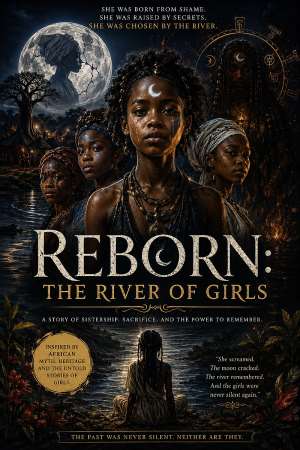
There is a particular kind of silence that falls over Accra when the heavens open in June. The gutters fill, the markets empty, and for a few hours the whole city seems to hold its breath, waiting for the water to decide what it will take and what it will leave behind. It is, perhaps, the most fitting season imaginable to discover a story about a river that remembers everything — every scream, every secret birth, every girl who was sent away "for the sake of the family name."
That story is "REBORN: The River of Girls," and if you have not yet read it, I am asking you — as a sister, as a storyteller, as someone who has spent years searching for fiction that actually sounds like home — to put down whatever else you are reading and go find it. It is free. It is on Wattpad. It is on Medium. There is no excuse.
A STORY THAT OPENS WITH A FUNERAL AND NEVER LOOKS BACK
"The night Ama died, the moon refused to rise."
That is the first line, and I promise you, it does not let go after that. Within a single page, we are at the bedside of a midwife who has just died delivering a child that the village will spend years pretending does not exist — a child born of a sixteen-year-old girl's shame, a shame that, as the story makes painfully clear, was never hers to carry in the first place.
What unfolds from there is the tale of Esi, the baby Ama died bringing into the world, raised by Ama's grieving daughter Abena. But Esi is no ordinary child. By two, she is speaking in full sentences. By three, she is in the herb garden, working with a precision that should not belong to a toddler. By five, she is bleeding — a medical impossibility that no clinic, no doctor, and certainly no village elder, can explain away.
If you have ever sat with your grandmother as she told you a story that started ordinary and ended somewhere you didn't expect — somewhere that made the hair on your arms rise — then you already know the rhythm of this tale. It moves the way our best oral stories move: quietly, patiently, until suddenly it doesn't.
THE GIRLS WHO CROSS BORDERS TO FIND HER
What struck me most — and what I suspect will stay with you long after you've finished — is what happens when the other girls begin to arrive. One by one, they come to Esi: Aminata from Côte d'Ivoire, whose body was punished for refusing to "grow" on schedule. Fatou from Senegal, who survived what was done to her at a "cleansing" shrine at six years old. Nguea from Cameroon, intersex and nearly married off to settle a debt of firewood.
Each girl arrives speaking her own language — Baoulé, Wolof, Bassa — and each is met, without translation needed, with recognition. "I know," Esi tells one of them. "The river told me."
This is where the story stops being merely a fantasy tale and becomes something far more urgent. Beneath the moonlight and the masks and the chanting witches, this is a story about the things West Africa does not like to say out loud — about girls cut, girls married off, girls whose bodies are policed before they have even learned the word for "body." The fantasy elements don't soften these realities. If anything, they give the writer a way to hold them up to the light without looking away, and without turning the work into something unbearable to read. That, to me, is the mark of a writer who understands exactly what she is doing.
A WORLD BUILT FROM OUR OWN MYTHOLOGY
The second half of the story pulls Esi — and us — into a hidden camp of women the villages call "witches" but who are, in truth, guardians of memory. Here, alongside Nguae, Amina, and Fatouma, Esi discovers that she carries within her not just one life, but many — including the life of Ama, her own "twin," reborn in shadow and convinced that only one of them can survive.
What follows is, frankly, some of the most striking imagery I have come across in independent African fiction this year: a moon that "bleeds silver," a river that rises not in fury but in release, masks carved from bone and glass and moonstone, and a chant — "One to remember, one to suffer, one to choose" — that I suspect readers will find themselves repeating long after they've closed the app.
And then there is the ending. I will not spoil it for you, except to say this: when Esi finally speaks to the river — not as a sacrifice, but as a witness — I felt something many of us rarely feel when we read fiction about girls and rivers and old rituals. I felt hope that did not come at the cost of honesty.
A FEW HONEST NOTES
I would not be doing my job, or doing the writer the respect she deserves, if I pretended this story is flawless. It is fast — almost breathless in places — and there are moments where you may find yourself flipping back a page to confirm a name, a timeline, a detail that moved quicker than expected. Some of the dialogue between Esi and Ama in the climax leans heavily on exposition to explain the rules of this world. These are the kind of things that, with a little more room to breathe — perhaps in a longer, expanded version — could be smoothed into something even more powerful than it already is.
But here is what I will say without hesitation: I would rather read a story this alive, this urgent, this unafraid, with a few rough edges, than a polished story with nothing to say. "REBORN: The River of Girls" has something to say. It says it in Twi, in Wolof, in Baoulé, in Bassa, and it says it without apology.
WHY NOW? WHY THIS SEASON?
There is something about the wet season here at home — the way the rivers swell, the way the rains seem to wash old things to the surface — that makes this exactly the right time for this story. And for our people abroad, scattered across cities where the rain falls differently but the longing for home falls the same, "REBORN" is a reminder of the stories our grandmothers carried, the ones about rivers that listen, and girls who are never quite as ordinary as the village pretends.
So this rainy season, while you wait out the downpour with your phone in hand, do yourself a favour. Open Wattpad. Open Medium. Search for "REBORN: The River of Girls." It will cost you nothing but an hour of your time — and I suspect it will leave you with something you didn't expect to carry away.
Every womb deserves mercy. Every story like this one deserves an audience.
Go and read it. Then tell someone else to do the same.
— Chief Tutu Baffour Asare Brownsy Williams Brownsy Silva Company

 Iran deal: Trump is back to square one, but the cards are now in Tehran’s favor
 Mahama held back acceptance of Sophia Akuffo's resignation letter at request of ...
 Zoomlion workers petition Ashanti Regional Minister over unpaid salaries
 Stay away from married men to avoid premature deaths - Atwima Trabuom Queen moth...
 Afigya Sekyere East: NPP Constituency Chairman petitions regional executives ove...
 Nyinahin Catholic SHS incident: 11 CSOs petition NTC to investigate alleged teac...
 Current presidential staff salaries inherited from Akufo-Addo era — Kwakye Ofosu
 Publish Sophia Akuffo’s resignation letter now – Martin Amidu urges govt
 Bole SHS investigates alleged sexual misconduct involving teacher and student
 Justice Sophia Akuffo did not disclose reason for Council of State resignation —...


