




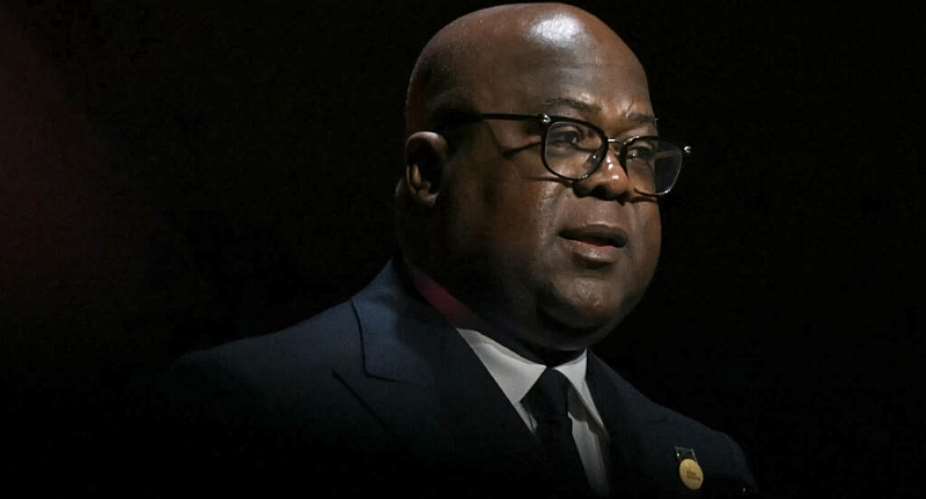
"If the people of Congo ask me to return, I am at their disposal," Tshisekedi said during a three-hour press conference in Kinshasa on Wednesday evening.
In power since 2019 and more than halfway through his second term, the president stressed any constitutional change would be submitted to a referendum: "If any change or revision is to be made, it will never be without consulting the people."
His comments quickly drew criticism from his opponents. Speaking to RFI, former MP Claudel-André Lubaya – now living in exile – said Tshisekedi had effectively announced his intention to breach the country's fundamental laws.
"No provision of the constitution allows a so-called popular will to justify violating its letter and spirit," he said.
Constitutional battle
The battle centres on article 220 of the DRC's constitution, which bans revisions that would change fundamental rights and governance systems, including the two-term cap on presidential terms.
Under the 2006 constitution, established by former president Joseph Kabila, article 220 forbids "any modification of the number and length of terms of office of the president", a measure introduced to guard against dictatorship after the autocratic rule of Mobutu Sese Soko, who governed the country from 1971 to 1997. Mobutu Sese Seko, future president of Zaire (later the Democratic Republic of the Congo), on 16 September 1960 in Leopoldville (later Kinshasa). In 1960, Mobutu led an army coup against the nationalist government of Patrice Lumumba; Mobutu soon became the army chief of staff. After a second coup in 1965, he assumed the office of prime minister, then established a presidential form of government headed by himself.
Kabila nonetheless remained in power beyond the end of his constitutionally mandated second and final term in December 2016.
At the time, Tshisekedi was part of the political opposition that called on Kabila to respect the constitution, including on presidential terms.
But since late 2024, Tshisekedi's UDPS party has been pushing for a revision.
The president's supporters have given various justifications, including the need to review the balance of powers between provincial authorities and the central government – which article 220 also rules out. They also argue that the constitution was largely drafted by foreign legal experts.
DR Congo weighs price of security in minerals deal with US
In his speech this week, Tshisekedi also invoked the partnership agreement DRC signed with the United States in December 2025, which gives the US preferential access to Congolese mineral reserves and a direct role in overseeing the mining sector. It requires DRC to amend its legal framework, including potentially revising its constitution.
Speaking to RFI in April, the vice-president of the DRC parliament, Jean-Claude Isaac Tshilumbayi, said allowing Tshisekedi a third term was not "the main thrust" of the drive to change the constitution.
However, his critics see it as an attempt to hold on to power.
"The DRC cannot enter a new cycle of institutional tensions and the personalisation of power. All democrats must stand against this slide," former presidential candidate Delly Sesanga wrote on X after Tshisekedi's press conference.
Election delay
Tshisekedi also warned that presidential elections due in 2028 could be delayed by the conflict in eastern DRC.
The AFC/M23 coalition, a rebel group backed by Rwanda, controls large swathes of territory in the east, and fighting continues despite mediation attempts by the US and others.
"If this war cannot be ended, unfortunately we will not be able to organise elections in 2028," Tshisekedi said, noting that Ukraine has also delayed elections amid its war with Russia.
"You cannot hold elections when parts of the country are occupied."
The year ahead for African democracy: who is going to the polls in 2026?
Lubaya and others pointed out the contradiction with Tshisekedi's promise to submit constitutional reforms to a vote. "He said himself he can't organise elections while the war continues," the former MP told RFI. "So how is he going to organise a referendum?"
Trésor Kibangula, a political analyst at Congolese research institute Ebuteli, said the security situation in the east was being "used as a factor to delay the democratic process".
He told RFI that Tshisekedi's comments this week suggest he is increasingly emboldened.
"I think that gradually he is winning the battle for public opinion because, in Kinshasa today and across the country, the opposition has become inaudible," Kibangula said.
"We are witnessing a shrinking of the political space. Most opposition figures are living in exile. So the government's narrative is gaining ground."
This article has been adapted from RFI interviews in French.


 James Agalga named majority leader following Mahama Ayariga's ministerial appoin...
 Omane was a true friend, a younger brother and a loyalist — Mahama eulogises lat...
 'My focus is on delivering the mandate' — Prof. Opoku-Agyemang responds to rumou...
 US appeals court halts construction of Trump’s $400 million White House ballroom...
 Saudi Arabia, Pakistan and Turkey sign mutual defence agreement
 Rwanda in talks with Italy to take in migrants trying to reach EU
 Threat against the President can't be described as exercise of free speech — Pro...
 'Failure to stop galamsey will make August 6 deaths meaningless' — Solomon Owusu
 Jailed Wontumi still in NPP national chairmanship race — Dr Palgrave Boakye-Danq...
 Mahama reshuffles cabinet, nominates Zanetor Rawlings and Mahama Ayariga to Envi...

