




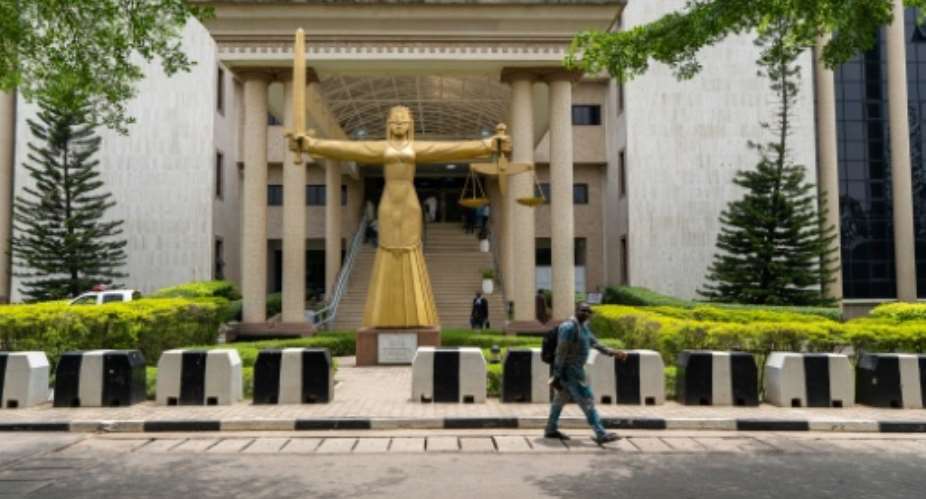
A court martial over last year's foiled coup plot in Nigeria is expected to get under way Friday, two weeks after the judges were sworn in.
Three dozen officers are on trial for allegedly planning to overthrow the government.
If successful, it would have brought an end to more than a quarter century of democracy in Africa's most populous country, which spent much of the 20th century under junta rule after gaining independence from Britain in 1960.
Here is what we know so far:
Who is the alleged coup leader?
The Nigerian military has not officially identified a ringleader of the alleged coup plot and the court martial will be held behind closed doors, as is usual, at a military venue in Abuja.
Local media reports named Colonel Mohammed Ma'aji as the officer who mobilised the plotters.
Court documents seen by AFP accused "Ma'aji and others" of committing an "act of terrorism".
Ma'aji reportedly gained much of his operational experience in the Niger Delta, where he participated in major army operations targeting militancy and oil theft.
At the time of his arrest, the 49-year-old was serving as commanding officer of the Nigerian Army 19 Battalion.
Were civilians involved?
In a separate trial for civilians who allegedly participated in the coup plan, court documents seen by AFP named former oil minister Timipre Sylva -- who is at large and has not been officially charged -- as having allegedly acted alongside the accused.
Also allegedly involved was an electrician who worked at the presidential villa.
According to a video interview with investigators, played before the Federal High Court where the civilian trial is being held, the electrician, Zekeri Umoru, was recruited by the plotters to gain access to the villa.
He said that Ma'aji had met him and started transferring large amounts of cash, without explicitly telling him what it was for.
Others charged at the Federal High Court are retired major general Mohammed Ibrahim Gana and retired captain Erasmus Ochegobia Victor.
They have all pleaded not guilty.
The civilian court trial has been ongoing since last month, though access for journalists to the case has been severely curtailed, without an official explanation.
How was the failed putsch allegedly financed?
A witness for the Nigerian military told the Federal High Court in Abuja last month that Sylva had a financial link with the suspected coup plotters, according to the government-owned News Agency of Nigeria.
"We found financial trails between Ma'aji, former Governor Timipre Sylva and some of the defendants here before the court," the witness told the court.
"We also observed financial trails between some of the defendants" and Ma'aji, the witness said.
The country's anti-graft agency, the EFCC, declared Sylva wanted in November, weeks after news of the failed coup broke, over an "alleged case of conspiracy and dishonest conversion of $14,859,257".
The EFCC however did not mention the alleged coup attempt. The government had initially denied that the plot took place, until making a U-turn in announcing the court martial in January.

 Accra Is Sinking Yet Again — Time to Be Truthful With Ourselves
 Fire guts rubber factory at Circle Odawna as flooding hampers firefighting effor...
 Flooding strands commuters on Winneba Cape Coast Highway
 Three feared dead after electrocution in Alajo flooding incident
 Nine missing after floods hit Awutu Senya East
 'Your mother, I should go to heaven and ask Nebuchadnezzar to stop the rain?' — ...
 Flood victim found dead along Alajo Railway track as rescue operations continue
 GMet warns more rain as flooding disrupts movement across Greater Accra
 'You sit on social media and talk nkwasiasem' — Nigel Gaisie blasts critics over...
 Osahen Afenyo-Markin accuses NDC of using GoldBod to promote illegal mining
