




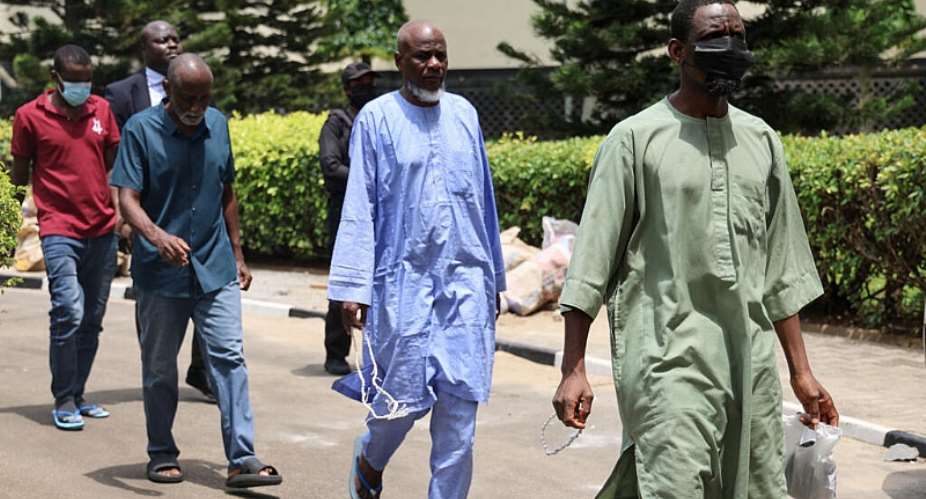
The military trial comes days after six civilians appeared before the High Court in Abuja over the same plot, which authorities allegedly tried to conceal for months after it unfolded in October 2025.
For weeks, both the presidency and the Nigerian army denied any coup attempt had taken place before finally acknowledging it earlier this year. The affair has raised fresh questions about worsening insecurity in Nigeria and tensions inside the country's military and security apparatus.
Who are the accused men? What really happened last October? And why did the presidency go to such lengths to hide the alleged plot?
Ibrahim said the government feared openly discussing the alleged coup attempt could encourage further plots at a time when military takeovers are once again spreading across West Africa.
RFI: Let's go back to the attempted coup last October. The Nigerian army first denied it had even happened, then admitted it three months later. Why do you think that was?
JI: For a government in power, talk of a possible coup is deeply unsettling. At first, the government did not want to acknowledge the attempt at all. But later it found itself trapped: if it stayed silent, what was it going to do with the suspects? I think that was the main problem.
US drones deployed to Nigeria alongside troops for intelligence and training
RFI: President Bola Tinubu's security record can be described as very poor. There was the attack in Jos, coordinated bombings in Maiduguri and US strikes on Nigerian territory. By hiding the coup attempt, was the government also trying to conceal deeper problems inside Nigeria's security apparatus?
JI: Absolutely. In Nigeria's recent history, the security situation has never been worse. Attacks by terrorists, bandits and groups claiming political motives are happening almost everywhere in the country.
Everyone is asking the same question: where is the state, and where are the security forces? It is a deeply worrying situation for Nigerians. People are asking whether the state is truly capable of protecting its own citizens.
RFI: A court martial was specially created to try the 36 accused officers. In a country that experienced several coups around 25 years ago, why is such a tribunal only being set up now?
JI: We do not really know, because the government worked hard to hide the failed coup. Even now, many people are questioning the accuracy of the information coming from Abuja. The hope is that the court martial and the civilian trial that began on Monday will help shed light on what really happened.
But in my view, the government is worried because this is very difficult for it to manage. There is a simple reason: military takeovers are once again spreading across West Africa, and many countries in the region have experienced coups in recent years.
The idea of a putsch is growing in Nigeria and that is the deeper problem. If the government talks about it openly, could that encourage others? If it says nothing, what are the risks? Could the suspects try again?
It is a very difficult situation for the government, and it shows. There is hesitation, uncertainty and a real difficulty in speaking clearly about what happened.
Nigeria opens investigation after deadly airstrike kills dozens in market
RFI: Shortly after the attempted coup, Tinubu completely overhauled the military high command. With 36 people facing prosecution and a presidential election less than a year away, was this simply a reorganisation or a deeper reform?
JI: I think the president wants to guarantee his own personal security above all else. He will choose the people who will stay loyal to him, whatever happens.
RFI: But has he also focused on the fight against armed groups, bandits and terrorists?
JI: Tinubu is thinking first about his own security. The proof is that the fight against terrorism and banditry is not improving. These bandits and terrorists do as they please – they attack the army and even kill senior military officers.
All these changes at the top of the armed forces have not made Nigeria any safer. It seems increasingly clear that the main objective is the personal security of the head of state himself.
This interview was adapted from the original version in French and has been edited for clarity.

 NDC behaving as if they will stay in government forever — NPP’s Alfred Thompson
 Residents protest at NEDCo office in Kpandai over power disconnections
 Toxic fumes from generator during dumsor kills three individuals at Manhean
 Police arrest 11 suspects over AI deepfake videos impersonating president Mahama
 Election 2028: Bawumia appoints all four NPP presidential aspirants as co-chairm...
 Ghanaians in US romance scam case: Jamal caged, Kamal set free
 How father allegedly dragged his son with quad bike on tarred road at North Lego...
 May 8: Cedi sells at GHS12.10 on forex market, drops to GHS11.28 on BoG interban...
 Health Committee Chair tells health professionals to resign if they are tired of...
 GTEC orders Bolgatanga Technical University Vice Chancellor to resume duties


