




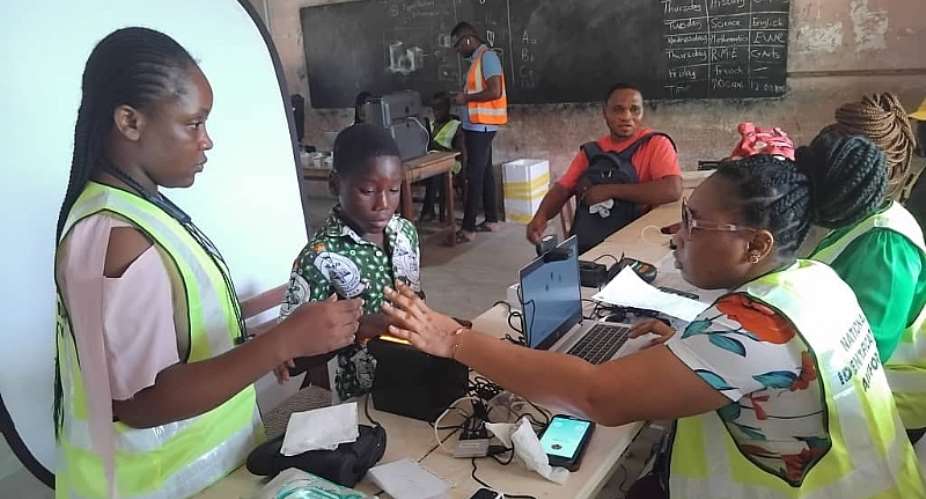
The National Identification Authority (NIA) has commenced the registration of children aged six to14 years in the Volta and Oti Regions as part of efforts to build a comprehensive and dynamic national database to support national development planning.
Mr Williams Ampomah Emmanuel Darlas, Director of Corporate Affairs of the NIA, said the exercise was in fulfilment of the Authority's mandate to register every Ghanaian, both at home and abroad, irrespective of age.
He was speaking during a monitoring tour at St Cecilia Roman Catholic Basic School in Ho on Wednesday, May 6, one of the registration centres in the region.
Mr Darlas said the Authority had successfully completed mass registration of persons aged 15 years and above across the country.
He explained that although the initial target was to register about 19 million people within that category, the NIA had so far captured close to 20 million Ghanaians.
“We started with persons aged 15 years and above because they are the group with immediate economic use of the Ghana Card. Now our next target is children aged six to 14 years, and that is why we are in the Volta and Oti Regions,” he said.
Mr Darlas said the registration exercise, which began on Tuesday, May 5, was deliberately being conducted in schools to make it easier to reach children within the targeted age bracket.
He said the Authority would spend about 21 days in the Volta and Oti regions before extending the exercise to the five northern regions and subsequently to other parts of the country, including Ashanti, Eastern and Bono regions.
According to him, the nationwide exercise aimed at registering about 3.1 million children aged between six and 14 years.
Mr Darlas stressed that accurate population data was critical for effective national planning and development.
“For any country to progress, there is a need to prioritise data. If we are able to capture this age bracket, it will help the government plan ahead in areas such as education, health infrastructure and other social interventions,” he said.
He noted that many of the children being registered would soon transition to senior high school, making it imperative for government to have reliable data for forward planning.
Mr Darlas said the exercise was being undertaken in collaboration with the National Health Insurance Authority (NHIA) to integrate children's National Health Insurance Scheme (NHIS) records with their Ghana Card data.
He explained that the integration would, in the long term, make the Ghana Card the primary identification document for accessing healthcare services.
“In future, when you go to the hospital, all you will need is your Ghana Card and you will be attended to,” he said.
Mr Darlas emphasised that the registration exercise was free of charge and urged parents and guardians to take advantage of the opportunity.
He explained that children could be registered using a valid birth certificate or passport, while parents or guardians without those documents could vouch for the children.
Because the exercise involved minors, he said the NIA had introduced measures to link children's records to those of their parents or guardians for proper identification and future tracing.
“After registering the children, we link their details to the parent or relative who vouched for them. This makes it easier to trace their roots in the future,” he said.
Mr Darlas said the Authority had deployed registration machines to various schools and was increasing the number of devices at centres with large student populations to ensure efficient processing.
“At St Cecilia RC Basic School alone, we understand the population is about 700, so we are deploying more machines to ensure faster processing and avoid delays,” he said.
He acknowledged some technical challenges at the initial stages of the exercise but assured the public that measures had been put in place to address them promptly.
Mr Darlas said lessons learnt from a pilot registration exercise conducted in 2024 had informed improvements in the current exercise, particularly regarding delays in card issuance.
Unlike the pilot phase, where some registered children received their cards months later, he said the current exercise had been designed to ensure instant issuance of cards upon registration.
“We have learnt from past challenges. This time, once a child is registered, the card is printed and issued immediately to the parent or guardian for safekeeping,” he said.
Some parents who brought their children for registration told the Ghana News Agency that although the process was generally smooth, network-related challenges occasionally slowed down operations.
Others said they had reported to the centres on the first day of the exercise but were given numbers and asked to return later due to long queues.
GNA
 NDC behaving as if they will stay in government forever — NPP’s Alfred Thompson
 Residents protest at NEDCo office in Kpandai over power disconnections
 Toxic fumes from generator during dumsor kills three individuals at Manhean
 Police arrest 11 suspects over AI deepfake videos impersonating president Mahama
 Election 2028: Bawumia appoints all four NPP presidential aspirants as co-chairm...
 Ghanaians in US romance scam case: Jamal caged, Kamal set free
 How father allegedly dragged his son with quad bike on tarred road at North Lego...
 May 8: Cedi sells at GHS12.10 on forex market, drops to GHS11.28 on BoG interban...
 Health Committee Chair tells health professionals to resign if they are tired of...
 GTEC orders Bolgatanga Technical University Vice Chancellor to resume duties


