




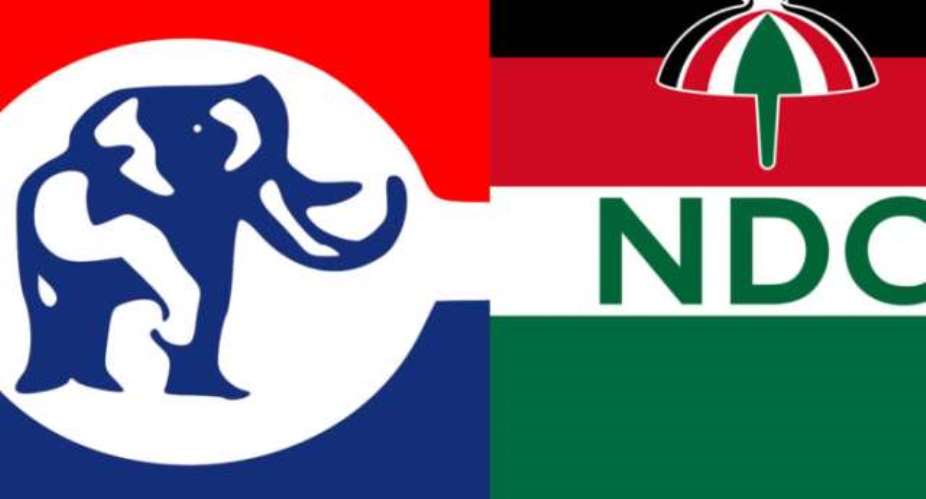
For over three decades, Ghana’s political landscape has been dominated by two major parties: the New Patriotic Party (NPP) and the National Democratic Congress (NDC). These two have become household names in Ghanaian elections, taking turns in power since the return to multi-party democracy in 1992. Despite the presence of several smaller parties and independent candidates, the political reality remains the same Ghanaians continue to vote mainly for NPP or NDC.
But why has it become so difficult for Ghanaians to break free from this two-party grip? And why do new or smaller parties fail to gain significant ground, even when the political climate calls for change?
- Deep-Rooted Political Loyalty
Many Ghanaians grow up in homes and communities that are strongly aligned to either the NPP or NDC. Political loyalty is often passed down through generations, much like support for a football team. In some regions, voting for one party over the other is seen not just as a political choice, but as part of one's identity.
This loyalty makes it difficult for voters to give smaller parties a chance, even when they may offer fresh ideas or credible candidates.
- Lack of Visibility for Smaller Parties
Parties like the Convention People’s Party (CPP), People’s National Convention (PNC), and newer ones such as GUM (Ghana Union Movement) and PPP (Progressive People's Party) have made attempts to challenge the dominance of NDC and NPP. However, they often struggle with limited funding, poor media coverage, and weak nationwide structures.
Without strong organization, clear messaging, or access to the same resources, these parties rarely reach the average voter in the same way the big two do.
- Electoral Strategy and Fear of “Wasting Votes”
Many voters in Ghana are afraid of “wasting” their votes on smaller parties that are unlikely to win. As a result, even those who are unhappy with both NPP and NDC often choose the "lesser evil" between the two, rather than taking a risk on a new option.
This fear keeps the cycle going: voters want change, but believe change is not possible without choosing one of the two.
- NPP and NDC Control State Resources
Being in government comes with significant advantages. The ruling party often has better access to funding, media, and public attention. This creates an uneven playing field where the opposition and especially smaller parties struggle to compete.
Moreover, both NPP and NDC have built strong networks across the country, using state influence and political appointments to reward supporters and grow their base.
- Lack of Political Education
A large number of voters still lack proper political education to analyze policies, manifestos, or the real impact of governance. Many vote based on party colors, slogans, or ethnic and regional ties, rather than on performance or ideology. This keeps political debate shallow and prevents new ideas or leaders from gaining ground.
Can Change Happen?
Yes, but it will take time and effort. For Ghana’s democracy to mature, voters must be encouraged to:
Focus on issues, not just party loyalty.
Hold leaders accountable, regardless of party.
Give new voices and ideas a chance to grow.
At the same time, smaller parties must improve their organization, visibility, and connection to the grassroots.
Conclusion
Ghana’s democracy is one of the strongest in Africa, but its future depends on a more open and competitive political system. For now, NPP and NDC remain the giants, with new or smaller parties struggling to break through. Real change will come when Ghanaians begin to vote not just out of tradition or fear but out of hope, trust, and a deep understanding of what is best for the country.
By Mustapha Bature Sallama
Medical / science communicator
International Conflicts management and Peace building
Alumni Gandhi- King Global Academy, United State Institute of Peace USIP
[email protected]
+233-555-275-880


 'We have spent 60years arguing about Nkrumah and rather less time doing what he ...
 Judge recounts attempted MoMo scam on him moments after jailing scammer
 'Systemic failure due to NACOC removal from port inspections' – Inusah Fuseini o...
 Akyem Oda commercial drivers raise fares arbitrarily amid commuter concerns
 Two arrested over alleged GH¢22,000 SHS placement scam
 Police uncover alleged network behind Ghana Jollof videos
 NACOC says cocaine suspects were under surveillance for up to two years
 Suhuyini assures Accra-Kumasi Expressway won’t miss December 2028 deadline
 Foreign Affairs Ministry releases 200-page RTI response on GH¢49.7m South Africa...
 Chartered flights account for GH¢27.18m of South Africa evacuation cost


