




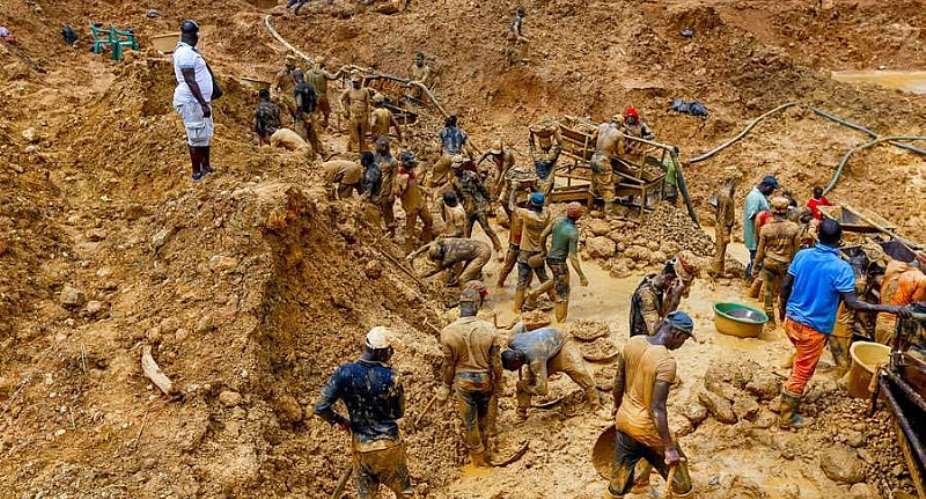
The menace of illegal mining, locally known as galamsey, continues to sit on Ghana’s conscience like an unmovable boulder. Its devastation is everywhere --- polluted rivers, destroyed farmlands, collapsed cocoa production zones, and broken communities. Yet, the most tragic part of this national canker is not only the destruction of land and water but the human cost. Major Maxwell Mahama was brutally murdered in bizarre circumstances in 2017 while on anti-galamsey duty. Defense Minister Dr. Omane Boamah and seven others perished in a helicopter crash, also in connection with operations to fight illegal mining. These were lives lost in service to Ghana, yet the monster of galamsey remains undefeated.
How many more ordinary Ghanaians have died in pits, inhaled mercury fumes, or been trapped in collapsed shafts? Nobody knows. What we do know is that galamsey is now entrenched in almost every corner of our country, sometimes more powerful than state authority itself.
It is not only soldiers and politicians who have fallen. Even respected professionals like Prof. Kwabena Frimpong-Boateng, a world-renowned heart surgeon and former Minister of Environment, Science, Technology and Innovation, found himself bruised and humiliated in his attempt to fight galamsey. His exit left a bitter lesson. In Ghana, fighting galamsey can cost one’s life, career, or reputation.
And yet, the brazenness of the practice continues. JoyNews recently revealed how excavators meant for galamsey were offloaded at our ports under the cover of night. Who cleared them? Who gave the orders? Who are we deceiving? Chiefs, politicians, security operatives, and community leaders cannot feign ignorance. If entire communities are engaged in galamsey without the knowledge of our security and intelligence apparatus, should we not be alarmed that rebels or terrorists could one day do the same?
The Numbers Tell the Story
The statistics paint an even grimmer picture. According to the Water Research Institute (2022), over 60% of Ghana’s water bodies are polluted, with illegal mining being the primary source. The once mighty Pra, Ankobra, Offin, and Birim rivers are now brown, lifeless streams carrying mercury, cyanide, and silt. Ghana Water Company has repeatedly warned that some treatment plants may shut down because purification costs have skyrocketed due to contamination.
The Forestry Commission reported in 2021 that over 18,000 hectares of forest reserves had been destroyed by illegal mining. Meanwhile, COCOBOD estimates that Ghana has lost more than 50,000 hectares of cocoa farmlands to galamsey activities. This directly undermines our cocoa exports, which account for a significant portion of our GDP. A report by the International Growth Centre (IGC) in 2019 estimated that Ghana could lose up to $2.3 billion annually in cocoa revenue if galamsey continues unchecked.
The UN University’s Institute for Natural Resources in Africa (UNU-INRA) warned in 2022 that mercury pollution from galamsey is a ticking time bomb, with long-term health consequences including cancers, kidney failure, and neurological disorders. Yet, mercury is smuggled daily across Ghana’s borders for use in illegal mining.
Political Hypocrisy and Rhetoric
Political hypocrisy makes the fight even harder. During the 2020 campaign, John Mahama accused President Akufo-Addo of failing to end galamsey. Yet under Mahama’s own watch, galamsey festered. Akufo-Addo himself promised to put his presidency on the line to fight it. But today, that pledge rings hollow. Instead of a decisive battle, we see rhetoric, half-hearted operations, and selective enforcement. Governments come and go, but galamsey stays.
What Must Be Done
So, can galamsey ever be halted? The answer is both simple and difficult. It can, if the political will is genuine, uncompromising, and insulated from partisan or personal interest. Government must:
- Dismantle the cartel networks --- Galamsey is not just poor youth with pickaxes. It is a multi-billion-dollar syndicate involving foreigners, politicians, chiefs, and business elites. Until the state is bold enough to prosecute high-profile backers, the menace will thrive.
- Empower communities --- Chiefs and local assemblies must be held directly accountable for galamsey in their jurisdictions. If rivers are polluted and farmlands destroyed under their watch, they must face sanctions. As the Asantehene, Otumfuo Osei Tutu II, put it bluntly: “We cannot sit unconcerned while our rivers dry up. Chiefs know those who are destroying our lands. If you look away, then you are complicit.”
- Provide alternatives for the youth --- The unemployment crisis fuels galamsey. Until sustainable livelihoods in agriculture, manufacturing, and small-scale regulated mining are provided, young men will risk their lives in pits. The Ghana Chamber of Mines noted in 2023 that “illegal mining is not just about poverty; it is about the absence of credible alternatives for the youth.”
- Technology-driven monitoring --- Satellite imaging, drones, and water pollution trackers can expose galamsey hotspots in real-time. The state must invest in these tools instead of waiting for journalists to break the news. Environmental activist Dr. Ken Ashigbey has often argued that “without technology, the fight will continue to be a cat-and-mouse game, where miners move at night and government only reacts.”
- A non-partisan, permanent taskforce --- The fight must go beyond electoral cycles. A special independent authority with prosecutorial powers, insulated from political interference, is needed to treat galamsey as the national security threat that it is. Civil society group OccupyGhana once warned: “Illegal mining is not an environmental issue; it is a national security emergency that must be treated as such.”
Wake Up, Ghana!
Politicians must give Ghanaians a break. Politicizing everything in Ghana is not helping this country. We must as Ghanaians know what “political talk” for votes is, and what a national problem is. The time for empty rhetoric is long gone. Galamsey is eroding Ghana’s environment, poisoning future generations, and mocking our sovereignty. If we cannot protect our rivers, our lands, and our people, then what claim do we have as a functioning state?
But this fight cannot be left to government alone. Citizens must refuse to buy or consume food grown on poisoned lands. Communities must rise up and reject the quick money that destroys their children’s future. Chiefs must choose legacy over silence. Churches, mosques, and civil society groups must amplify their voices, because environmental destruction is also a moral failure. And every Ghanaian must hold politicians accountable, regardless of party colours.
The real question is not whether galamsey can be halted. It is whether we, as a people, are willing to confront the truth, take collective action, and demand courage from our leaders. Until then, galamsey will continue to be the shameful inheritance we pass on to our children.
PS: Captain (Rtd) Mahama was my senior at TAMASCO. I just learnt late Maj. Mahama was his son. Though belated, my heartfelt sympathies still go to the family for the big loss.
FUSEINI ABDULAI BRAIMAH
+233208282575 / +233550558008
[email protected]


 NDC not worried about NPP’s Kojo Bamba, he is small boy – Azorka
 Obuasi SHTS: 'Children are not buffet' – NPP’s Fatimatu confronts Zuba
 'I didn’t know I was supposed to chop and not work' – Blakofe on her time at GTD...
 Resource exploitation fuelling Africa’s conflicts – Mahama
 Our ports' growth always depended on collaboration across maritime, logistics va...
 Stranded Ghanaian fishermen narrate how they ate fresh fish, drunk sea water to ...
 How notorious armed robber died on the way whiles leading police to arrest accom...
 'We must continuously improve cargo handling, coordination among port operators'...
 Nii Lante Vanderpuye confident of winning NDC national chairmanship despite Gold...
 Agalga dismisses critics, assures Builsa North of progress on Sandema–Wiaga Road


