




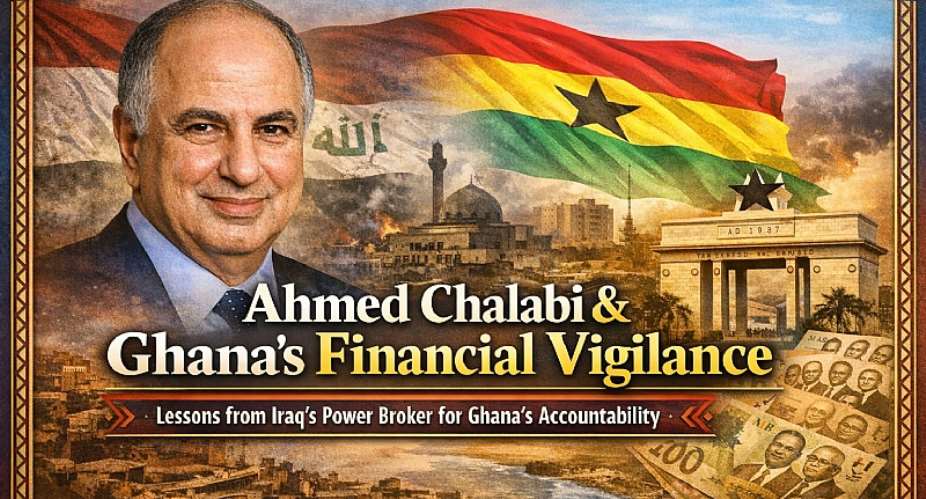
Ahmed Chalabi (1944–2015) remains one of the most polarizing figures in modern Middle Eastern history. To Ghanaians and the international community, his story offers lessons about the dangers of politicized intelligence, the complexities of exile-driven politics, and the consequences of foreign intervention. His life journey—from mathematician and banker to political exile and power broker—illustrates how individuals can shape the destiny of nations, for better or worse. In Ghana’s current financial debates, Chalabi’s legacy resonates as a warning about unchecked influence and opaque governance.
Early Life and Education
Born in Baghdad into a wealthy Shiite family with banking ties.
Exiled with his family after the 1958 coup that toppled Iraq’s monarchy.
Earned a B.S. in Mathematics from MIT (1965) and a Ph.D. in Mathematics from the University of Chicago (1969).
Briefly taught mathematics at the American University of Beirut.
Petra Bank Scandal
Founded Petra Bank in Jordan (1977), which grew rapidly but collapsed in 1989 with a $200 million deficit.
Convicted in absentia in 1992 for fraud and embezzlement, sentenced to 22 years.
Chalabi denied wrongdoing, claiming political persecution.
Role in the 2003 Iraq Invasion
Founded the Iraqi National Congress (INC) in 1992, lobbying Washington for Saddam Hussein’s removal.
Provided intelligence alleging Saddam possessed weapons of mass destruction (WMDs) and ties to Al-Qaeda.
These claims, later discredited, were central to the U.S. justification for war.
Famously declared: “We are heroes in error,” defending the invasion despite false intelligence.
Political Career in Iraq
Returned to Iraq after the U.S.-led invasion in 2003.
Served on the Iraqi Governing Council, briefly as its rotating president.
Deputy Prime Minister (2005–2006).
Interim Oil Minister on two occasions.
Headed the De-Baathification Commission, purging Saddam’s party members—a move widely blamed for fueling sectarian conflict.
At his death, chaired Iraq’s parliamentary Finance Committee.
Fallout and Controversies
Fell out with the U.S. in 2004 after accusations of passing intelligence to Iran.
U.S. forces raided his Baghdad home, marking his decline in American support.
Despite his influence, he never gained broad popular legitimacy among Iraqis.
Death and Legacy
Died of a heart attack in Baghdad on November 3, 2015, aged 70.
Remembered by some Iraqi leaders as a seasoned politician, but by others as divisive and corrupt.
His legacy is tied to the flawed intelligence that justified war and the sectarian policies that destabilized Iraq.
Lessons for Ghana and the World
Beware politicized intelligence: False claims can justify catastrophic wars.
Exile politics: Outsiders may not represent domestic realities yet can sway powerful nations.
Institutional resilience: Iraq’s collapse underscores the need for inclusive, strong institutions.
Accountability: Leaders who manipulate truth for political ends leave lasting scars.
Ghana’s Financial Vigilance
The story of Ahmed Chalabi is not only Middle Eastern history—it is a mirror for Ghana. His Petra Bank scandal and manipulation of narratives highlight the dangers of opaque financial dealings and unchecked authority. In Ghana’s context:
Financial Transparency: Ghana must insist on transparency in all state financial transactions.
Politicized Narratives: Misleading financial claims can destabilize the economy. Citizens must scrutinize official narratives about debt and expenditure.
Institutional Oversight: Oversight bodies like the Auditor-General and Parliament’s Finance Committee must be strengthened.
Public Vigilance: Ghanaians must cultivate a culture of questioning and civic engagement.
Avoid Personality-Driven Governance: Power must not be concentrated in individuals but balanced through collective decision-making.
Concerns about Ken Ofori-Atta and allegations of financial mismanagement resonate with Chalabi’s cautionary tale. Whether in banking scandals or state finance, the danger lies in allowing unchecked authority to dictate national economic destiny. If Ghanaians remain passive, the risk of repeating Iraq’s mistakes—where trust was eroded and institutions weakened—becomes real.
Ahmed Chalabi’s rise and fall remind us that truth, accountability, and institutional strength are essential for national stability. For Ghana, his story underscores the importance of vigilance against misinformation and the need to safeguard democratic institutions against manipulation. Ghanaians must be on the lookout, not only for “heroes in error,” but also for leaders whose financial decisions could mortgage the nation’s future.
✍️ Retired Senior Citizen
For and on behalf of all Senior Citizens of the Republic of Ghana 🇬🇭
Teshie-Nungua
[email protected]

 Accra Is Sinking Yet Again — Time to Be Truthful With Ourselves
 Fire guts rubber factory at Circle Odawna as flooding hampers firefighting effor...
 Flooding strands commuters on Winneba Cape Coast Highway
 Three feared dead after electrocution in Alajo flooding incident
 Nine missing after floods hit Awutu Senya East
 'Your mother, I should go to heaven and ask Nebuchadnezzar to stop the rain?' — ...
 Flood victim found dead along Alajo Railway track as rescue operations continue
 GMet warns more rain as flooding disrupts movement across Greater Accra
 'You sit on social media and talk nkwasiasem' — Nigel Gaisie blasts critics over...
 Osahen Afenyo-Markin accuses NDC of using GoldBod to promote illegal mining
