




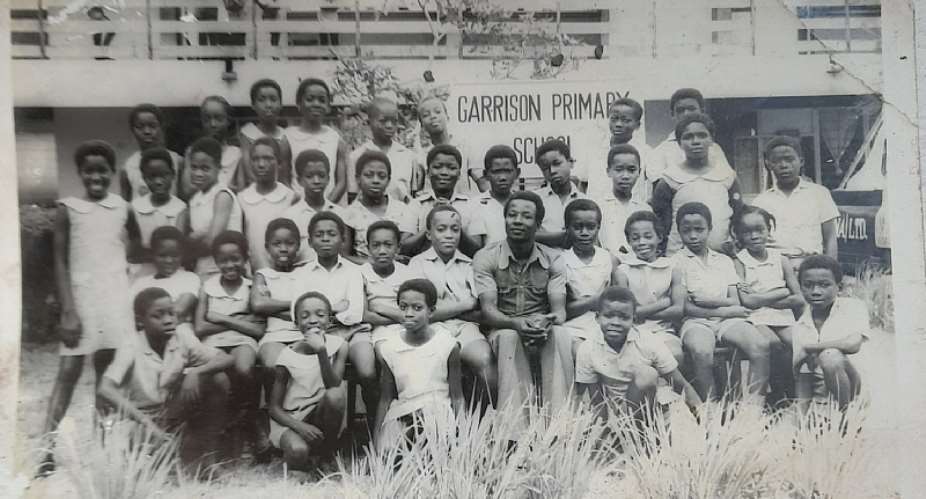
This vintage photograph of Garrison Primary School captures a class of 33 children—19 girls and 14 boys—alongside their teacher. Taken in front of a concrete school building with a hand-painted sign, the image is more than a class portrait; it is a historical record of Ghana’s educational journey.
The Setting: Concrete Echoes of Independence
In the mid-1970s, at Michel Camp or similar garrison locations, the school building stood as a symbol of Ghana’s post-colonial ambitions. Its open-air corridors and sturdy railings reflected the architectural style of the era, designed to foster both discipline and community.
The Protagonists: 33 Hopes for the Future
The Teacher: Seated at the center, embodying authority and guidance, bridging military discipline with civilian education.
The Girls (19): Dressed in light-colored uniforms with rounded collars, their presence highlights the success of gender-inclusive reforms.
The Boys (14): In button-down shirts and shorts, their posture mirrors the discipline of the soldiers they saw daily.
The Conflict: Military Discipline Meets Civilian Curriculum
Garrison schools carried a dual identity. They were both military institutions and civilian educational centers. The hand-painted sign “GARRISON PRIMARY SCH...” symbolized this experiment—where the Ghana Armed Forces Code of Discipline met the Ghana Education Service curriculum.
The Resolution: A Legacy in Black and White
The photograph immortalizes a generation shaped by the 1961 Education Act, which mandated free and compulsory education. These children were part of Ghana’s “experimental” generation, many of whom would later contribute to the nation’s development.
The Foundations: The 1961 Education Act
Free and Compulsory Education: Established universal primary and middle school education.
Rapid Expansion: Enrollment nearly doubled within a year.
Gender Inclusion: The high number of girls in the photo reflects reforms aimed at closing the gender gap.
The Garrison Identity: Military Discipline in the Classroom
Code of Discipline: Parents signed agreements to uphold military standards of punctuality and behavior.
Traditions: Students participated in drills, silence hours, and cadet activities.
Modern Impact: Garrison schools remain among Ghana’s top-performing institutions, blending discipline with academic excellence.
Contemporary Significance
Today, Garrison schools are highly sought after by both military and civilian families. They continue to uphold traditions of discipline while adapting to modern educational reforms.
Admission Process
Eligibility: Priority for military children, but civilians admitted as well.
Application: Aligns with Ghana Education Service calendar.
Documentation: Birth certificate, health records, school reports, proof of residence.
Discipline Agreement: Parents commit to military standards.
2025 National Service Military Reforms
Mandatory Training: Six-week basic military training introduced for 10,000 personnel.
Focus Areas: Physical fitness, leadership, patriotism, emergency response.
Implementation: Pilot phase began in August 2025, with expansion planned for all graduates.
In conclusion, this photograph of Garrison Primary School is more than a snapshot; it is a testament to Ghana’s educational heritage. It reflects the intersection of military discipline and civilian education, the success of gender-inclusive reforms, and the enduring legacy of the 1961 Education Act. Today, Garrison schools continue to embody excellence, discipline, and national pride.
✍️ Retired Senior Citizen
For and on behalf of all Senior Citizens of the Republic of Ghana 🇬🇭
Teshie-Nungua
[email protected]

 Accra Is Sinking Yet Again — Time to Be Truthful With Ourselves
 Fire guts rubber factory at Circle Odawna as flooding hampers firefighting effor...
 Flooding strands commuters on Winneba Cape Coast Highway
 Three feared dead after electrocution in Alajo flooding incident
 Nine missing after floods hit Awutu Senya East
 'Your mother, I should go to heaven and ask Nebuchadnezzar to stop the rain?' — ...
 Flood victim found dead along Alajo Railway track as rescue operations continue
 GMet warns more rain as flooding disrupts movement across Greater Accra
 'You sit on social media and talk nkwasiasem' — Nigel Gaisie blasts critics over...
 Osahen Afenyo-Markin accuses NDC of using GoldBod to promote illegal mining
