




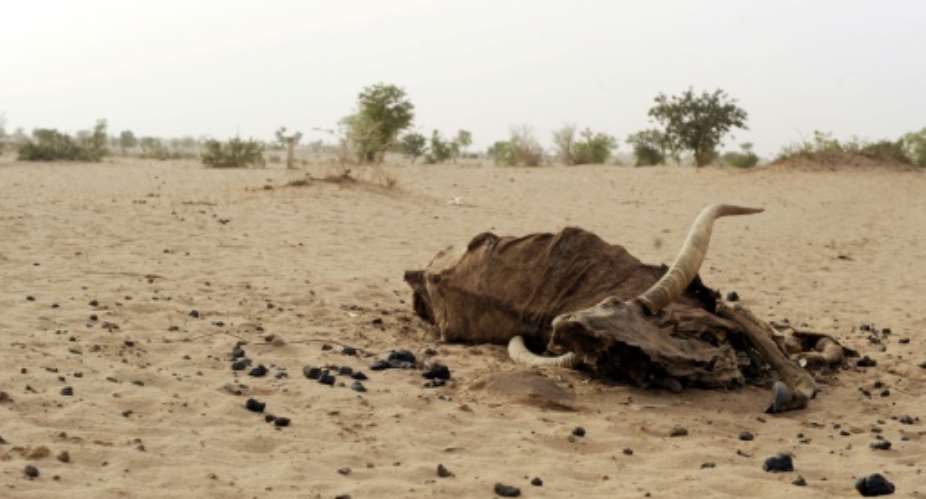
Leaders of 17 countries on the rim of the Sahel began talks on Monday on a nearly $400-billion plan to help the fragile region cope with climate change.
The 2018-30 scheme, covering countries ranging from Mauritania to the Horn of Africa, aims at reducing carbon emissions and providing help in the fight against desertification and other climate-related problems.
"We are continuing to pay for the consequences of a situation for which we are far from being responsible," said Niger President Mahamadou Issoufou, whose country is hosting the summit.
Issoufou said there was a "link" between security and climate -- an association that some scientific experts agree is becoming more visible as the global warming affects weather patterns.
He referred to the emergence of the Nigerian jihadist group Boko Haram, whose insurgency is nearly 10 years old.
The rebellion has claimed more than 27,000 lives and left 1.8 million homeless in Nigeria alone and spread to other countries in the Lake Chad region.
"The emergence and development of Boko Haram are in part connected to the impoverishment of people caused by the shrinking of Lake Chad, which has had an impact on agricultural, grazing and fishing resources," he said.
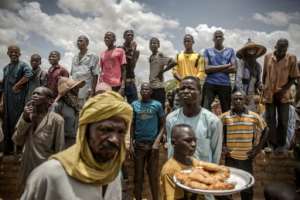 Food insecurity is a regular problem. By Luis TATO (AFP/File)
Issoufou also pointed to concerns -- especially in Europe -- about uncontrolled migration as poor people sought a better life.
"The Sahel will probably be one of the main source regions for the 250 million migrants that are expected in the world in 2050," he said.
The summit -- a followup on the 2015 Paris Agreement on climate change -- on Tuesday will put forward a proposal for 1.3 billion dollars in funding from outside donors, he said.
Around half a billion people live in the Sahel, where extreme heat, water scarcity and poverty make the region highly vulnerable to higher temperatures and shifting rainfall patterns.
The 17 countries at the summit comprise Benin, Burkina Faso, Chad, Cameroon, Cape Verde, Djibouti, Gambia, Guinea, Ethiopia, Eritrea, Ivory Coast, Mali, Mauritania, Niger, Nigeria, Senegal and Sudan.
Four other countries besides Niger -- Burkina Faso, Chad, Guinea and the Republic of Congo -- sent their president for the meeting.

 COPEC Boss Urges GoldBod CEO to Embrace Criticism for Better Performance
 Otumfuo Departs Kumasi for Two‑Week Working Visit to the United States
 Minority Challenges GoldBod CEO, Signals Next Steps
 COKA Urges NPP Executives to Return to Core Values and Rebuild for 2028
 'We don't reject partnerships, but those partnerships must be on our terms' — Ma...
 Police arrest suspect in GH¢1.1m fake gold deal in Berekum
 C/R: Wildlife Guard shot dead by suspected poacher at Kakum Forest Reserve
 Here are areas affected by planned power interruption on Sunday from 3 AM to 6 P...
 Upper East youth raise concern over ‘snail-paced’ development
 Gold buyer reportedly shot dead in daylight robbery at Manso Adubia

