




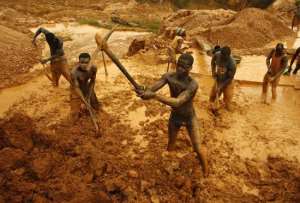
I had a discussion the other day with a person whose understanding of social realities is normally quite profound.
But he shocked he when he told me that he thought the Government's approach to the galamsey problem was wrong.
“You've got to invest in the people doing it!” he said. “You've got to incentivise them to move from galamsey into land reclamation plus reafforestation,” he said.
“But it was concern for the unemployed that started the problem in the first place,” I explained. “In 1989, the PNDC passed a law that was intended to empower “Small-scale Miners” to undertake mining, under licence from the Ministry of Lands and Mineral Resources, so that the practice of allowing only large companies to benefit from our mineral resources would end.”
“Yes, I am aware of that. . .” he interjected.
“Well, what the lawmakers of the the time did not anticipate fully was the nature of the gold trade itself or the character of the ordinary Ghanaian. Whereas the law-makes thought of enabling the “small-scale” or artisanal miner to earn a “decent living”, some Ghanaians merely saw the passing of the law as a means of earning a “cheapliving.” You got a licence; bought a few implements; and you went into the bush to look for gold – especially in areas where disused ancient mines (known in Twi as nkomena) indicated the presence of gold.”
“But the Ministry of Lands and Mineral Resources was supposed to take the licences to Parliament for ratification? Before they could be used?”
“Precisely! The Ministry and the Lands Commission neglected to perform their responsibilities under the law! Up to today, the Lands Commission has NOT said a word about its failure to take “small-scale” mining licences to Parliament for ratification!
"Yet the requirement amounts to no less than a CONSTITUTIONAL order!! That's what I mean by the character of the Ghanaian. The Constitution-writers realised that mining licences could be abused, and so put in that provision to give future law-makers a chance of approving or disapproving of what the civil servants in the Land Commission and the Ministry would have done. They, as Ghanaians, realised only too well that corruption could creep in, to make a nonsense of such a well-intended measure!”
“It has turned out to be more than a nonsense? It's now a national disaster?”
“Absolutely! Instead of using the licences themselves, the licence-owners (most of whom obtained their licences not because they had any desire to operate as miners nor because they had a record of being good businessmen, but because they were the footsoldiers of politicians)....”
“Jobs for the boys?”
“A classic example! That's why, if you look at the issue clearly, you will find that the leaders of the small-scale miners are always threatening the NPP Government with political action. They will demonstrate! They will not vote for Nana Addo! They want Operation Vanguard disbanded right now! And so on.”
“Meanwhile?”
“The small-scale miners had all found it easier to cash in on their licences by becoming the agents of Chinese and Ghanaian businessmen, who possessed the capital to import excavators and bulldozers and the mercury and cyanide ussed in gold-winning”.
“Dangerous stuff? And yet people are still pretending -- despite the evidence to the contrary -- that galamsey is “small-scale mining?”
“Yep! The stupidity of some members of Ghana's political class is beyond imagination. If a Western mining company so much as spilt ten ounces of poisonous chemicals into any of our water-bodies, we would take the matter to the United Nations Security Council, no less. People would march! Some would shout: “coupd'etat!” But because galamsey is being carried out by Ghanaians in collaboration with some citizens from a 'friendly' country, China, they excuse it.”
“Yes; they endlessly parrot the phrase “galamseyers must be allowed to earn a living”!
“Yie! Yie! Yie! Yie! What sort of country is this?”
“Hmm! It is a country where some people demand to be allowed to destroy the drinking water of others, in order that they should 'be able to earn a living!'”
“Have you heard the like of it before anywhere?”
“In the Philippines, if you are merely caught with drugs, they shoot you without bothering to take you to court!”
“Singapore recently hanged a Ghanaian caught with amphetamines – not even the more notorious drugs such as heroin or cocaine.!”
“And in China, where our most destructive galamsey equipment comes from, if you're caught polluting water with industrial waste... anywater, not just drinking water....”
“God help you!”
“Yes! Let me quote you a report from China:
China's top court [has] upheld an earlier ruling to impose a record-high penalty of 160 million yuan (US$26 million) on six companies from the city of Taizhou, in eastern Jiangsu province, for discharging waste acids into two rivers....The court's decision set an unprecedented example for businesses in China to better manage industrial waste. It only marks the beginning of the country's uphill battle against its massive water pollution crisis...The water pollution action plan, announced by [China's] State Council in April 2014, gives the political green light for enforcement by the Ministry of Environmental Protection.... The [China]] Supreme Court upheld the case's initial verdict, [and ruled that] all six defendants remained responsible, after they sold more than 25,000 metric tons of waste acid in 2014 to a leather company that didn't have the authority to discharge the waste into the rivers.
I concluded by telling my friend, “In Ghana's case, most of the people killing our rivers have been infected and blinded by an ACTUAL DISEASE known as “GOLD FEVER”!
“You're kidding me?”
“No! They just don't know they have the disease. Google “gold+fever+disease” and see:
Raw gold creates an impulse inside of you that makes you want to possess it, to own it for yourself; to hoard it away; to treasure it as your own! Not too long ago, while dredging with partners on the Klamath River in northern California, we located a very rich deposit, sometimes recovering as much as 24 ounces of gold per day. While some people are sceptical about the subject, the condition of “gold fever” really does exist. ...When my partners and I uncovered this very rich deposit, we started by finding about two ounces during the first 30 minutes of sampling. Because it looked so good, we decided to drop back on the pay-streak several hundred feet and dredge another sample hole. We recovered a pound of gold the first day we uncovered bedrock. … [We were] screaming at the top of our lungs, patting each other on the back, and uncovering the gold as slowly as possible, to prolong the incredible excitement of uncovering a real treasure. It is a experience that gets into your blood, goes directly to your heart and soul, and gives you a case of gold feverthat will probably never be cured!
That is the nature of the diseasen that is galamsey. We must expertly combat it, at both the physical and psychological levels.
OR IT WILL KILL OUR COUNTRY DEAD!


 Third Drug Mule in 3 Weeks: R2m Heroin Found in SA Man’s Luggage at OR Tambo
 NACOC Debunks MP’s Claim as France’s €225m Cocaine Case Deepens
 Zimbabwe Suspends Journalist for One Year Over ‘Unethical’ Reporting on Chinese ...
 Trump to meet Macron in New York before UN General Assembly
 Five takeaways from Germany's regional elections after far-right gains
 Putin party retains majority in first vote since 2022 invasion of Ukraine
 Third-country removals: Trump’s deportation policy by the numbers
 US, China discuss AI safety ahead of Trump-Xi summit
 Mysterious illness leaves children struggling to walk, hear in Mafi Kope
 ‘We’ve come back to make sure our father's ideas never die’ – Nkrumah family


