




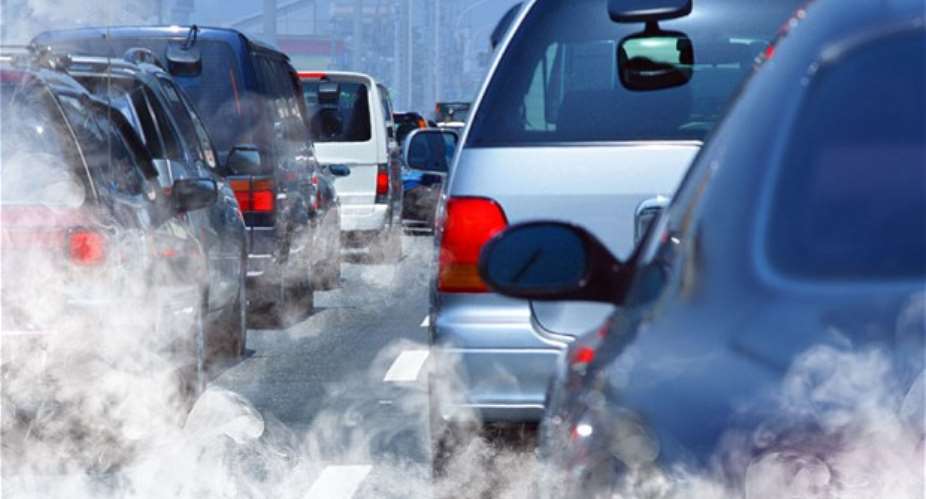
This article will review literature on vehicle emissions and its effects as well as recommendations. My review will be in two parts; with the first part drawing mainly from the work of Wargo et al (2006), to dissect the effects of vehicle emissions; whilst the second will focus on some recommendations drawing from the work of the same author and Atibila A. F. (2011)
One of the greatest challenges the human race is confronted with in the 21st century is that of global warming and climate change effect which is mainly caused by emission of dangerous gasses into the atmosphere. Exhaust gas has been known to be one of the gasses that pollute the air more often than not due to the increase in demand for the use of motor vehicles in the world at large.
Indeed, according to Esi Nerhuaye Tetteh Nerquaye, a Deputy Director of EPA in Ghana, Ghana for example which had a little over five hundred thousand (500,000) registered vehicles in 2000 reached over one million (1,000,000) registered vehicles in 2009.
In ‘Harmful Effects of Vehicle Exhaust: A Case for Policy Change’, Wargo et al after a research in Connecticut has outlined some of the effects of vehicle exhaust on the human race and the environment at large. The list two main groups in society who are mostly at risk as a result of exhaust gas; thus children and the elderly.
Wargo et al contend that, certain illnesses are exacerbated by air pollution caused by exhaust gas. These illnesses include “cardiovascular diseases, chronic obstructive pulmonary disease, lung cancer, diabetes and asthma”. They say, scientists have concluded that, “chemicals in exhaust are harmful... can adversely affect lung function and many promote allergic reactions and airway restrictions”.
They go on to look at the laws and regulations in Connecticut and pointed out some air quality monitoring deficiencies. They went on further to explain how the used the Photochemical Assessment Modeling (PAM) to gauge air pollution.
Furthermore, they do well in my opinion to go beyond just illuminating the harmful effects of exhaust gas, but then also list some initiatives being undertaken to solve the problem of vehicle emissions. Their research revealed that, countries such as the United States of America, Japan and Canada have “anti-idling policies” and have launched massive campaigns to promote anti-idling and remind drivers to turn off their cars if they are stopped for more than 10 seconds. This is done because of the belief that, millions of tons of carbon dioxide can be prevented from entering the atmosphere if drivers avoid idling for five minutes every day of the year.
They go on further to list their own recommendation to cut down on vehicle emissions on our roads. Their first recommendation is that, the government should “adopt standards that encourage the production and sale of more fuel-efficient cars…” Secondly, “government should allow… tax deductions for hybrids and fuel-efficient vehicles, while increasing taxes on vehicles that use excessive amounts of fuel”. Also, “funds and incentives should be increased to provide effective and efficient public transportation options”. Fourthly, government “should adopt regulations that prohibit the unnecessary idling of all vehicles”.
Beynd these, Wargo et al believe individuals have a role to play in reducing harmful emissions and suggest that, “when buying a car, consider the following:
(1) Check the posted fuel-efficiency rating. The greater the efficiency, the lower the carbon dioxide emissions per mile. (2) Older cars pollute more. When buying a used car, have a mechanic check the catalytic converter and other pollution controls to be sure they are working properly. Be sure to keep the vehicle well-maintained”. Also, “reduce the number of vehicle miles traveled by carpooling, using public transportation, and planning ahead. One person, using mass transit for an entire year instead of driving to work, can reduce reduce hydrocarbon emissions by 9.1 pounds, carbon monoxide by 62.5 pounds, and nitrogen oxides by 4.9 pounds”.
Although Wargo et al’s work is commendable in many respects; it fails woefully to highlight the effects the emissions from vehicles have on the environment and animals also. He seems to focus on the direct effects on humans alone in terms of our health to the neglect of the environment we find ourselves in.
Another scholar who gives a recommendation more suited to the case of Ghana is Atibila F.A (2011), who contends that, scheduled inspection and preventive maintenance on vehicles can help reduce the harmful effects of exhaust gas. In his work “Effect ff Scheduled Inspection and Preventive Maintenance on Exhaust Emissions and Fuel Economy”, he argues that scheduled inspection and preventive maintenance do not only yield environmental benefits by reducing greenhouse gas such as carbon dioxide (CO2), and other pollutants like particulate matter measuring 10μm (PM10), Sulfur Dioxide (SO2), Nitrogen Dioxide (NO2), Carbon Monoxide (CO), Ozone (O3), Lead (Pb) in PM10, and Manganese (Mn) in PM10 but also confer substantial financial benefitsbrought about through improvement in engine efficiency, reducing maintenance and repair (M&R) costs over time, and increased operating longevity.
Atibila conducted a research in three workshops in Ghana and found out that, two were found to be non-compliant with their own scheduled inspection and preventive maintenance schedules due to lack of finances.
Vehicle emissions or exhaust gas has been established by this paper to be harmful in a lot of respects, and scholars agree it must be dealt with. Several ways exist to stop them including legislation, taxation and sensitization, but some of these methods are costly and more difficult to implement than others and thus countries have to look at themselves and their ability in terms of financial wherewithal and take the best decision to reduce these emissions.
The Author Albert Opare is a political science graduate from the University of Ghana and a social commentator as well as a social & political activist. You can contact the author by mail on [email protected] or txt on 0575125101. Comments and Criticisms are welcome
REFERENCES
Atibila, A. F. (2011). Effect of Scheduled Inspection and Preventive Maintenance on Exhaust Emissions and Fuel Economy. Retrieved 18th September, 2015. From ir.knust.edu.gh/bitstream/.../FRANCIS%20AKABOTI%20ATIBILA.pdf
Esi, N. (2010). Vehicular Emissions Reduction Programme in Ghana. Retrieved 18th September, 2015. From www.unep.org/transport/pcfv/PDF/Abidjan_9GHANA.pdf
Wargo, J. et al. (2006). The Harmful Effects of Eehicle Exhaust: A Case for Policy Change. Retrieved 18th September, 2015. From www.ehhi.org/reports/exhaust/

 Site for Adaklu District 24-hour economy market handed over to contractor
 Govt to complete over 1,000MW power expansion in Kumasi — John Jinapor
 Amin Adam made co-chair of Buwumia's Finance and Economy Committee
 NPP appoints Akosua Manu as spokesperson for gender and social protection commit...
 GHS activates national surveillance following hantavirus outbreak on Cape Verde ...
 South Africa denies xenophobia claims as Ghana pushes AU action
 Kennedy Agyapong rejects co-chair appointment by Bawumia
 Police arrest six suspects over alleged child trafficking syndicate in Kasoa
 Former Deputy AG urges GJA to resist return to ‘Culture of Silence’
 Four killed in Savannah Region road crash involving tipper truck


