




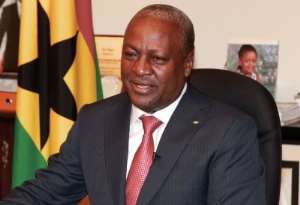
HIS EXCELLENCY THE PRESIDENT, MR JOHN MAHAMA ORDER OF THE CLANGING CYMBAL (FIRST DIVISION
Your Excellency,
You are the Fount of Honour in Ghana.
You are custodian of the National Purse.
Such responsibilities would weigh heavily on the minds of most people.
But you, Sir, do not appear to worry about much.
Your left and went to spend Christmas in Dubai. Whilst the fellow citizens you left behind were working out the implications of new fuel prices, a new VAT rate, higher prices for water and electricity.
Every palm wine and akpeteshie bar; every restaurant and fufuo and tuo joint; every shade tree under which draughts or oware is played; every dusty ground that is breeding the next Muntari; every hospital waiting area and every market bargaining corner, was awash with intense discussion of your Government's incredible deeds:
Was it really true that the same Zoomlion that woefully cannot collect Accra's refuse, was allowed to form companies that obtained lucrative contracts under GYEEDA?
Did amounts disbursed by GYEEDA to so-called contractors for no work done really amount to hundreds of millions of Cedis?
Did SADA really spend millions on the non-breeding of guinea fowls?
And whilst GYEEDA and SADA were still on everyone's lips, did your Government's Revenue Authority really dispense scores of millions of Cedis to a company which had not yet collected a penny's tax for the Authority?
On your return from Dubai, Your Excellency met representatives of the media.
You were expected to have been briefed beforehand on issues such as those above, by the state agencies that listen to how Ghanaians talk, and supposedly tell you about it.
But when the media put these issued to you (in “batches” of questions that could not be followed up!) you resorted to your usual generalities.
The Attorney-General had been tasked to look into any possible corruption.
The Attorney-General was discussing how moneys wrongly paid by beneficiary companies could be refunded.
EOCO was also looking into some of the payments to ascertain those that were wrongly paid.
We are in a democracy, so you “cannot arrest” the people to whom money has been improperly paid, you further said.
You hate corruption, you claimed. Because corruption amounts to mass murder.
Corruption amounts to mass murder? And you cannot arrest people suspected of “mass murder”?
Which lawyer told you that? Mr T.... ?
Mr President, go to any police station in the country. Go to the counter-back and ask some of the people you see, why they are languishing there.
You will hear, Sir, things like “my master said 130 Cedis had vanished from his bag and he thinks I stole it!!”
“The police stopped my taxi and I could not produce my driving licence and they said I didn't have one, so they put me at counter-back!”
“A fraud complaint against me is yet to go to court, but the police said I would interfere with witnesses if I was bailed, so they put me at counter-back.”
Mr President, people who are SUSPECFTED of committing such minor crimes, fill the jails and even prisons of this country. But those who are suspected – in your own words – of committing crimes that amount to mass murder, to wit, stealing huge public funds that could be used to: buy medicine for our hospitals; buy books for our school children and students; repair the roads that are used by lorries to bring food to markets and also promote other economic activities by making it easier to move from one town to another; provide the funds that can make it easier for our security organisations to protect us; buy the correct type of vehicles to collect rubbish from our cities' streets and prevent the gutters from stinking to high heaven; buy pumps and other machinery that can dig boreholes to provide our rural dwellers with water, or beef up the water supplies of urban areas like Takoradi (which today, is learning what the residents of Ashale Botwe and other areas of Accra have known for years, namely, that publicly-supplied water is a luxury to be enjoyed only by a few! ....
\
Mr President, the failure of your Government, through pilfering of funds, to provide funds for any of these services (and I can, of necessity, name but a few!) is what amounts to the “mass murder” you talked about but which, I dare-say, you never really intended to highlight in detail. “Corruption equals mass murder!”-- what an Orwellian phrase, you must have said to yourself -- “I must use it!”
It sticks in the mind all right, Mr President. And it is what will be used to judge the performance of your Government.
You can see huge sums of money pocketed from Government coffers in a myriad of corrupt contracts and other operations. But you only attack the culprits with your lips.
Meanwhile, your country is dying under your feet. There is high inflation. That is not unrelated to the fact that the budget-deficit-to-GNP ratio is also quite high. And the Cedi's value is declining – at a percentage per annum in the unpleasant neighborhood of double digits!
\But all you ever do, Mr President, is to say, I will do this! I will do that!
Almost everything you say relates to the future. You never say, “Countrymen, I am happy to report to you that yesterday, my Government, using INTERPOL,did bring down from abroad, Mr X or Mr Y, or Mr Z, whom we suspect to have defrauded the people of Ghana of x millions of Cedis". Or, “I have today ordered that all negotiations over the sale of Trenchzant Bank should cease forthwith until public expressions of disquiet over the sale have been fully examined and dispelled. Any lack of transparency, over the proposed sale, cannot be tolerated..”
For assuming that you can rule Ghana by words that are not backed by concrete deeds, when your own father was a member of a Ghanaian Government that gave us free education, built Tema Harbour and the Akosombo Dam, created the Accra-Tema Motorway and other projects that showed it to be an ACTI0N GOVERNMENT;
And IN PARTICULAR, for failing to have the notorious deadly 31-km section of the Accra-Kumase road completed;
I hereby award you the Order of the Clanging Cymbal, First Class Division.
(By the way: Translation of “Clanging Cymbal” -- for those who are challenged in English – is “Empty barrels make the most noise!”

 How tipper truck killed UCC lecturer and his TA in their vehicle parked
 UCC TA killed alongside lecturer graduated as best student of Geography Departme...
 UCC mourns lecturer and teaching assistant killed in road crash
 NPP should be the last to speak on recent power crisis — Akwatia MP
 Our client will not retract gay allegations against Ntim Fordjour - Angel Maxine...
 Calls for Energy Minister's resignation baseless — Steve Manteaw
 President Mahama has not gagged free expression — Shamima Muslim
 Ghanaians wish Bawumia is currently the President — NPP communicator
 Fourth Akosombo unit restored as power recovery efforts intensify
 King Charles and Trump toast ties despite Iran tensions


