




Before his death, there was much dissatisfaction with the president – now a new man has to try to hold the nation together.
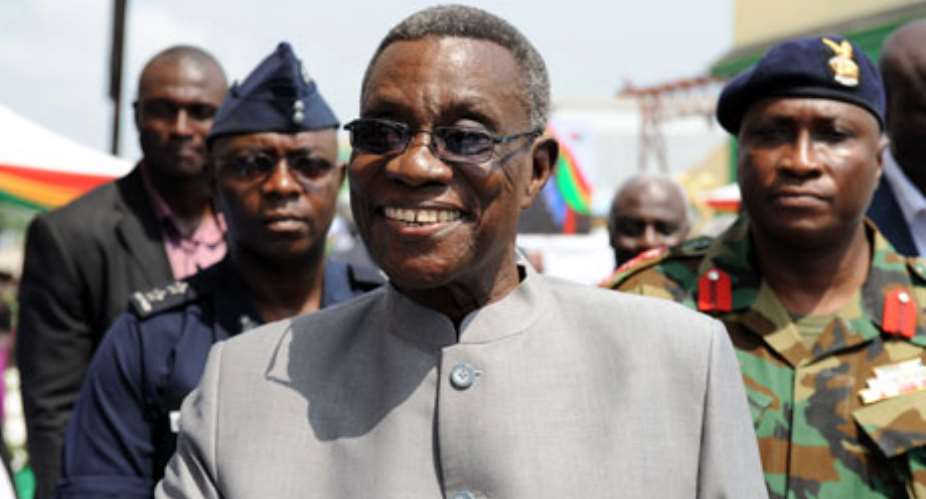
'Death has enabled John Atta Mills to hand over the headache of rehabilitating public amenities to the new president.' Photograph: Pius Utomi Ekpei/AFP/Getty Images
The outpouring of grief that has gripped Ghana following the death of President John Atta Mills this week was so great it would have surprised the man himself were he in a position to see it.
There have been numerous anecdotes on how humanitarian he was. And even his former boss, ex-president Jerry Rawlings, described Mills as “the finest”. Rawlings revealed that Mills died from cancer and intimated that had Mills been “more wisely” advised, he would have avoided campaigning for the elections scheduled for December 2012, as the cancer had affected “his throat and eyes”.
Rawlings, though, had made no secret of his desire that Mills should step down in favour of his wife, Nana Konadu Agyeman Rawlings, as the candidate of the ruling National Democratic Congress in the December 2012 election. The NDC was founded by Rawlings when he needed to transform himself from a military ruler (1981-1992) into a civilian president (1992-2000), but Mills eventually took control of the party.
On one occasion, while recoiling from criticism by Rawlings that his government was so incompetent that it should be classified as a “Team B” government, Mills reminded Rawlings: “There is only one president in Ghana.”
Nevertheless, even though Rawlings had an axe to grind, dissatisfaction with Mills's performance was real enough among the populace. Although the start of petroleum production has increased the country's gross national product, very little of this has trickled down to the people.
According to the World Bank, Ghana's GDP grew by 14% in 2011. But power shortages and the lack of water, even in urban areas, provoke people to ask “where is this growth?”
And Ghanaians have recently discovered, to their shock, that state revenue can be shared between politicians and their cronies – by the simple act of government lawyers knowingly refusing to defend the state in court when contractors make fraudulent claims against it. In one case now before the courts, a contractor and two government lawyers are charged with concocting a “judgment debt” from a lawsuit, in which the state was made to pay the contractor about £20m.
Those angered by this include the unemployed, whose ranks are being swelled by young new graduates, and the parents in rural areas whose children have to attend school under the shade of trees. Also, health facilities are so unsatisfactory that Mills often went to America or South Africa to obtain treatment.
Death has enabled him to hand over the headache of rehabilitating public amenities to the new president, John Dramani Mahama. However,Mahama's own immediate concerns will revolve more around how he manages to meet the challenge posed by the Rawlings family than around national policies.
Already, there is a great deal of acrimony in the struggle between the NDC and the New Patriotic party over the December election. That is because they are evenly matched in the polls: the December 2008 election, for instance, was won by Mills by a few thousand votes.
Mahama has only five months to prove that he can hold the country – and his party – tightly together. He would have wished, though, that he'd been given the task at a more auspicious time.

 BoG's $260 million building: It was Ato Forson who first proposed 'sell-and-leas...
 'We have to do soul-searching' — Mahama orders nationwide flood assessment
 Court orders woman beater to pay GHS5,000 compensation to midwife at Tema Commun...
 Over 12,000 women living with obstetric fistula in Ghana — Asokwa MP
 Mahama secures 1,840 farm equipment deal from Belarus
 Titus Glover slams Mahama’s flood report directive, calls it “waste of energy an...
 We have increased posting of doctors from 12 to 100 to underserved regions in 20...
 'You had the effrontery to call me struggling lawyer, you won't come back to pow...
 Belarus manufacturers to storm Ghana next week after President's visit
 Government to offer tax incentives for factories located outside Accra


