




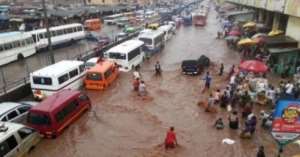
ACCRA, Ghana the Ghanaian capital woke on Monday, 29 June 2026, not to the familiar rhythms of the morning rush, but to a city under siege from its own skies. Torrential rains that had begun sweeping across the Greater Accra Region late on Sunday, 28 June, intensified overnight and continued unrelenting into the early hours of the working week, unleashing scenes of chaos, displacement, and tragedy that once again exposed the chronic vulnerabilities of West Africa's most populous city.
By the time commuters attempted to begin their journeys to offices, markets, schools, and factories, much of Accra had already been transformed into a network of rivers the streets swallowed by rising floodwaters that submerged vehicles, breached homes, and turned residential neighborhoods into desperate emergency zones. The events of that morning were not merely meteorological misfortune. They were the culmination of decades of institutional neglect, dysfunctional urban planning, and a governance failure that continues to punish the city's most vulnerable residents season after devastating season.
A City Swallowed: The Scale of Devastation
The extent of the flooding that paralyzed Accra on Monday morning was staggering in its reach. According to reports compiled by Citi Newsroom, GhanaWeb, and the Ghana News Agency, flooding was recorded in virtually every major corridor of the capital. Sections of the N1 Highway the arterial spine connecting Greater Accra to the rest of the country were submerged, bringing traffic to a complete standstill. The Accra–Kasoa stretch and surrounding communities at Weija were rendered nearly impassable, with water levels described by road users as dangerously high.
In the central districts, the situation was equally grim. Apenkwa towards Tesano, Adabraka, Achimota, Kaneshie, Darkuman Junction, and significant portions of the Kwame Nkrumah Interchange one of Accra's busiest transport nodes were all submerged. Spintex Road in the east, Atomic Junction at Madina, the Tse Addo–Teshie bush road, the LEKMA–Kofi Annan stretch, and the Tema–Accra Beach Road were reported impassable. Dzorwulu's pig-farm-to-Achimota-Forest stretch caused severe gridlock. Bridges at Tse Addo's Kor Bridge and the GNAT Road were flooded. The entire GREDA Estate was reported sealed off with no motorable exit by morning.
In low-lying residential communities, the human toll moved beyond traffic inconvenience. Homes and shops in flood-prone neighborhoods from Afienya to Odaw, from Avenor to Dansoman, were inundated. Families waded through waist-deep water, salvaging whatever belongings they could carry to higher ground, while some remained trapped, unable to move safely through the currents that had claimed their streets.
The Compound Catastrophe: Fire, Electrocution, and Power Failure
As if the flooding were not sufficient crisis, Monday's disaster spiralled into a compound catastrophe that underscored just how ill-equipped the city remains to manage concurrent emergencies. GhanaWeb reported that at approximately 8:15 in the morning, a fire broke out at the Odawna/Okaishie Rubber Market area in central Accra even as floodwaters continued to rise around it. The juxtaposition of fire and flood in the same neighborhood at the same hour captured the surreal and dangerous character of the morning.
More gravely, at least one person was confirmed dead. According to Adom Online and classfmonline.com, the deceased a man in the Adabraka area was electrocuted while inside his home, attempting to pack his belongings as floodwaters rose around him. The National Disaster Management Organization (NADMO) confirmed the fatality. The Municipal NADMO Coordinator, Mr. Daniel Odei, stated that the tragedy was directly attributable to a delayed response from the Electricity Company of Ghana (ECG), which failed to cut power to the flood-affected zone despite receiving distress calls as the rains began. The death underlines a recurring and lethal pattern: in Accra's flood disasters, the secondary hazard of live electricity in rising water claims lives that drainage engineering cannot excuse.
Power outages cascaded across multiple districts. Pulse Ghana reported that flooding triggered an emergency shutdown at key GRIDCo and ECG substations in Mallam and Achimota a protective measure, but one that plunged thousands of already distressed homes and businesses into darkness.
The State Responds: Operation Boafo and NADMO Activation
By mid-morning, the state had mobilized. MyJoyOnline reported that the Ghana Armed Forces activated a rescue operation codenamed Operation Boafo, deploying personnel from the 48 Engineer Regiment to flood-prone communities across the capital. The Commanding Officer, Lieutenant Colonel Frank Osei Amponsah, confirmed that troops had been stationed at strategic locations including Klagon, Tse Addo, Dzorwulu, and surrounding communities. By mid-morning, at least 20 persons had been rescued from their homes.
NADMO issued a formal flood alert at 7:30 a.m. covering Accra, Tema, and Kasoa. The organization’s Director of the Inspectorate Division, Richard Amuyatey, urged the public to remain indoors and avoid all contact with floodwaters. 'We are on the ground, and so we are responding to all. What they need is to stay indoors where they are to stay safe,' he stated, as reported by The Ghana Report. The national emergency lines 112 and 0302964884 were broadcast widely for residents in distress.
The Interior Minister advised Ghanaians to remain in place until conditions improved. Vice President Mahamudu Bawumia extended sympathy to victims and called for swift emergency response and public cooperation with authorities.
The Meteorological Warning: A Storm Forecast Ignored
Monday's flooding did not arrive without forewarning. The Ghana Meteorological Agency (GMet) had in the days proceeding 29 June issued alerts predicting heavy rainfall across southern Ghana, including coastal and inland areas of the Greater Accra Region. YEN.com.gh reported that GMet had warned of thunderstorms and intense rainfall, with a storm system from the Togo-Benin coast expected to intensify conditions. The agency's forecast proved grimly accurate. The rains that began late Sunday continued without meaningful pause, and by Monday morning the cumulative effect of hours of precipitation on saturated ground, blocked drainage channels, and through a city whose infrastructure simply cannot absorb the volume of water it regularly receives had produced the predictable catastrophe.
An Old Problem Without New Solutions
Ghana's capital has flooded every rainy season for as long as most of its residents can remember. The structural reasons are exhaustively documented: inadequate and poorly maintained drainage systems, indiscriminate solid waste disposal that clogs gutters and channels, encroachment on natural waterways and floodplains by unchecked residential and commercial construction, and rapid urban population growth that has far outpaced any corresponding investment in storm water infrastructure.
ModernGhana and other outlets noted that the cancellation of the Zoomlion sanitation contract has been cited as a factor worsening Accra's flooding situation. Whether or not that specific contractual decision bears direct responsibility, it speaks to a broader pattern in which drainage management is treated as expendable rather than essential. Beyond Ghana's borders, MyJoyOnline reported that parts of Lomé, the capital of Togo, were simultaneously experiencing flooding, confirming that Monday's chaos was part of a broader coastal weather system affecting the Gulf of Guinea littoral.
The Political Accountability Question
As images of submerged cars, stranded commuters, and families wading through chest-deep water circulated on social media, public anger intensified rapidly. Broadcaster Nana Aba Anamoah called out Greater Accra Minister Linda Ocloo directly over the floods, according to YEN.com.gh, with observers reacting sharply to the question of accountability.
The political dimension of Accra's flooding is inescapable. Each rainy season, emergency declarations follow emergency declarations. Investigations are promised. Contractors are summoned. Engineers are consulted. Yet the waters return with the rains, and the same communities are submerged, and the same emergency lines are broadcast, and the same lives are disrupted or lost. The problem is not technical ignorance Ghanaian engineers, urban planners, and hydrologists understand precisely what needs to be done. The problem is political will, budget prioritization, and the institutional continuity needed to execute multi-year infrastructure investments across changes of government.
Conclusion: Beyond Emergency Response
When the floodwaters of 29 June 2026 eventually recede, as they always do, Accra will once again begin the familiar process of tallying damage, burying its dead, and resuming life as if the episode were an act of God rather than the predictable consequence of institutional decisions made across decades. But the citizens of Accra from the wealthiest neighborhoods to the most flood-prone communities of Dansoman and Afienya deserve better than an emergency response cycle that never graduates into permanent prevention.
What is required is not sympathy or emergency operations, vital as those are in the immediate term. What is required is a funded, long-term, technically rigorous, and politically sustained commitment to transforming Accra's storm water infrastructure from a network that drowns the city every year into one that actually protects it. The flooding of 29 June 2026 was entirely predictable and, in the deepest sense, entirely preventable. The rains did not paralyse Accra a failure of governance did.
Mustapha Bature Sallama.
Medical/ Science Communicator,
Private Investigator, Criminal investigation and Intelligence Analysis.
International Conflict Management and Peace Building.USIP
[email protected]
+233-555-275-88
References
Citi Newsroom. (29 June 2026). Heavy rains flood parts of Accra, disrupt morning commute. https://www.citinewsroom.com/2026/06/heavy-rains-flood-parts-of-accra-disrupt-morning-commute/
GhanaWeb. (29 June 2026). Here are areas badly hit by Accra floods after heavy rains. https://www.ghanaweb.com/GhanaHomePage/NewsArchive/Here-are-areas-badly-hit-by-Accra-floods-after-heavy-rains-2041010
GhanaWeb. (29 June 2026). Parts of Accra hit by floods, fire and power outages during June 29 downpour. https://www.ghanaweb.com/GhanaHomePage/NewsArchive/Parts-of-Accra-hit-by-floods-fire-and-power-outages-during-June-29-downpour-2041029
YEN.com.gh. (29 June 2026). Heavy Rains Flood Accra Streets, Disrupt Commuters and Residents on Monday Morning. https://yen.com.gh/ghana/306997-heavy-rains-flood-accra-streets-disrupt-commuters-residents-monday-morning/
ModernGhana. (29 June 2026). Torrential Rains Flood Accra: Major Roads Submerged, Commuters Stranded in Monday Chaos. https://www.modernghana.com/news/1506261/torrential-rains-flood-accra-major-roads-submerge.html
MyJoyOnline. (29 June 2026). GAF deploy troops to flood-hit communities in Accra under 'Operation Boafo'. https://www.myjoyonline.com/gaf-deploy-troops-to-flood-hit-communities-in-accra-under-operation-boafo/
after Monday morning rains. https://www.pulse.com.gh/story/nadmo-issues-flood-alert-for-3-major-areas-2026062908290306215
The Ghana Report. (29 June 2026). Flooding in Accra leaves many stranded. https://theghanareport.com/news/flooding-in-accra-leaves-many-stranded/
The Ghana Report. (29 June 2026). Do not attempt to navigate through floodwaters – NADMO cautions. https://theghanareport.com/news/do-not-attempt-to-navigate-through-floodwaters-nadmo-cautions/
Adom Online. (29 June 2026). One dead as military, NADMO move to rescue Accra flood victims. https://www.adomonline.com/one-dead-as-military-nadmo-move-to-rescue-accra-flood-victims-video/
classfmonline.com. (29 June 2026). NADMO confirms electrocution death during Accra downpour. https://www.classfmonline.com/news/NADMO-confirms-electrocution-death-during-Accra-downpour-75994
ModernGhana. (29 June 2026). Don't drive or walk through floods – NADMO advises Accra, Tema and Kasoa residents. https://www.modernghana.com/news/1506276/dont-drive-or-walk-through-floods-nadmo-advi.html
Ghana Politics Online. (29 June 2026). Heavy Rains Flood Accra, Submerge Major Roads and Disrupt Morning Commute. https://ghanapoliticsonline.com/2026/06/29/heavy-rains-flood-accra-submerge-major-roads-and-disrupt-morning-commute/
AmaGhanaOnline. (29 June 2026). Flood Alert: Last Days of June as Accra Gets Worse. https://amaghanaonline.com/2026/06/29/flood-alert-last-days-of-june-as-accra-gets-worse/


 Interior Minister proposes mandatory drug testing for public sector recruits
 GPHA plans £101million floating dock project to strengthen Ghana’s maritime indu...
 US$270million poultry project to cut chicken imports
 Govt launches GHS598m electrification project for 206 Volta communities
 Bolgatanga Girls SHS restores boarding status of student in alleged sexually abu...
 11 arrested as Police-military team seizes gun, ammunition at Kromase
 ‘Remain focused’ — NDC Regional Chairmen declare support for Sammy Gyamfi over $...
 DVLA to begin producing and embossing vehicle number plates locally
 Stop begging tourists for tips, It damages Ghana’s image - Mahama
 “They beat me with cable wire” — Carpenter accuses Sandema soldiers of assault

