




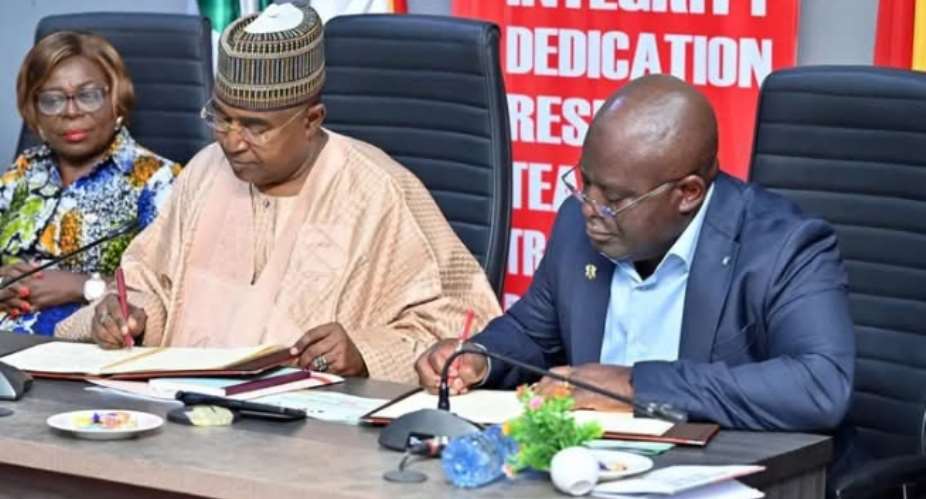
In a landmark show of regional solidarity, Nigeria and Ghana have formalized a strategic alliance to combat transnational drug trafficking, sending a direct warning to criminal cartels operating across West Africa. The partnership, sealed with the signing of a Memorandum of Understanding (MoU), marks a major step toward unified law enforcement across the sub-region.
The Partnership
Nigeria and Ghana have strengthened bilateral cooperation in the fight against drug trafficking and transnational organized crime, with both countries pledging a more coordinated and aggressive response to the menace across West Africa.
The National Drug Law Enforcement Agency (NDLEA) Chairman, Mohamed Buba Marwa, made this known while hosting a delegation from Ghana's Narcotics Control Commission (NACOC) at the agency's headquarters in Abuja. The Ghanaian delegation, led by its Director-General, Maxwell Obuba Mantey, was in Nigeria on a study tour to understand the operational model of the NDLEA and explore areas of enhanced collaboration.
The MoU
A major highlight of the visit was the signing of a Memorandum of Understanding between the NDLEA and NACOC to combat the illicit production of psychotropic substances, their precursors, and related money laundering activities. Marwa described the agreement as a critical step toward establishing a structured and unified front against drug trafficking in the sub-region.
He noted that closer collaboration in intelligence-led operations, interdiction strategies, and digital forensics would significantly shrink the operational space available to criminal syndicates.
A Warning to Cartels
Marwa issued a direct warning: "We will continue to innovate, collaborate, and dominate the tactical space until our streets and communities are safe. Let this visit serve as a warning to those who seek to destabilize our societies with illicit drugs Nigeria and Ghana stand united."
He further stressed that the growing sophistication of drug is trafficking and its links to money laundering demand deeper regional collaboration, describing the visit as a strategic step beyond mere diplomacy.
Ghana's Shifting Drug Landscape
The NACOC Director-General highlighted an alarming development back home, noting a shift in Ghana's role from being primarily a transit point for illicit drugs to now experiencing increased domestic consumption and distribution a development that has heightened the urgency for coordinated action.
Mantey also emphasized that the new MoU must result in "measurable outcomes" rather than remaining a symbolic gesture, calling for intensified intelligence sharing and coordinated joint operations to tackle the linkages between narcotics and other forms of organized crime. He stressed: "The true value of this partnership will be defined not by what we sign, but by what we implement."
Evolving Threat Landscape
Mantey warned that drug trafficking across West Africa is becoming more complex, with traffickers adopting advanced methods, expanding maritime routes, and increasing the production and distribution of synthetic drugs.
"No single country can effectively address this threat in isolation," he said, underscoring the need for practical cooperation in operations, intelligence sharing, and institutional capacity building.
Building on Existing Foundations
This bilateral pact builds on earlier multilateral momentum. Earlier in February 2026, officers from Ghana, Nigeria, and Kenya graduated together from the United States Drug Enforcement Administration (DEA) Training Academy in Quantico, Virginia, in an intensive programme under the theme "Different nations, shared duty, one fight," focused on building capacity to handle sensitive assignments related to organized crime and illicit drug trafficking.
In November 2025, a high-level international dialogue held in Accra resulted in the adoption of the "Accra Call to Action on Drug Markets in West Africa," committing nations to a more effective and strategic set of responses that puts health, human rights, and the rule of law at its core.
What Comes Next
With cartels growing bolder and more technologically sophisticated, the Nigeria–Ghana pact represents a recognition that fragmented national responses are no longer sufficient. Joint operations, shared intelligence databases, and cross-border training are expected to follow.
The region is watching to see whether this agreement translates into tangible arrests, seizures, and the dismantling of criminal networks that have long exploited West Africa's porous borders.
Mustapha Bature Sallama.
Medical/ Science Communicator,
Private Investigator, Criminal investigation and Intelligence Analysis.
International Conflict Management and Peace Building.USIP
[email protected]
+233-555-275-880


 Appointment of Emelia Agbenyo as EC deputy chair was well calculated, reasoned –...
 Relief for students as GAUA and TUSAAG call off strike; declare return to work o...
 Who gave Cabinet authority to decide for Ghanaians to join BRICS without parliam...
 Mahama urges Ghanaian businesses to tap CSIR innovations
 Partisan EC appointments could set dangerous precedent — NPP's Kamaldeen
 Winneba: Afenyo-Markin commissions police apartments at Fetteh-Osakam
 Council of State failed Mahama over Emelia Agbenyo’s EC appointment – Prof. Asa...
 CDD‑Ghana: EC Deputy Chair Should Step Down Now
 Family Announces October 23 Memorial Mass for Nana Konadu Agyeman-Rawlings
 Eduwatch Urges Nationwide Audit of Sexual Misconduct in Secondary Schools


