




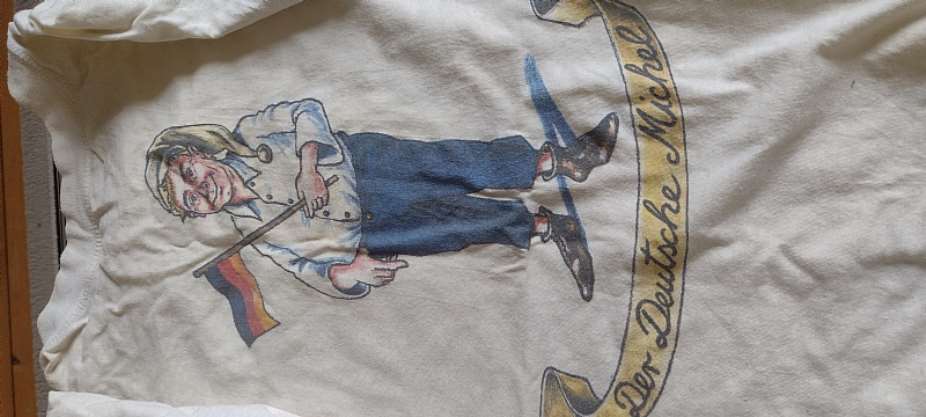
The other autobiography
So let me tell you....“
„Before you start sharing this part of your life with us, let us first have more information about Der Deutsche Michel,“ asked Tobias Wittmann. He lay down on the grass to be in a better mood for what was about to come.
„Really?“
„Yes, please...really?“ answered Tobias Wittmann, seeing that the rest of them agreed. All eyes on me.
„I thought this would not interest anyone,“ was my surprised response.
„It interests us...that is what matters here,“ replied Tobias Wittmann, full of confidence. He asked Frieda Schöngruber to add more wood to the fire for more time at the campfire of storytelling.
„You are certainly aware that, unlike countries such as the UK, France, Denmark, or Sweden, we here in Germany are a country and not a nation. In our history, we never had any moment for longer than one that ushered us from a country into the status of a nation. Just like in Africa, where you will not find countries you can seriously call a nation, but only a country. Nation-building in Africa is an ongoing process, and as things stand now in the history of the African continent, this process will be cut short. African Union is a dream...Sorry, I get carried away. Let`s go back to Germany.
The reason for my having left Germany wanting to stay in the UK for good is based on the fact that many of us cannot say we are Germans. I can proudly say I am a Hamburger, others Berliners, Düsseldorfers, Esseners, and so on, reflecting the region they come from. To go out and proudly say someone is a German for many of us deeply conscious about Germany and its past, not only the Third Reich, is challenging, not so for the French or British, and very natural for Scandinavians. I always have the distinct feeling to have to explain myself abroad with a slight bitter taste while doing so. Germans living life as it is, without reflecting on it, certainly do not face those challenges. Only when you dive deep into what Germany was, is, and will possibly be in the future this problem come to you. For foreigners from the outside, this might look strange, and they will not understand what you are talking about. But it perfectly reflects in the way we treat our Der Deutsche Michel. The Americans have their Uncle Sam, the British John Bull, the Irish St. Patrick, the French Jean D`Arc, and the New Zealanders have their Kiwi. Germans have a much more complex and complicated relationship to their Der Deutsche Michel.
Der Deutsche Michel, by its wording, goes back to archangle Micheal as Michel is the short form of Michael. The archangel Michael is, by definition of German culture, the protector, the guardian angel of the Germans. When someone is labelled Der Deutsche Michel, it stands for the highest possible honour. During the Thirty-Year War, the religious war in Europe, from 1618-1648, when the Catholics and Protestants fought for the right belief and religious practices in Europe based on Martin Luther of Wittenberg, a German monk, and his theses nailed at the church of Wittenberg in 1517, demanding a radical change in the doctrines of the Catholic Church, one soldier made history. Born in Stromberg in the Hunsrück along the River Rhine and close to Mainz and Wiesbaden, Oberst Michael Ellias von Obentraut fought for the rights of the Protestants against the armies of the Catholic Church. He, in his later years, served for the King of Denmark in the religious war. When Generals gave up a battlefield as lost, Oberst Michael Ellias von Obentraut stood his ground with his men and kept on fighting. All these you can see in the little museum in his honour in Stromberg. He was highly decorated for bravery. The King of Denmark gave him a state funeral, and his remains can be found today in Seelze near Hanover.
In the seventeenth century, not many people were able to write and write. Information and King`s orders were often communicated by special singers or storytellers travelling the country up and down. Gutenberg had invented the printing machine, which printed Bibles and posters. As always, he hero to better use and explanations is turned into a black and white or colour figure on paper. Someone unknown came up with the image of Der Deutsche Michel, and it gave many artists painting in various places of the Holy Empire of German Descent, which was our place here in Europe. Half of Europe was in the hands of this Empire, which lasted for one thousand years after the fall of the Roman Empire.
To pay tribute to Oberst Michael Ellis von Obentraut, the honourable name Der Deutsche Michel got associated with him. Images of the old von Obentraut see a connection to that effect, even though it must clearly be said that we do not have many records about von Obentraut or the figure Der Deutsche Michel. This is a very difficult subject for any historian. The original versions of the Der Deutsche Michel show a hero, and as it fell in the late eighteenth century in the time of the French Revolution, we often find a Der Deutsche Michel with the Jacobins hat, the hat the radical revolutioonars used for their fight for democracy and human rights. We all know that in 1815, when the Vienna Congress was dancing to find a new order in Europe and assign new borders to the new states, most German royals were no longer able to speak German but only French. French in those days was a very popular language, the language of the modern world, the language of human rights and democracy. Very fashionable. The common German thought spoke local dialect or German. Unlike royals and the clergy able to speak French and Latin, keeping their secrets hidden from the common German, in these two languages, the common German demanded to be ruled over in their language, German. To fight the royals, they used a figure, Der Deutsche Michel. Once again, Der Deutsche Michel entered center stage, not only did it stand for asking the German language to be used in Germany in daily life and certainly in political life for Germans to hear what the people at the top of society had to say, but Der Deutsche Michel also stood in for the protection of German identity, our traditions, our values, and our rules. In the best sense of the word, and meaning it was a fighter for the Germans as they wanted to find themselves not only as Germans in their regions but as Germans on a national stage. Today, we call this process nation-building. Africa is the best present witness of. In most countries, if not all, the common people, due to various historical influences, do not know much about their national identity and what makes them a people. But they know much, or at least something, about the culture and history of their tribe. African leaders have missed out on this vital process to create a figure around which the entire nation can rally. But this is another subject for later.
In the nineteen hundreds, Germany and France fought each other in several wars. When the French saw that they were about to lose the psychological warfare. They wanted to destroy the morale of the German fighters. So they printed the Der Deutsche Michel on little leaflets and dropped them behind the German defence line. The image they used was of a sleepy Der Deutsche Michel with a nightcap on. The trick they used did not work as France in 1870 was defeated, and the German Kaiserreich German Empire under Kaiser Wilhelm I, King of Prussia, was established. The period until the end of the Weimarer Republic saw Der Deutsche Michel hidden in history, or better to say, not used. It is controversial, but not with evidence to prove either way. Adolf Hitler had tried in his years to use Der Deutsche Michel for his NSDAP movement but dropped the idea quick realiszing the Der Deutsche Michel stands for the honest and correct German in its purest form and not for Germans ready for war and killing millions of Jews and others. During that period, Der Deutsche Michel was buried alive.
After ending WWII, it emerged again during the time of the Wirtschaftswunder in the nineteen sixties. This time, as a sleepy, overweight, corrupted by money, and similar figure in newspapers and newsmagazines. The general German public did not take much notice of them, and when they laughed at the figures drawn in these publications. Even most German intellectuals never heard of Der Deutsche Michel, let alone its meaning. The German elite simply has no interest in dealing with such a figure and again uses it as the cultural identity of Germans. They are busy with other issues that seem to take Germany away from its roots. I personally think this is wrong. Remarkable is that the right-wing party AfD in Germany has no knowledge about Der Deutsche Michel either. When this story can serve for Africa as a negative example to improve on their process of nation building and African Unity...I would be very happy to be honest.“

 Police arrest two as search intensifies for missing couple
 Three Akosombo units restored after fire incident — Energy Ministry
 'Weep not for rude CEOs, weep for your dying nation' – Kwesi Yankah tells Julius...
 UCC lecturer, TA die in accident
 Malaria deaths fall by 98% since 2011 – GHS
 Two-month salary arrears for newly recruited nurses paid — Health Ministry
 'We'll complete all Big Push projects on schedule' — Roads Minister assures
 Voltaian Basin Project: GNPC Explorco engages Yaa Naa, stakeholders ahead of dri...
 Senyo Hosi praises Ayine’s role in OSP creation, urges broader policy approach t...
 PUWU condemns ECG staff transfers, reassignment


