




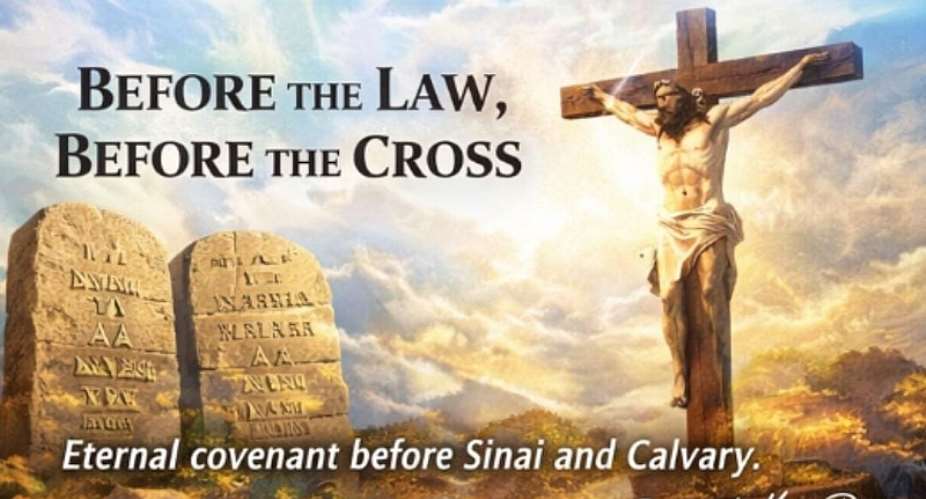
When Redemption Appears Before Religion
For much of religious history, salvation has often been framed through the lens of law, morality, and obedience. Faith communities have frequently assumed that humanity’s relationship with God begins with rules — commandments that define righteousness and expose failure.
Yet the biblical narrative quietly suggests something different.
Long before the Law was given at Sinai, long before the Cross appeared on a hill outside Jerusalem, the Book of Genesis had already introduced the idea that humanity’s relationship with God would ultimately be defined not by regulation but by union.
In this reading, Genesis is not merely the story of origins. It is the architectural sketch of redemption — a design later revealed through Christ.
Before the Law
The Law occupies a central place in the biblical story. Delivered to Moses on Mount Sinai, it became the moral framework for ancient Israel and, for many readers, the starting point for understanding righteousness.
Yet the New Testament makes an important distinction.
In Romans 3:20, the Apostle Paul writes that the Law functions primarily to reveal sin, not to eliminate it. The Law clarifies humanity’s moral distance from God, but it cannot create the union that redemption ultimately promises.
This insight places Genesis in a new light.
Genesis 2:24 — the famous declaration that “a man shall leave his father and mother and be joined to his wife, and the two shall become one flesh” — appears centuries before Sinai.
Union is introduced before commandment.
The sequence is significant. It suggests that belonging precedes regulation. Covenant relationship is not sustained primarily by moral effort but by a deeper relational design.
The Apostle Paul echoes this principle in Galatians 2:16, arguing that humanity is not justified through strict legal observance but through faith.
The Law, in this sense, diagnoses separation.
Genesis quietly announces belonging.
Before the Cross
The Cross stands at the center of Christian history. For believers, the crucifixion of Christ represents the decisive moment of redemption.
Yet the New Testament also suggests that the meaning of the Cross existed long before the event itself.
The Book of Revelation describes Christ as “the Lamb slain from the foundation of the world.”
The statement implies that redemption was not merely a reaction to human failure. It was embedded in the story of creation from the beginning.
One of the most intriguing parallels appears when comparing two passages separated by centuries.
In Genesis 2:21–22, the narrative describes how Adam’s side is opened, and from it a companion — Eve — is formed.
In John 19:34, the Gospel records that Christ’s side is pierced during the crucifixion.
For centuries, theologians have noted the symbolic resonance between these two moments.
| Genesis | Gospel Narrative |
|---|---|
| Adam’s side is opened | Christ’s side is pierced |
| A bride emerges | A redeemed people emerge |
| The first covenant union begins | The new covenant community begins |
These parallels suggest more than coincidence. They reveal a narrative symmetry that runs from the opening chapters of Genesis to the climactic moment of the New Testament.
Seen this way, the Cross becomes not an isolated event but the historical unveiling of a design already present in creation.
The Architecture of Redemption
When the biblical narrative is read in full, its structure becomes striking.
- Genesis introduces union.
- The Law exposes separation.
- The Cross restores relationship.
The movement from creation to redemption follows a pattern that appears intentional rather than accidental.
This does not diminish the moral importance of the Law or the historical reality of the Cross. Instead, it places them within a larger theological framework — one in which humanity’s ultimate destiny is restored communion with God.
For many readers today, this perspective reframes the story of faith.
Redemption is not merely a legal pardon.
It is the restoration of a relationship envisioned from the beginning.
Reflections
“The Cross was not God’s emergency response. It was the unveiling of what creation had already declared — that humanity’s destiny was union with Christ.”


 Appointment of Emelia Agbenyo as EC deputy chair was well calculated, reasoned –...
 Relief for students as GAUA and TUSAAG call off strike; declare return to work o...
 Who gave Cabinet authority to decide for Ghanaians to join BRICS without parliam...
 Mahama urges Ghanaian businesses to tap CSIR innovations
 Partisan EC appointments could set dangerous precedent — NPP's Kamaldeen
 Winneba: Afenyo-Markin commissions police apartments at Fetteh-Osakam
 Council of State failed Mahama over Emelia Agbenyo’s EC appointment – Prof. Asa...
 CDD‑Ghana: EC Deputy Chair Should Step Down Now
 Family Announces October 23 Memorial Mass for Nana Konadu Agyeman-Rawlings
 Eduwatch Urges Nationwide Audit of Sexual Misconduct in Secondary Schools


