




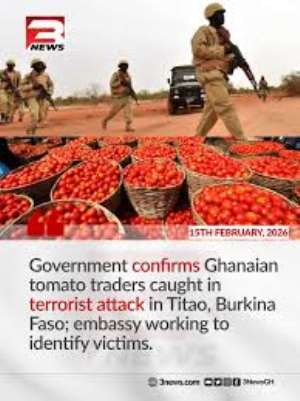
The recent killing of Ghanaian tomato traders in Burkina Faso is a tragedy that demands sobriety, clarity, and leadership. Families are grieving. Communities are shaken. Yet even before the dust has settled, political narratives have begun to compete for attention. In moments like this, we must ask ourselves a difficult question. Are we genuinely seeking the truth, or are we searching for angles? Two prominent political reactions have emerged. On one hand, former Defence Minister Dominic Nitiwul reportedly suggested that Ghanaians who heap praise on Burkina Faso’s leader, Ibrahim Traoré, may have contributed to the atmosphere that led to the killing of the traders. On the other hand, a communicator of the National Democratic Congress (NDC) has blamed the New Patriotic Party (NPP), arguing that if the Pwalugu Dam had been built, Ghana would have produced sufficient tomatoes locally and traders would not have needed to travel to Burkina Faso in the first place. Both arguments are striking. Both are political. And both risk missing the most important question. What actually happened, and who is responsible?
The “Praise for Traoré” Argument
If the suggestion is that public admiration by some Ghanaians for Captain Ibrahim Traoré somehow provoked hostility that resulted in the killing of Ghanaian traders, then that is a serious claim. It implies causation, that online commentary or public praise translated into violent retaliation. But where is the evidence? Admiration for a foreign leader, whether justified or misplaced, is not a crime. It is a matter of opinion. To move from social media praise to deadly violence requires a clear and demonstrable chain of cause and effect. Without credible intelligence or investigative findings linking such praise to the killings, the claim remains speculative. Security matters must be handled with precision. When senior figures make suggestions, the public naturally assumes those suggestions are backed by information. If they are not, such statements risk deepening confusion rather than bringing clarity. Moreover, Burkina Faso has in recent years struggled with severe insecurity, including extremist attacks, armed groups, and cross-border criminality. If the killings occurred within that broader security context, then the explanation may lie in insurgency, banditry, or general instability rather than Ghanaian social media sentiment. Until official investigations establish motive, caution is not weakness; it is responsibility.
The “Pwalugu Dam” Argument
The counterargument from the NDC communicator takes a different route. It links the tragedy to domestic agricultural policy. According to this view, had the Pwalugu Dam been constructed, Ghana would have achieved greater irrigation capacity and tomato production. As a result, traders would not have needed to cross into Burkina Faso to buy tomatoes, thereby avoiding exposure to danger. This argument is structurally different. It does not claim that the NPP pulled a trigger. Rather, it implies that policy inaction created conditions that indirectly led to vulnerability. It is true that agricultural infrastructure matters. Irrigation systems, dams, and food security policies reduce dependency and strengthen domestic supply chains. It is also true that cross-border trade carries risks, especially in regions experiencing instability. But here again, we must separate long-term economic debates from immediate security accountability. If a violent act occurred in Burkina Faso, responsibility first lies with the perpetrators and with the security environment in which it occurred. To leap from that act to an unbuilt dam in Ghana is a stretch that may satisfy partisan instincts but does little to illuminate the immediate cause of the killings. Infrastructure policy is a legitimate subject of debate. However, transforming a security tragedy into a campaign argument risks trivializing the lives lost.
What Do We Actually Know?
At the heart of this discussion lies an uncomfortable truth. We may not yet know enough. Were the traders specifically targeted because they were Ghanaians? Were they victims of generalized violence in a volatile region? Was the attack politically motivated, criminally motivated, or opportunistic? Was it linked to extremist activity? Without clear, verified findings from Burkinabè authorities and Ghanaian security agencies, any confident assignment of blame remains premature. Diplomacy also plays a role. Ghana and Burkina Faso are neighbors with longstanding ties. Governments may be cautious in their public statements while investigations are ongoing. That caution should not be misinterpreted as indifference. At the same time, transparency is crucial. Families deserve answers. The Ghanaian public deserves clarity. If Ghanaians were specifically targeted because of nationality, that is one matter. If they were caught in broader insecurity, that is another. Each scenario demands a different policy response.
The Danger of Politicizing Grief
There is a troubling pattern in our public discourse. Tragedies quickly become political footballs. When lives are lost, our first instinct should be empathy and solidarity. The second should be investigation and fact-finding. The third, and only then, should be policy debate. Reversing that order creates noise instead of solutions. When politicians suggest speculative causes or draw long chains of indirect blame, they may energize their base, but they risk eroding public trust. Citizens begin to see every event through partisan lenses. Serious national security issues become talking points. Leadership demands restraint. Words matter. In volatile regional contexts, careless rhetoric can inflame tensions or misdirect public anger.
A Broader Regional Reality
West Africa is experiencing a period of instability. Several countries in the Sahel have faced insurgencies, military takeovers, and deteriorating security environments. Cross-border trade, once routine and relatively safe, now operates within a more fragile framework. Ghanaian traders, transporters, and businesspeople who operate across borders are contributing to economic integration. They should not have to fear for their lives while engaging in lawful commerce. This reality calls for enhanced regional security cooperation, improved intelligence sharing, and clear travel advisories where necessary. It calls for diplomatic engagement at the highest levels to ensure the protection of citizens abroad. It does not call for premature partisan conclusions.
The Questions We Should Be Asking
Instead of asking which political party to blame, perhaps we should be asking:
- What have investigations revealed about the perpetrators?
- Were security warnings issued prior to the incident?
- What measures are in place to protect Ghanaian traders operating in high-risk areas?
- How can Ghana and Burkina Faso strengthen joint security mechanisms?
- What compensation or support will be provided to affected families?
These questions are constructive. They move us toward accountability and prevention rather than rhetorical sparring.
My Thoughts: A Call for Responsibility
The killing of Ghanaian tomato traders is not a metaphor. It is not a campaign slogan. It is a human tragedy. Blaming social media praise without evidence risks oversimplifying a complex security situation. Blaming an unbuilt dam risks stretching causality beyond credibility. Neither approach honors the seriousness of the loss. What honors the loss is commitment to truth. Let investigations proceed transparently. Let governments communicate clearly. Let regional cooperation be strengthened. And let political actors resist the temptation to score points before facts are established. In moments of tragedy, a nation reveals its maturity. We can choose speculation or we can choose responsibility. We can choose partisan comfort or uncomfortable truth. For the sake of the tomato traders who will never return home, let us choose truth.
FUSEINI ABDULAI BRAIMAH
+233208282575 / +233550558008
[email protected]

 Site for Adaklu District 24-hour economy market handed over to contractor
 Govt to complete over 1,000MW power expansion in Kumasi — John Jinapor
 Amin Adam made co-chair of Buwumia's Finance and Economy Committee
 NPP appoints Akosua Manu as spokesperson for gender and social protection commit...
 GHS activates national surveillance following hantavirus outbreak on Cape Verde ...
 South Africa denies xenophobia claims as Ghana pushes AU action
 Kennedy Agyapong rejects co-chair appointment by Bawumia
 Police arrest six suspects over alleged child trafficking syndicate in Kasoa
 Former Deputy AG urges GJA to resist return to ‘Culture of Silence’
 Four killed in Savannah Region road crash involving tipper truck



Comments
If not because of laziness ,how in a world would a rain forest nation like Ghana will have it's nationals travel to a desert nation to buy vegetables ?
Author's Reply
We must think collectively as a nation and do away with the so-called political party manifestos. Both parties must insist that we have a national policy for all facets of human endeavour.