




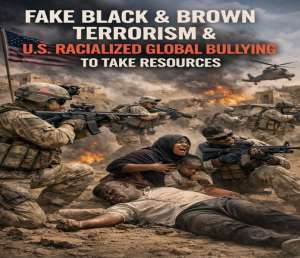
When Violence Puts on a Flag
Violence is universally condemned—until it carries a passport, a press conference, and a preferred skin tone. When a bomb is strapped to a brown body in a poor nation, it is “terrorism.” When that same level of destruction is delivered by a drone, a jet, or a naval fleet under the banner of a wealthy state, it becomes “defense,” “deterrence,” or “democracy promotion.”
The title of this column is deliberate. “Fake Black & Brown Terrorism, Disaster Capitalism, & U.S. Racialized Global Bullying to Take Resources” speaks to three intertwined realities:
- Black and Brown people across the globe are disproportionately labeled as inherent threats. Here are black and brown terrorists, but the ones being killed, blown away on the high seas, and now in Nigeria are not the ones who threaten the existence of the United States. These aren’t fake terrorists, but have no
- U.S. power often behaves like a global bully—deciding what counts as violence, what counts as “legal,” and whose deaths count.
- Crises are regularly used as cover to secure access to resources, not to rescue victims.
Let’s be clear: terrorism is a behavior, not a race or ethnicity. It has no single color, faith, or region; it's not gay, bisexual, or transgender, but it can be rich or poor. Yet the American security narrative consistently cherry-picks its villains. Black and Brown nations are spotlighted, sanctioned, and surveilled. White-majority states and European allies—whose histories are full of conquest, colonization, and mass killing—rarely receive the same branding.
When the perpetrators look like the people who built what we call “the West,” the language shifts: violence becomes “intervention,” coups become “regime change,” and civilian deaths become “collateral damage.” But when the victims are Afghans, Iraqis, Yemenis, Haitians, Nigerians, Mexicans, Sudanese, or Colombians, their resistance is quickly labeled “terror,” even when it emerges from foreign occupation, economic strangulation, or generations of betrayal.Costs of War+1
That is fake Black & Brown terrorism: a selective label slapped on already-marginalized peoples to justify more control.
A Young Empire Playing Global Parent
The United States likes to speak as if it is the world’s elder statesman. Historically, it is not. At barely 250 years old, with fewer than 60 years of broadly enforced civil rights protections, America is still arguing over who counts as fully human.
For most of its existence, the U.S. enslaved, segregated, excluded, and mass-incarcerated Black and Brown bodies. Those weren’t “mistakes”; they were core design features of the system. Only within living memory have laws even tried to extend freedom beyond white, male, property-owning norms. A child nation playing global hall monitor is not leadership; it is projection.
Moral maturity requires at least three things:
- Memory – honest history with truths, not sanitized myth with some facts
- Accountability – owning harm, not outsourcing blame
- Restraint – knowing when not to use power
- Self Control – Saying no to revenge, killing, and the American default to guns
America has struggled with all four.
Scripture warns us about this posture:
“There is a way that seems right to a man,
but its end is the way of death.” (Proverbs 14:12)
“If we say we have no sin, we deceive ourselves,
and the truth is not in us.” (1 John 1:8)
“Pride goes before destruction,
and a haughty spirit before a fall.” (Proverbs 16:18)
These verses are not anti-American; they are anti-arrogance. They remind any nation that confusing power with righteousness is a deadly spiritual and political mistake.
Today, U.S. security agencies themselves admit that the most persistent and lethal terrorist threat to the homeland is not foreign jihadists, but domestic violent extremism—largely white supremacist and anti-government in character.Department of Homeland Security+1
Yet the public face of “terrorism” in American discourse remains overwhelmingly Black, Brown, or Muslim. That gap between data and narrative is not an accident—it is policy, politics, and racial hierarchy at work.
Fentanyl, Borders, and the Manufactured Brown Villain
Consider the fentanyl crisis. Federal reports and enforcement actions have documented how fentanyl precursors originate largely in China and, increasingly, India, and are then processed and moved by transnational criminal organizations, often via Mexico, into the United States.Department of Justice+3DEA+3Congress.gov+3
But the political imagery we are fed is simple and racialized: the “brown trafficker” at the southern border—the poor migrant—becomes the visual villain. The white-collar chemists, financiers, brokers, and logistics networks at the top of the chain are rarely centered in public debate.
If fentanyl were imagined accurately—as a complex web of chemistry, capital, and corruption—white and non-Black actors in labs, boardrooms, and shipping lanes would have to come into focus. Instead, the crisis is framed in ways that justify more militarized policing of Black and Brown communities and harsher border enforcement against Latin American migrants.
As Scripture reminds us:
“The violence of the wicked will destroy them,
because they refuse to do justice.” (Proverbs 21:7)
Refusing to do justice includes refusing to name all of the actors in a system of harm—not just the darkest and poorest.
Disaster Capitalism in Christian Clothing
Nowhere is this racialized selectivity more visible than in the recent U.S. airstrikes in northwest Nigeria. On Christmas Day 2025, the Trump administration ordered cruise-missile strikes on alleged Islamic State targets in Sokoto state, framing the operation as a mission to protect Christians from terror.Reuters+2TIME+2
There is no question that violence against Christians in parts of Nigeria is brutal and very real. Organizations like Open Doors and human rights monitors have documented extremely high levels of deadly attacks on Christian communities in recent years, noting that a majority of Christians killed worldwide in some reporting periods were killed in Nigeria.
But Nigerian officials and many scholars also point out a crucial fact: jihadist and bandit violence in Nigeria kills both Christians and Muslims, and is rooted in overlapping drivers—poverty, corruption, climate stress, and state failure—not a simple “Christian vs. Muslim” storyline.So why is U.S. intervention framed so narrowly around Christian persecution? This is where disaster capitalism enters: create or amplify a moral crisis, inflame fear, declare urgent need for military action, and then move into the region with troops, bases, and bargaining leverage.
Political figures who have shown little concern for Christians struggling in U.S. cities, in Haiti, or in Palestine suddenly discover a burden for persecuted believers in oil- and mineral-rich African regions. The “Christian” language becomes a passport for intervention. The question is not whether Nigerian Christians suffer—they absolutely do. The question is who benefits when their suffering becomes the center of U.S. strategic storytelling.
Uranium, Not “Vibranium”: What’s Really at Stake in West Africa
Look at the map.
- Nigeria is a regional powerhouse with significant oil and gas reserves, as well as a strategic coastline.
- Niger, its northern neighbor, supplies an estimated 5% of the world’s uranium, long feeding European nuclear reactors, especially France.World Nuclear Association+1
- Mali holds reserves of uranium, gold, copper, and other minerals, and has increasingly pushed back against Western military domination.
Recent years have seen coups and political upheaval across the Sahel. Niger’s new regime has moved to reassert control over uranium, clashing with French nuclear giant Orano and signaling that its uranium will be sold on the wider international market.Business Insider Africa+2SightLine | U308+2
This is the broader context in which U.S. concern about “Christian persecution in Nigeria” must be read. Military positioning in northern Nigeria does not just put U.S. hardware near persecuted Christians; it puts it near uranium routes, energy corridors, and a belt of African states increasingly resistant to Western control.
Africa’s uranium is not a comic-book fantasy like vibranium in Black Panther. It is very real, very finite, and very contested. Control over where it flows shapes who has energy security, nuclear leverage, and bargaining power in the 21st century.
So when the U.S. launches Christmas-morning strikes in Nigeria, we must ask: is this primarily about protecting Black Christian lives—or about establishing the precedent and positioning to pressure, destabilize, or reshape governments in a resource-rich corridor? If the U.S. is a Christian nation, why then go to kill people on the birth of the one and only, God-Man, Jesus who is the breath of life.
Who Gets to Define Violence—and What’s “Illegal”?
At home, U.S. officials now openly acknowledge that white supremacist and other racially motivated violent extremists are among the most dangerous domestic threats.Department of Homeland Security+1
Abroad, however, the face of “terror” remains overwhelmingly Black and Brown. When brown-skinned militants kill, it is terror. When U.S. or allied bombs kill civilians in Afghanistan, Iraq, Syria, Yemen, or Somalia, those casualties are flattened into statistics in reports like Brown University’s Costs of War project—more than 430,000 civilians killed directly by post-9/11 wars, many by airstrikes and bombardment.Costs of War+2Costs of War+2
Who, then, gets to define violence? Who decides what is terrorism, what is “unfortunate but legal,” and what is “regrettable but necessary”?
This is not an argument against America’s existence or potential. It is an argument against American selective innocence—the habit of pretending that our violence is always surgical, always lawful, always noble, while the violence of others is always savage, always criminal, always terror.
Until the United States is willing to apply to itself the same moral microscope it applies to Black and Brown nations, every attempt to police the world will look less like guidance and more like bullying.
Age without wisdom is not adulthood. Power without humility is not protection. It is provocation—dressed up as peace, baptized in moral language, and financed with the suffering of people whose lives are counted only when they are useful to someone else’s agenda.
The Bible does not let anyone, including empires, off the hook:
“The violence of the wicked will destroy them,
because they refuse to do justice.” (Proverbs 21:7)
The verse does not name a race, a region, or a flag. It names a pattern. The question for this generation is simple and searing:
Will the United States break that pattern—or will it continue to mistake its own reflection for righteousness while the world buries the bodies?
ABOUT THE AUTHOR:
Edmond W. Davis is an American social historian, international speaker, and Amazon #1 author. He is a globally recognized authority on the Tuskegee Airmen. He serves as Founder and Executive Director of America’s only National HBCU Black Wall Street Career Fest, based in Little Rock, Arkansas. A Philadelphia native and former homeless youth, Davis has dedicated his career to education, social impact, and the empowerment of underrepresented communities.


 WASSCE: School officials helped students cheat for years, but we now see the tru...
 Probe alleged military killing of lecturer in Bawku – Kusaug Youth demands
 ‘If we all pay GH¢1,000 each, we should be able to construct National Cathedral’...
 Mahama inspects proposed site for Upper West Regional Airport
 Mahama reiterates government's commitment to end double-track SHS system
 Police interdict officer over death of 23-year-old Ivan Baidoo on Tema Motorway
 NDC gov't ‘scored own goals’ with new SHS placement policy — Dr. Bempah Tandoh
 Five-year presidency will give governments more time to deliver — Kofi Bentil
 Improved invigilation is exposing true performance of Ghanaian students — Mahama...
 There's no policy to introduce Arabic, Chinese in all public schools — Mahama


