




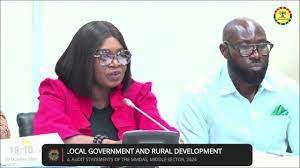
For once, citizens watching Ghana’s Parliament in action have cause to applaud. The recent appearance of Municipal and District Chief Executives before Parliament’s Committee on Local Government and Rural Development has sparked a quiet but powerful conversation about accountability, leadership and the culture of power at the district level. The Committee’s approach, led by its current Chairperson and my woman of the moment, Hon. Queenstar Maame Pokuah Sawyer, deserves commendation. Its tone has been balanced, its questioning fair, and its objectives clear: to ensure that local governments work, that the nation’s decentralization policy delivers, and that those entrusted with leadership of districts act in the public interest rather than in partisan or personal comfort. For years, such oversight was either perfunctory or missing altogether. Now, in an era where citizens are demanding results, this Committee’s work offers a glimmer of how governance can be redeemed. Kudos to the President, John Dramani Mahama for implanting a very important mandate.
A Turning Point in Oversight
Facebook and other social media platforms have been buzzing with images and short videos of the Mayors and DCEs taking their turns before the Committee in Accra. Though informal in their circulation, the posts reveal something deeply institutional: Parliament is beginning to exercise the oversight role it has long had on paper but seldom enforced. The Committee on Local Government and Rural Development has a clear constitutional and legislative mandate to oversee the performance of Metropolitan, Municipal and District Assemblies (MMDAs). Its focus includes the implementation of development plans, compliance with audit recommendations, and the relationship between political and administrative heads of local authorities. When such a Committee works well, it strengthens Ghana’s entire system of decentralization --- the very foundation upon which local democracy and development are supposed to stand. The Committee’s sitting could not have come at a better time. Many citizens, journalists and assembly members have lamented the increasing tension between Members of Parliament and MCEs/DCEs. That tension, the Committee’s questioning has now exposed, is a silent saboteur of local development.
When Politics Outshines Partnership
Across the country, but especially in the Northern Region, the friction between DCEs and MPs has become a running sore. DCEs often see themselves as the President’s direct representatives, holding both executive and financial authority over their districts. MPs, on the other hand, are elected legislators expected to champion development projects and serve as advocates for their constituencies. In theory, the two roles should complement each other. In practice, ego, competition, and party factionalism have turned cooperation into rivalry.
This is why the Committee’s interrogation of both DCEs and MPs is timely. In public service, friction between the political heads of a district not only slows down development --- it paralyzes it. When MPs and DCEs operate in parallel lanes without coordination, project duplication, stalled works and funding confusion become common. Communities lose faith in the very institutions meant to serve them. The Committee’s decision to bring such issues into the open, asking MCEs/DCEs direct questions about their relationships with MPs, is a sign that Parliament is finally acknowledging the root cause of dysfunction at the local level.
A Commendable Chair and a Fair Process
Many observers, including local government practitioners, have praised the members of the Committee, especially the Chairperson of the Committee for their balance, firmness, and impartiality. They have not used the hearings as a platform for humiliation or partisanship but as a diagnostic session --- identifying what works, what doesn’t, and where change must begin.
This kind of oversight is what strengthens democracy. It is a marked departure from the political theatre that sometimes characterizes parliamentary committees. Instead of point-scoring, the Local Government and Rural Development Committee is restoring confidence that Parliament can be both firm and fair. The public deserves to know who sits in that chair and what principles guide the person. Oversight that is neither vengeful nor indulgent is rare. When Parliament exercises it, the ripple effects go far beyond the hearing room --- they echo through every district assembly office and conference hall in the country.
DCEs Behaving Like “Presidents” in Their Districts
One striking theme emerging from both public commentary and Committee interactions is the behaviour of some DCEs, described by citizens as “district presidents.” They lobby, they bribe their way through, they visit shrines, powerful “mallams” (a corrupted form of “mualim”, meaning teacher in Arabic) and pastors to catch the eye of the President. Once appointed, many treat the district as a personal estate rather than a public trust. They impose decisions, ignore assembly members, and sideline MPs who do not belong to their internal political faction. They go to work late, absent themselves often, and close at will. By empirical estimates, 95% do not have good communication and interpersonal skills, and surprisingly, do not have good command of the English Language. Many MCEs and DCEs are so arrogant, and very disrespectful. Meet some of them and it is as if the whole world is that tiny district he is she is administering.
In the Nanton and Karaga examples, the problem extends beyond attitude to geography. Several reports indicate that some DCEs are not even resident in the districts they are paid to administer. They live in Tamale, the regional capital, and commute occasionally to their districts. This is not a mere inconvenience; it is a structural defect. How can one manage a district’s affairs effectively when one is physically absent most of the time? Residency in the district should be a basic condition for holding the office of DCE. Living in Tamale and “visiting” Nanton or Karaga turns administration into absentee leadership. It breeds lateness, disconnect from community life, and unnecessary transportation costs charged to the public purse. If this Committee’s work is to mean anything, it should recommend strict enforcement of residency rules, and where those rules are flouted, prompt sanctions should follow.
Political Capture and the Need for Meritocracy in MCE/DCE Selection
Beyond the frictions and absenteeism exposed by the Committee, there lies a deeper structural disease --- the politicization of DCE appointments. Across Ghana, the process of selecting district executives has become a competition among party financiers, regional chairmen, chiefs, and big political influencers. In many cases, it is impossible for a qualified but “unconnected” individual to make it through. Merit has long been replaced by money, loyalty, and who one knows in Accra.
This is a dangerous culture. District leadership should be the first line of competence in our national administration. Those appointed must possess communication skills, interpersonal grace, a clear development vision, and the ability to unite diverse local interests. Every DCE should come to office with an action plan approved by the Assembly --- and be monitored and evaluated by that plan, not by political favour. Ghana must also reopen the debate on how DCEs are chosen. Under Article 243(1) of the 1992 Constitution, the President appoints them with approval of two-thirds of the Assembly members. But this has turned the DCE position into a patronage reward, not a professional office. Many citizens now believe it is time to elect DCEs directly, to give power back to the people. At the very least, we could adopt a system where DCEs are elected from candidates of the ruling party, within two or three months after every general election. Such elections, perhaps in February or March after December polls would ensure political harmony while allowing the people to choose the most competent local leader. This would require a constitutional amendment, but it is consistent with the spirit of Article 240, which calls for the “people’s participation in local government.” If Ghana truly wants effective decentralization, this is the reform to pursue.
Citizen Participation Must Be Built into the Process
The Committee’s hearings have also inspired many citizens to wonder how they, too, can contribute to oversight. Parliament must answer that call. If the Committee opens its doors to properly verified complaints from the public, it will multiply its reach and relevance. A practical system is easy to design: letters from citizens with names, signatures, digital addresses and phone numbers, accompanied by photocopies of National Identification Cards, should be accepted as valid submissions. Anonymous tip-offs can be useful for leads, but formal action should only follow verifiable reports. This protects both the complainant and the accused and prevents the process from being weaponized for political vendetta. By formalizing citizen input, Parliament can create a living feedback loop between Accra and the hinterlands, turning oversight from a one-off event into a continuous conversation.
The Decentralization Dream Deferred
Ghana’s decentralization policy, enshrined in law and policy since the early 1990s, sought to bring governance closer to the people. The District Assemblies were meant to be vibrant engines of local planning, service delivery and accountability. Yet more than three decades later, decentralization remains more a slogan than a lived reality. Assemblies depend almost entirely on central government transfers, many of which arrive late. Citizens feel disconnected from decision-making, and MCEs/DCEs act more as district party chiefs than as public administrators. The friction between MPs and DCEs is only a symptom of that deeper malaise. True decentralization would make DCEs answerable to the people of their districts, ideally through local elections, rather than solely to the President. Until that reform happens, committees like the one now at work in Parliament are the best available mechanism for injecting accountability into the system.
When Parliament Works for the People
Ghanaians are rightly skeptical of parliamentary committees; too often, they meet, deliberate and issue reports that gather dust. The Local Government and Rural Development Committee is beginning to challenge that cynicism. By calling MCEs/DCEs, questioning their conduct and insisting on answers, the Committee is showing that Parliament can be both relevant and responsive. If the Committee’s current energy is sustained, and if its findings translate into real reforms, it could set a new benchmark for local governance. It could push the Ministry of Local Government and the Presidency to rethink how district leaders are selected and supervised. For sure, many Ghanaians will start rethinking their decisions to occupy the seat of a DCE. When the going gets tough, only the confident get going.
What Next? From Hearings to Action
For this Committee’s work to make a lasting difference, it must go beyond the hearing phase. Here are a few practical steps it could champion:
- Publish its findings and recommendations for each Assembly, making them accessible online (via GhanaDistricts) and in print for public scrutiny.
- Collaborate with the Auditor-General to ensure that audit infractions at the district level trigger immediate action.
- Establish a citizen complaint desk with the verification process outlined above. The Committee must let Ghanaians have their toll-free number and email address as a matter of utmost urgency.
- Recommend sanctions for absentee DCEs and set clear residency rules.
- Encourage mediation between MPs and DCEs, with periodic progress reviews on cooperation.
If implemented, these steps could transform the oversight exercise from a momentary spectacle into a sustainable governance mechanism.
The Lesson: Oversight is Not Punishment --- It is Progress
The lesson from the Committee’s engagement with MCEs/DCEs is clear: oversight, when done fairly, strengthens leadership. Those who appeared before the Committee have now been reminded --- publicly and unmistakably --- that accountability is not optional. The Committee’s work has also reminded citizens that governance can, and should, work in their interest. For once, Facebook posts and viral clips are telling a positive story --- of Parliament doing its job; a good job. But the ultimate test lies ahead. Will these hearings lead to reforms in how MCEs/DCEs are appointed, supervised and disciplined? Will absentee and arrogant DCEs be shown the door? Ghanaians are watching and hoping. If this Committee keeps its balanced, professional tone, it could become the model for how Parliament reclaims its oversight power. The country needs that now more than ever.
Hon. Queenstar and your team, I pray that the Good Lord continues to guide you and protect you. A Dagomba man’s Ayekoo is: Ni ituma pam!
FUSEINI ABDULAI BRAIMAH
+233208282575 / +233550558008
[email protected]

 Site for Adaklu District 24-hour economy market handed over to contractor
 Govt to complete over 1,000MW power expansion in Kumasi — John Jinapor
 Amin Adam made co-chair of Buwumia's Finance and Economy Committee
 NPP appoints Akosua Manu as spokesperson for gender and social protection commit...
 GHS activates national surveillance following hantavirus outbreak on Cape Verde ...
 South Africa denies xenophobia claims as Ghana pushes AU action
 Kennedy Agyapong rejects co-chair appointment by Bawumia
 Police arrest six suspects over alleged child trafficking syndicate in Kasoa
 Former Deputy AG urges GJA to resist return to ‘Culture of Silence’
 Four killed in Savannah Region road crash involving tipper truck


