




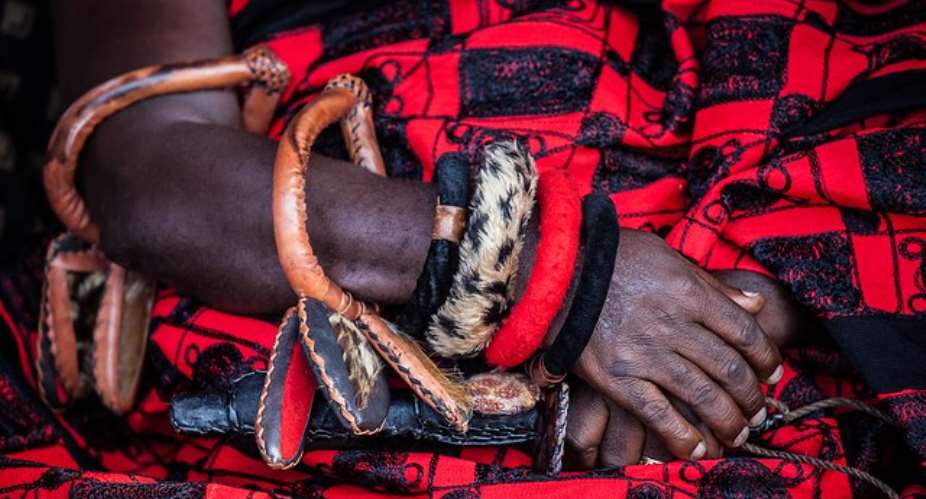
The very spiritual shields and amulets worn with pride trace back to centuries of Northerner–Asante collaboration.
Across the funeral grounds of the late Asantehemaa, one could not miss the dazzling display of leather amulets --- symbols of power, protection, and spiritual charisma. Yet beyond their sacred beauty lies a deeper story. The centuries-old Northerner–Asante bond that shaped traditions, fortified kingdoms, and continues to challenge today’s misconceptions.
The Cultural Display at Manhyia
The recent funeral rites of the Asante Queen Mother provided not only a moment of mourning but also a rare cultural showcase. Amulets, stitched from animal hides, wrapped in black, red, or white leather, and inscribed with sacred Arabic texts, adorned the wrists, waists, and garments of men and women who thronged Manhyia. To the ordinary eye, they were colourful accessories; to the initiated, they were profound statements of faith, history, and identity.
These amulets serve multiple purposes. Protection against the evil eye, resistance to witchcraft, shields against weapons, carriers of charisma, and enhancers of courage. Their colours are not random --- black symbolizes power and mystery, red denotes sacrifice and vitality, while white reflects purity and divine favour. The animal skins used --- lion, leopard, hyena, crocodile, and many others, are carefully chosen to imbue the wearer with the spirit and strength of those creatures.
The Origins of the Amulets
Many wonder when and how such charms became part of Asante culture. The answer lies in the long, intertwined history of Northerners and Asantes. The introduction of leatherwork, talismanic writing, and amulet preparation into the Asante kingdom cannot be separated from the influence of Muslim clerics, traders, and craftsmen from the North. As far back as the 17th and 18th centuries, Wangara traders and Hausa scholars brought with them Qur’anic knowledge and Arabic scripts, which were quickly adopted into Asante ritual life. Northerners settled in Kumasi and beyond, offering not just commerce but also spiritual expertise. The amulets, or “laaya”, became prized possessions --- spiritual shields worn by chiefs, warriors, and even commoners. It was Northerners who supplied the knowledge of leather curing, Arabic incantations, and animal hide preparation. These practices were blended with Asante metaphysical traditions, producing the hybrid amulets we see today.
Dagbon* and Asante: Who Came First?
To understand this history better, one must compare the age of the two kingdoms.
The Dagomba kingdom (Dagbon) was founded as early as the 1400s, traditionally traced to Tohazie, the Red Hunter. By the 1500s, Dagbon had already developed a strong chieftaincy system, cavalry warfare, and trade connections with Mali, Hausaland, and beyond. Its capital at Yendi became a hub of Islamic learning, leatherworking, and horse trading. The Asante kingdom, by contrast, emerged much later in the late 1600s and early 1700s, formally consolidated under Osei Tutu I and Okomfo Anokye after the famous Battle of Feyiase in 1701. In short, the Dagomba kingdom predates the Asante kingdom by about 250–300 years.
This historical timeline explains why Northerners, already skilled in Arabic literacy, leather craftsmanship, and cavalry, played such a decisive role in Asante’s rise. When Asante was consolidating its empire, Dagbon and other Northern societies were already centers of spiritual, military, and commercial expertise. Thus, what some today dismiss as “foreign influence” was in fact the very backbone that fortified Asanteman.
Brotherhood Forged in History
The Asante Empire was never built in isolation. The greatness of Asanteman was a product of alliances, cultural borrowing, and strategic brotherhood with the North. Northerners served as blacksmiths, horse traders, warriors, and spiritual protectors in the Asante court. Even today, Kumasi Zongo communities, with their Hausa, Dagomba, and Wangara roots, remain living testimonies of this brotherhood. When the Asantehene prepared for war, it was often Northerners who armed his soldiers with charms said to deflect bullets or render enemies powerless. When kings sat in state, it was Northerners who prepared leather cushions, ceremonial shoes, and protective amulets. Without this input, Asanteman’s spiritual and political shield would have been weaker.
Misconceptions about Northerners
And yet, despite this long-standing partnership, stereotypes persist. In contemporary Ghanaian discourse, Northerners are too often branded as “riff-raff,” “second rate,” or “hewers of wood and drawers of water.” These corrupted tags are not only unjust but also historically inaccurate. The very amulets that dignitaries displayed at the Asantehemaa’s funeral --- items of prestige and spiritual defence, are rooted in Northerner ingenuity. The spiritual shields that once preserved Asante kings on the battlefield were products of Northern skill. To demean the Northerner is to deny Asanteman’s own foundations.
Lessons for the Asante Youth
For the youth of Asante today, there are vital lessons to learn. First, cultural pride must be coupled with historical honesty. The amulets you wear are not just symbols of Asante spirituality, they are testimonies of Northerner–Asante unity. To mock, marginalize, or stereotype Northerners is to spit on the very legacy that fortified your kingdom.
Second, unity is strength. Asanteman rose because it embraced collaboration. The future of Ghana likewise depends on dissolving stereotypes, promoting mutual respect, and harnessing the talents of all its people --- North and South alike.
Finally, the Asante youth must resist the temptation to see tradition as mere decoration. The amulets you inherit are living reminders of a covenant of brotherhood. They call you to humility, respect, and shared identity.
A Call to Rethink Brotherhood
The funeral of the Queen Mother was a reminder that death is not only an end but also a mirror. As Ghanaians watched the amulets flash across Kumasi, the deeper message was this. Culture is stronger than division, and unity is older than prejudice. Northerners and Asantes have walked side by side for centuries, building, defending, and blessing one another. It is time the Asante youth acknowledge this truth, not in whispered conversations but in loud, public affirmation. To despise the Northerner is to despise your own cultural soul. To honour the Northerner is to honour yourself.
A Word to the Wise …
The amulets on display at Manhyia were not just leather and hide, nor were they just ritual protections. They were living testimonies of centuries of collaboration, sacrifice, and shared destiny between Northerners and Asantes. The Asante youth must now rise above corrupted stereotypes and embrace the truth. The Northerner is not a second-rate figure but a cornerstone of Asanteman’s greatness. And as the Qur’an says, “And We made you into nations and tribes so that you may know one another” (Qur’an 49:13). History, culture, and the very charms you wear demand that you remember this.
*Asterisk: Much of what I know about the North, I learnt from my late father, Alhaji Abdulai Braimah (Gbiengbiedoo). He limited himself to Dagbon History, so my limitation.
FUSEINI ABDULAI BRAIMAH
+233208282575 / +233550558008
[email protected]

 Cape Coast assembly declares war on floods, announces demolitions and emergency ...
 Fire guts GBC staff quarters in Wa
 PRINPAG condemns high court jailing of Herald Newspaper editor Larry Dogbe
 NPP gives disciplinary committee two weeks to probe petitions against Kennedy Ag...
 Yaw Dabo mistaken for a child on live 2026 World Cup broadcast
 Free-for-all fight at NPP NEC meeting as supporters clash over 'Ken Must Go' pro...
 TOR resumes crude oil processing after four years maintenance shutdown
 Cabinet approves State Assets Protection Bill to safeguard public property – Mah...
 Asantehene calls for engineering solutions to curb flooding in Ghana
 “I’ll divorce my wife If Ghana doesn’t beat Croatia” – Lil Win


