




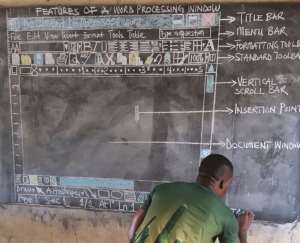
Lack of Access to Technology Hinders Academic Progress and Future Opportunities for Students. In today's technology-driven world, computers have become an essential tool for learning and academic success. However, many schools in Ghana still lack access to computers, leaving students at a significant disadvantage. This digital divide has far-reaching consequences, affecting not only the students' academic performance but also their future prospects.
Without computers, teachers are forced to rely on traditional teaching methods, which can be time-consuming and ineffective. Students miss out on the opportunity to develop essential skills such as typing, research, and critical thinking. Moreover, the lack of access to technology hinders students' ability to access online resources, participate in virtual learning experiences, and collaborate with peers.
Studies have shown that students who have access to computers and the internet tend to perform better academically than those who do not. Without computers, students are at a disadvantage when it comes to completing assignments, conducting research, and preparing for exams. This can lead to lower grades, decreased motivation, and a higher dropout rate.
In today's digital age, having basic computer skills is a prerequisite for many careers. Students who lack access to computers are at a disadvantage when it comes to competing for jobs and pursuing higher education. Employers increasingly require employees to have basic computer skills, and universities expect students to be proficient in using technology.
To address the digital divide, the government, educational institutions, and private organizations must work together to provide schools with the necessary resources. Some possible solutions include:
Donation of computers and equipment: Private organizations and individuals can donate computers and equipment to schools in need.
Government initiatives: The government can launch initiatives to provide schools with computers and internet access.
Public-private partnerships: Partnerships between private organizations and educational institutions can help provide schools with the necessary resources.
Teacher training: Teachers must be trained to effectively integrate technology into their teaching practices.
The lack of computers in schools has far-reaching consequences for students, affecting their academic performance, future opportunities, and career prospects. It is imperative that we address the digital divide by providing schools with the necessary resources. By working together, we can ensure that all students have access to the technology they need to succeed in today's digital world.

 Israel must win 'because we’ve got no other choice’, PM Netanyahu tells UN
 Mahama reiterates Ghana's commitment to two-state solution to Palestine-Israel c...
 Ablakwa calls for Return of African Artefacts held abroad
 Madina MP Francis-Xavier Sosu reportedly collapses while speaking at GIMPA
 Kumasi drivers, passengers react to 8% transport fare increase
 I will unite Africa, Caribbean and Latin America into world's biggest trading bl...
 Mahama petitioned to halt Sentuo Airport Garden City construction after sod cutt...
 Government should not fund the $4 billion Accra-Kumasi Expressway project — Alan
 Democracy must deliver tangible social benefits to citizens – Mahama
 Court to rule on bail applications of six accused in 3.9-tonne cocaine seized in...


