




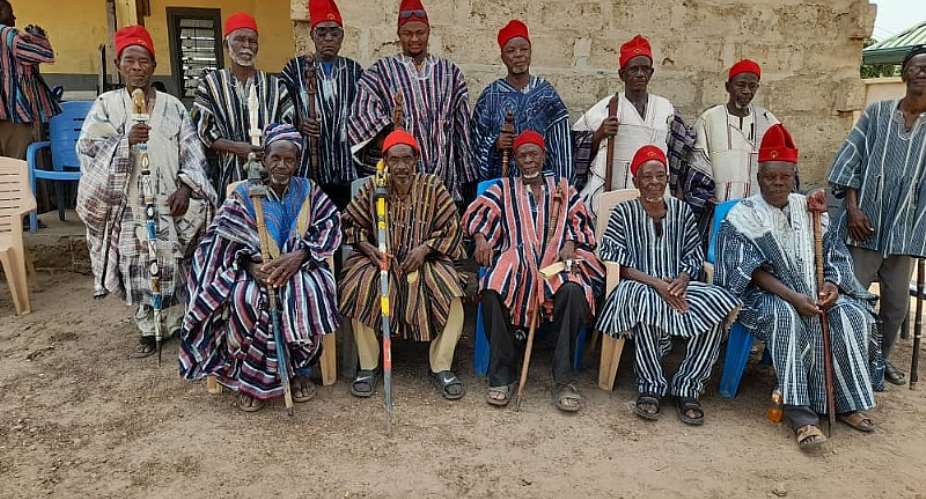
Vagla people of the Savannah Region of Ghana historically met in their ancient village known as DAGBIGU which is located very close to the Black Volta, Ghana’s border with Cote D’Ivoire. Dagbigu is one of the earlier settlements of the Vagla people who first settled in the land classified as Gonjaland the Vagla are the earlier Gonja tribe who occupied the Western part of Gonja, Vagla are traditionally Fetish in terms of religious orientation.
Vaglas by occupation, are mostly farmers and a few of them as hunters. The farmers do their farming diligently and mostly cultivate food and in a few cases cash crops. The Vagla hunters also hunt for games and the senior hunter is celebrated as Digbon whenever the hunter poaches and kills a big animal like an elephant, the hunter is celebrated with a Vagla Dance known as KPANA. Vagla of Gonja is the originator of KPANA DANCE. A Hunter in Vagli (Vagla tribe) is called KPANA hence the dance Kpana refers to the hunter dance or dance of the hunter based on Vagla culture as the originator of KPANA DANCE in the current Savannah Region of Ghana (formerly Northern Region). Other tribes in the Region also borrowed the Kpana and they do dance it. But it is a VAGLA DANCE. Vaglas have several dances and festivals in Northern Ghana.
The Vagla people are an embodiment of the Vagla, Safalba, Chorba and Nomee/Batigee indigenous tribes living in the extreme western Gonja which today falls into the political districts of Bole, Sawla-Tuna-Kalba and West Gonja Municipality of the Savannah Region of Ghana. Vaglas are noted with several traditional feasts and festivals and one of them is the Kaafo Festival of Dagbigu. Kaafo is the name of the Earth Shrine or Earth god of Dagbigu. Kaafo has been the most powerful god/shrine for over two centuries among the Vagla. Kaafo of Dagbigu experienced a decline due to the new Sonyo Kipo.
The Vagla people or groups often meet in Dagbigu for their annual Kaafo Festival. The Kaafo god was celebrated for over two centuries due to the power of the Earth Shrine or the Earth god in Dagbigu and this annual meeting and prayers to Kaafo were performed by the Chiefs of the Vagla groups (Koro/Heuhin) and the Vagla elders (Nabonzie) and the people across the Vagla Nations or country. Kaafo Festival remains the single most important festival for the Vaglas within the 13th-17th Centuries in the Vagla history and is in line with the customs and practices of Vaglas.
Historically, the Vagla, People used to have their annual festival in a community known as Dagbiigu. It was the centre of the Vagla ethnic groups. The reason for their annual meetings in Dagbiigu (Dagbigu) was the result of the powerful god (Earth Shrine) in Dagbigu. It is believed that the Dagbigu god (Kaafo), was the most powerful shrine/deity in the Vagla land or enclaves of the Great Vagla Nation State. So, the Vagla, Safalba, Choruba and Nomee/Batigee people met annually at Dagbigu to worship or make sacrifices to the Dagbigu Kaafo (Earth Shrine) to seek blessings and fortunes for a good harvest in farming. As per the customs and the traditions of the Vagla people, after harvest, all these people or tribes converge at Dagbigu to give thanks to their powerful god/deity for a bumper harvest and protection against calamities, enemies, eternal forces, intruders as well as protection against snake bites. It is important to note that the Kaafo god, is known for its power over snake bites across the Vagla communities. So, the Vagla people do come to Dagbigu to seek protection from snakes at home, in bushes and on their farms. Once the farming season ends, usually in the dry season after the harvest of farm produce, the Vaglas assemble or gather at Dagibgu to celebrate the Dagbigu Kaafo for the good harvest and the protection against calamities in their respective communities. The customary practice of meeting annually in Dagbigu lasted for many centuries from the literature and narrative of the Theocratic State of Dagbigu. These are the great and the good days of Dagbigu as the biggest meeting point of the Vagla groups. The Vagla Chiefs and Elders often return to their communities with more fortifications after performing the annual Kaafo Festival of Dagbigu. Dagbigu was the most popular Vagla Village due to the unique celebration of the powerful shrine of Kaafo. This narrative depicts the era of the Theocratic State of Dagbigu as the point of convergence of the Vagla people today in the Savannah Region of Ghana. Vagla belongs to the political classification known as Gonja or Gonja State and the Vagla lands are classified with the same terminology as Gonjaland. Thus, Vagla a Gonja Tribe.
The Decline of the Theocratic State of Dagbigu
The Vagla people experienced a drought which lasted for a long period. The period was too difficult for the Vagla People (Vagla, Safalba, the Choruba and the Nomee/Batigee Tribes). These indigenous Gonja tribes tried severally with the hope that the Dagbigu Kaafo could change the situation so that it would rain for farming. All efforts proved futile. Several prayers in the form of rituals and pacifications were made for rain across the Vagla communities but without success. The people's trust in Kaafo or deity could change the climatic condition for good but to no avail.
The Chiefs (Koora/Heuhina) and the Elders were in one of the annual gatherings at Dagbigu when Mandari Koro (Mandari Yiri Naa) suggested to the colleague Chiefs that there is a need to visit a group in a newly established community near Teehbol/Teinbol. The Mandari Koro who was also called Mandari Yiri Naa indicated that he had visited the new community known as Sornyor near the older village of Teinbol and took a traditional oath or vow to bring dance (Dern/Deng) and to make some sacrifices to the god/deity over drought and abductions of people across Black Volta. This, the Mandari Koro went to Sonyo and consulted the new deity (Earth Shrine) known as the Sonyo Kipo or Sonyo Kupo (in Choruba). The Mandari Koro convinced the rest of the Chiefs (Koora) to seek help from Sonyo Kipo which can change the drought into rains for farming. Some Chiefs (Koro) had doubts, others thought they should try the Sonyo new god to see (“try and see”) for magic or breakthrough over the perennial draught over Vagla lands or the Vagla country/nation.
What led to the decline of the Kaafo Festival of Dagbigu was the good testimony of the Mandari Koro about the breakthrough the Mandari area had from the Sonyo Kipo power and that made the Vagla Chiefs, and the Elders start to celebrate the Sonyo Kipo as well as still celebrating the Kaafo Festival of Dagbibu. This narrative does not mean the end of the Kaafo Festival, it is still celebrated by the Vaglas. Kaafo Festival is celebrated annually during the dry seasons in Dagbigu near Sawla (the District Capital of the Sawla-Tuna-Kalba Sawla in the Savannah Region, Ghana).
Sources
Archival records:
1876. Reports of his Journey into the Interior of the Gold Coast. London: CO.96jII9, 5162 no. 2(3).
1899. Report of the Northern Territories of Gold Coast. London: Office.
1902. Commencement of the Northern Territories, Gold Coast. Colonial Secretary and by district and regional commissioners Speeches (ADM15611144 and 45) Accra/Tamale: Ghana National Archives (ADM15611/46).
1908. The Native Customs Ordinance. This made the 'worshipping of other gods' punishable.
1911. Vagella People
1914. Colonial Annual Report for the Northern Territories. 31 December, 1914. ADM. 56/1/424; Accra. (Grunshi Tribes/Groups placement and matters arising in Mamprusi and Gonja)
1915. Letter to Acting D.C., Bole, to Commissioner, Southern Province 12/04/15. ADM.56/1/70.
1932. Rattray, R. S., Tribes of Ashanti Hinterland. Vols. 1&2 (London: 1932) - on Gur, Tindana
1968. The Vagla Chiefs Epistle to Local Authority.
1968. Levtzion, on the work of the Powerful Deity of Sonyo but spelt Senyon, on page 65.
Vagla History, Customs and Practices:
1987. Vagla Falaa Wia (Vagla History)
1997. EthnoDoxology of Vagla. Music and Dance in Worship.
Vagla Academic Work:
Plange, N-K (1984). The Colonial State in Northern Ghana: The Political Economy of Pacification. Review of African Political Economy, No. 31, Capital vs. Labour in West Africa, 29-43.
Author: JKAhiah has a special interest in Vagla History, Practices and Chiefdoms-Chieftaincy

 ICC chief prosecutor Karim Khan dismissed over sexual misconduct allegations, so...
 'I shall continue to walk in late President Atta Mills' footsteps' — Mahama mark...
 Flood Mitigation Task Force begins demolition of structures on waterways in Accr...
 Refund GH¢60 deductions in two weeks — Service personnel to NASPA
 Parliament expected to adjourn sine die on July 31
 Police bust motorbike theft cartel, seven suspects arrested in Upper West
 GoldBod suspends Dominic Bonsu Ventures' gold trading licence, secures bench war...
 Being better than the last NPP gov't should never be the standard — Sulemana Bra...
 Migration challenges will not strain Ghana-South Africa relations — Ronald Lamol...
 'You had your priorities wrong' – NPP's Peter Ayinbisa rejects govt's new SHS fo...

