




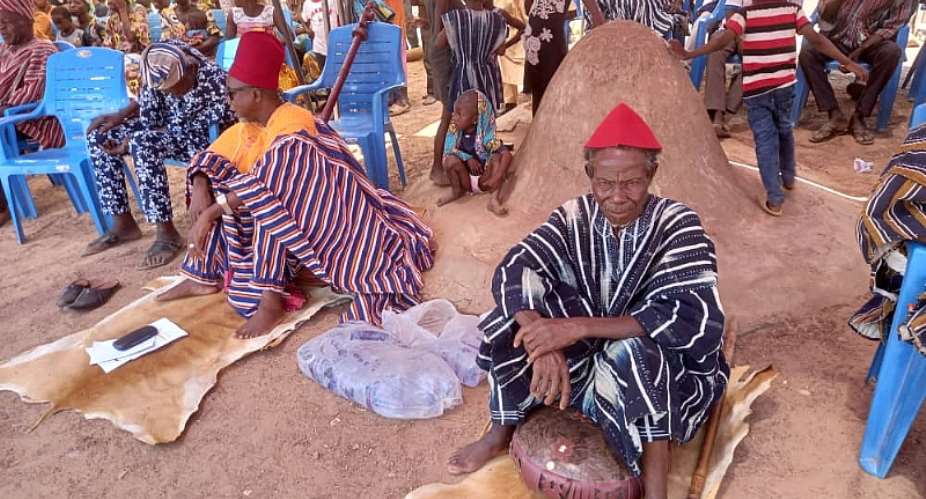
Origin of Vagla
Vagla is among the original people of the north believed to have settled at the scarp of the Togo range before, with tribes like Kusal, Likpankpan, and all the Gru-speaking people. The Gru family moved towards the South-West where they lived for centuries. The Gru family (tribes) include Isala (Sissala), Tampulma, Chakalaa, Kasim, Vaglas and Deg (Mo). These tribes are identical as they have the same ancestors, hence the Gru Family (Tribes) are one with the same origin.
The Gru-speaking people stayed or lived together for a very long time until a misunderstanding befell them. An animal was used as a sacrifice to a deity or a god, and history has it that the animal that was sacrificed was a dog 🐕. This shows the importance of Dogs to these tribes at their origin. During the sharing of the sacred dog, the Vagla group felt cheated after Isala, who was elderly took both the hindleg and the head of the dog simultaneously. So, the Vagla group started moving towards the South, leaving their ancestral land of the Isala (currently in the Upper West of Ghana). This period marked the separation of the Gru-Family (tribes) who were one at their land of Isala.
The Vagla group is believed to have settled in their current communities dating to the 10th or 11th century. Thus 1200. The Deg (Mo) moved further south and settled closer to the Black Volta with key towns such as Jugboi, Jama, Chibrinyoa, Bamboi among others. The Tampulma came to settle somewhere in Lingbinsi and are now closer to Daboya(andaaboanyi) enclave, while Chakalaa moved towards Dusie, Bugee in the current Wa East District of the Upper West Region the Kasim settled at Paga and Navro areas of the Upper East Region of Ghana. This piece points to the commonalities of these Ghanaian tribes namely Sissala, Kasena, Chakala, Tampulma, Vagla and Mo. These groups constitute the Gru-Family or Gurusi tribes or Gur-tribes of Nothern Ghana.
Movement of the Vagla (Settlement Patterns)
Vagla First Settlement
The first place that the Vagla Tribe settled was known as JANG. This means Jang is the oldest of the Vagla communities -towns and villages. This is why the Vagla respect Jang and its people as their first point of contact from their ancestral home of Isala. From Jang other settlements were established by the Vaglas. The settlements that were immediately established after Jang formed the second tier of the Vagla Settlement Pattern. In Jang, the Vaglas met no human beings or tribes.
Vagla Second Tier Settlement Pattern
The second settlement of other earlier native Vagla towns and villages to be established right after the JANG settlement include Kunlog, Dagbigu, Bɛɛl and Dabori. Thus, these four are also revered due to their long history of existence (centuries), rich and powerful deities, and their great culture.
Vaglas are the aborigines (first occupiers) of the current geographical area classified as Gonja. The Vaglas met no one in the land they occupied far back in the 12th and 13th Centuries.
Vagla Third-Tier Settlement Pattern
The Third Tier Settlement Pattern believed to have been established by the Vagla Tribe includes Chorazie (Chori) out of Jang, while Nakwabi and Gindaabol (out of Kunlog), Tuuna (now spelt Tuna) out of Dagbigu, then, Zaakpa (today spelt Sakpa) out of Bɛɛl while Teinbol and Kalinbol (which are extinct) and Sornyor out of Chorbang. Gorbol is an extension of Chorbang per Vagla history. Soma is a hybrid of Kunlog/Jang. It is important to note that the list is more than what is mentioned here. There is also a closeness between the people of Soma and the people of Gbaazie of Tuna. These historical narratives show the interconnectivity of the Vagla people and the Vagla towns/villages. Disputes in one community affect the other communities thus, the Vagla Collective security principle of an attack of one is an attack of all. Vagla people and chiefs do not sit aloof when other Vagla communities are fighting, or are in serious disputes over land, chieftaincy succession crises, disputes of deities, and streams among others like Nahar, Kunfulsi, Kpongli, Kanchen of the Vagla group of the respectful Nomee/Batigee fraternity of the Great Vagla Nation-State. Gbenful, Mamful, and Mandari (Mmaa mam daari) are believed to have emerged out of the Bɛɛl people likewise Segezi (Seripe) of the Safalba and Choruba nations respectively of the Great Vagla-Nation State. It is important to note there are many others not listed, some extinct.
Vagla Four-Tier Settlement Pattern
This represents the very last of the Vagla communities to be established next to the third tier. Sanyeri (Sanyari) is quite new but older than Sawla. Other relatively new communities include Tuuna Bol-Farlii now known as Yipala. The Vagla narratives have it that Sawla is one of the last communities to have been established or settled by Vagla of the Dagbigu/Kunlog descent/extract. Thus, Sawla emerged from Dagbigu and Kunlog and the Sawla lands were originally owned by Kunlog and Dagbigu (two older communities) who have a common land boundary. But Sawla has gradually become a bigger town than most of the older Vagla communities beside Bɛɛl. Sawla a Vagla town is the district capital of the Sawla-Tuna-Kalba district of the Savannah Region. Vagla history has Sawla Koro (Jara) as one of the relatively new Chiefs in terms of hierarchy.
Chorbang is an autonomous nation in Vagla history but is closely linked to Vagla history and culture. The Chorbang people are closely related to the Bɛɛl people and others related to the Jang People. Chorbang is also closely connected to the Deg (Mo) people and by extension the Asante people. These Vagla historians connect to the geopolitical dynamics of Chorbang whose Chiefdom is very distinct and unique to the larger Vagla people and chieftaincy system. Another uniqueness of Chorbang is the power of the supreme god Chorbang Heu (KUNGE) and other sub-deities like Biizie, Lampoga, Banzen in Chorbang, among others. Chorbang as an autonomous Chiefdom of the Vagla Nation-State continues to be respected by all the Vagla people of Bɛɛl and all Vaglas across communities. Chorbang Heu Festival is a point to look up to in terms of the uniqueness of Chorbang. The beauty of Chorbang Chiefdom is another glamour and the pride of the people.
Other Tribes Settlements Patterns with the Vagla Tribe
It is important to note that other tribes came to Vagla lands and Vagla communities. Some came and left, others came and settled and still stayed with the Vagla. The earlier of these tribes were the Black Dagombas from the Tolun areas whose stay was short-lived around the 15th Century. Then the arrival of the Nchumuru groups is believed to be around the late 15th Century. Then the people the Vagla described as ‘strange people’ whom Vagla described as people with body marks. These people entered from the South direction with their leader Sumaila Jakpa and they called themselves Ngbanya. Historical records have it that they got to the Vagla areas around the late 16th- to 17th Centuries, believed they first settled at a place called Banzen an outskirt of Bɛɛl (now Bole). Later groups came and settled North of Bɛɛl and Bɛɛl Vagla called the area Hori Bol (now Noriyiri) and others across the Ivory Coast as the Lobi/Brifo around the late 19th Century per Vagla history later groups are the Dagaba. It is important to note that the Vagla Tribe has lived peacefully with all these later groups or tribes. Vagla people are generally peaceful and very accommodating.
Vagla in Gonja (Gonja State or Yagbon Affairs) of the Savannah Region
There is no doubt about Vagla as the first Gonja Tribe to have occupied the current Gonjaland. In Gonja, everyone knows it as a fact that Vagla is the first tribe to have settled in Gonja. It is also a fact that the lands, the streams, and the deities (gods) are owned by the Vagla. Thus, the Vagla tribe is revered in terms of land and traditional issues in Gonja. Vagla is the aborigines of Gonja. Vagla is one of the Gur-Family aborigines of the North of Ghana, who have remained in their current area largely in the Bole and Sawla-Tuna-Kalba districts. Some Vagla also lived in the West Gonja around Gorbol now spelt (Grupe) many Vagla communities were extinct in West Gonja due to the creation of the Mole National Park immediately after independence in 1958 as a wildlife refuge for the preservation of wildlife for posterity. Many Vaglas originally settled in the current Hanga areas including Busunu but were affected by the creation of the Mole National Park. They scattered some went back, and some Vaglas assimilated in Hanga-Busunu enclaves of West Gonja.
Some Vagla remained in areas around Yapei, Hawaa, Ntereso and Tulwe enclaves as well as the Debre areas. But many of the Vagla got assimilated with the later arrival of the Ngbanya tribe with their leader Sumaila Jakpa and his team when they reached the current Central Gonja district areas. One reason for the assimilation is the lack of contact with the mainland Vaglas around Yagbon (Vaglas around Sakpa, Bole, Tuna, and Jang, areas). Most of the Central Gonja Land Priests (Kadema/Kajomo, Kasawulewura) and Kigriwura a good number of the Vagla who first settled and lived around Kigripe in the Debre Traditional Area and Gbipe, Kagbape are of Vagla descent. Per Vagla history, there seems to be no root or presence of Vagla in East Gonja enclaves of Northern Ghana (specifically in the former Northern Region). The traditional roles of the Vaglas remain pivotal in many other traditional areas of Gonja. These Gonja Tribes' prominent Traditional Areas such as the Bole Traditional Area, Kong Traditional Area, Dagbigu Traditional Area, Kunlog Traditional Area, Dobori Traditional Area, Jang Traditional Area, Tuna Traditional Area, Sor-nyor (now spelt Sonyo) Traditional Area among others are crucial in terms of Gonja Tribes traditions and practices. In terms of Yagbon or Yagbon State matters Vaglas are key players in terms of enskinment, and the burial of paramount Chiefs including Yagbonwura. Vagla is key in terms of traditional funeral rites of prominent Chiefs, hence Vaglas are key players in Land Administration in Gonja. Vagla is the fulcrum in which Gonja traditional festivals/rituals revolve.
Sources
1876. Reports of his Journey into the Interior of the Gold Coast. London: CO.96jII9, 5162 no. 2(3).
1899. Report of the Northern Territories of Gold Coast. London: Office.
1902. Commencement of the Northern Territories, Gold Coast. Colonial Secretary and by district and regional commissioners Speeches (ADM15611144 and 45) Accra/Tamale: Ghana National Archives (ADM15611/46).
1908. The Native Customs Ordinance. This made the 'worshipping of other gods' punishable.
1911. Vagella People
1914. Colonial Annual Report for the Northern Territories. 31 December, 1914. ADM. 56/1/424; Accra. (Grunshi Tribes/Groups placement and matters arising in Mamprusi and Gonja)
1915. Letter to Acting D.C., Bole, to Commissioner, Southern Province 12/04/15. ADM.56/1/70.
1932. Rattray, R. S., Tribes of Ashanti Hinterland. Vols. 1and2 (London: 1932) - on Gur, Tindana
1968. The Vagla Chiefs Epistle to the Colonial Administration.
1968. Levtzion, on the work of the Powerful Deity of Sonyo but spelt Senyon, on page 65.
Vagla History, Customs and Practices:
1987. Vagla Falaa Wia (Vagla History)
1997. EthnoDoxology of Vagla. Music and Dance in Worship.
2019. Vagla Research Committee Report. The credit of the Vagla Youth Association (VAYA).
Other Internet Sources of Information on Vagla
Vagla in Ghana people group profile | Joshua Project / PeopleGroups.org - Vagala
Vagla chieftaincy system: The Kunlog tradition area (ghanaweb.com)
VAGLA Chiefdoms/ VAGLA Chieftaincy System (KORA WIA) (modernghana.com)
Rituals of the Heukwaara Festival in Tuna and Sawla - Graphic Online
Deng Festival of the Vagla, Safalba, Choruba and Nomee people of the Savannah Region, Northern Ghana in West Africa (ghanaweb.com)
AUTHOR: JKAHIA
An Educationist and a Historian
 Site for Adaklu District 24-hour economy market handed over to contractor
 Govt to complete over 1,000MW power expansion in Kumasi — John Jinapor
 Amin Adam made co-chair of Buwumia's Finance and Economy Committee
 NPP appoints Akosua Manu as spokesperson for gender and social protection commit...
 GHS activates national surveillance following hantavirus outbreak on Cape Verde ...
 South Africa denies xenophobia claims as Ghana pushes AU action
 Kennedy Agyapong rejects co-chair appointment by Bawumia
 Police arrest six suspects over alleged child trafficking syndicate in Kasoa
 Former Deputy AG urges GJA to resist return to ‘Culture of Silence’
 Four killed in Savannah Region road crash involving tipper truck



Comments
The writer has twisted some of the narration.Sumaila Jaka didn't come to settle on the land. He came with a threat of war on the vagla people and they surrendered themselves and the lands they occupy to him peace and accepted to be owned. Because the vagla people were having their gods on the land, Jakpa allowed them to stay to worship and appease the gods under the authority of the Ngbanye otherwise Gonja. In fact, the name Gonja was first used in the Salaga area where the writer admitted th...