





Framing GMOs
Journalists are communicators who are consciously interested in how they communicate to the larger society. The emphasis is on how; it is about the conscious and deliberate efforts media employs to select and organise thoughts around messages for the needed attention. This attention driven mechanism of making an angle of a message more salient, impactful through choice of language, sentiments and themes is known as media or news framing processes. Media framing remains an important aspect of news making. Framing is that double-edge-magnet that pulls public consensus towards an issue or may build public dislike for an issue. In simple terms, the media provide society with boxes of mental-frames through which the public may think, act and behave. Furthermore, the media through its framing, does not only provoke the feelings of its audience, but also influences the attitudes and the views of the public. Also, the media’s framing-influences could direct public anger or peace towards government policies and initiatives. That is to say, the media as a social-sensitisation force, plays a critical role in national and global experiences (such as novel technologies, public health pandemics, vaccines and climate change) by directing public acceptance towards it or may whip up public displeasure towards any of the policies based on the media’s beliefs, values, and perspectives. Sometimes, the media’s frame is also blame for its anxiety, alarmistic, mistrust amplification of misleading and misinforming public opinions. A case in point is the Genetically Modified Foods technology (GMOs) narratives in the media.
GMO Scientists’ Ineffective Communication.
According to existing scientific appraisals, GMO technology has enormous benefits for the management of global hunger, improving on malnutritional challenges, its ability to reduce the extensive usage of pesticides and herbicides, tendency of increasing productivity and subsequently allowing farmers to accrue high economic returns. In spite of these positive attributes associated with GMO technology, the public at large remain skeptical about safety.
From its introduction in the 1990s, genetic modification technology has drawn criticism and support in USA, Europe, China and Africa. At the core of these criticism is public mistrust. There are many contributing factors to the public mistrust towards the genetic modified technology: Generally, the negative attitude towards GM foods stems out of scientific and food safety disasters in the past. The bovine spongiform encephalopathy (BSE) crisis in the 1980s and 1990s, and many of such scientific incidents has contributed to publics’ low attitude in embracing the GMO technology. Besides the past scientific precedents, United States, Canada, and some Latin American countries had widely adopted GM crops. However, a survey of 700 people in Africa in 2005 revealed that 80% of the respondents did not know the meaning of the word “biotechnology”. The Africa survey, in a way, it depicts the level of public educational campaign on biotechnology. It also shows the disconnect between scientific community and the public. Furthermore, the publics’ lack of science is also due to how scientist communicate scientific facts. Again, the poor incorporation of scientific facts in news reporting has also contributed to this biotech-knowledge gap. In addition, the inability of scientist to communicate effectively with the public and to remain more visible in the media has led other opinions filling the biotech-media space leading to a level of public distrust in the genetic modified technology. It is against these seemingly public distrust in the GMOs that this snap study was embarked upon.
A news content study by the Institute of Brands Narrative Analysis (IBNA) an Accra based media monitoring and social media analytics agency on thematic framing of genetic modified technology or GM food in the context of trust and mistrust tones in selected Ghanaian media revealed the following:
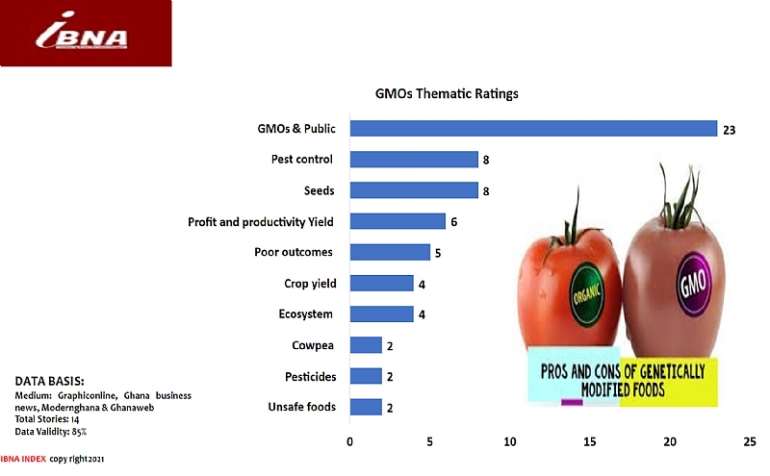
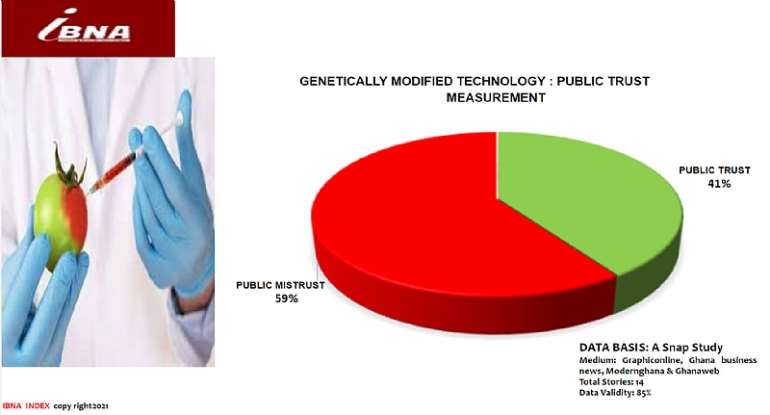
Anti and pro GMO campaigners has brought GMO issues to the public arena with much concern. Among the issues raised are food safety, ecosystems impact, pesticides and many more. In terms of the level of Public Trust and Public Mistrust measurements, 59% of GMO themes were framed with mistrust whilst 49% pointed to the public trust levels. This suggest that the Ghana National Biosafety Authority should embark on public sensitisation campaign to educate the public and subsequently build public trust in the genetically modified technology and GM food as a whole.
Don’t speak Science but Communicate Science
Scientific policy initiatives should be driven by effective public communication campaign. It seems this bit has eluded many scientific establishments. In an era of vast media ecology and heightened public misinformation, fake news and communication conspirators, it is important to place more emphasis on scientific communication efforts than speaking science to the population.
Naturally new scientific break throughs are accompanied by mix-attitudes of positive embracement and negative repellences, anxiety, uncertainties and mistrust. It is therefore necessary to embark on community-participation communication, thus reaching out to all opposing views on GMOs. The benefits of GMOs to the society should always be juxtaposed with opposing views in order to deepen understanding and public buy-in as a way of winning public trust. Hopefully this would ensure mutual understanding between anti-GMOs advocates and the government in Ghana.
To combat scientific miscommunication threats, scientific establishments should partner media to dilute public rumors surrounding genetic modification technology.
Also, government agencies should formulate well measured communication goals in managing the high level of stigmatization of GMOs.
To add, scientist should start acting as a trusted source, they should identify with the community in which they are operating, they should break down scientific jargons to lingual and cultural elements that resonate well with the community in GMOs public education campaign. A pictorial form of communication is also desirable.
It is highly recommended, if possible, spokes persons for scientific establishment or on scientific dispensations should be scientist with communication background. It helps in communicating science than speaking science.
Author: Messan Mawugbe (PhD): A lecturer at the Department of Communication Studies of the University of Professional Studies, Accra (UPSA, Accra) and also the managing founder of the Institute of Brands Narrative Analysis (IBNA). IBNA is an Accra based Media Monitoring and Social Media Analytics Agency
Email: [email protected]
 Police arrest two as search intensifies for missing couple
 Three Akosombo units restored after fire incident — Energy Ministry
 'Weep not for rude CEOs, weep for your dying nation' – Kwesi Yankah tells Julius...
 UCC lecturer, TA die in accident
 Malaria deaths fall by 98% since 2011 – GHS
 Two-month salary arrears for newly recruited nurses paid — Health Ministry
 'We'll complete all Big Push projects on schedule' — Roads Minister assures
 Voltaian Basin Project: GNPC Explorco engages Yaa Naa, stakeholders ahead of dri...
 Senyo Hosi praises Ayine’s role in OSP creation, urges broader policy approach t...
 PUWU condemns ECG staff transfers, reassignment


