




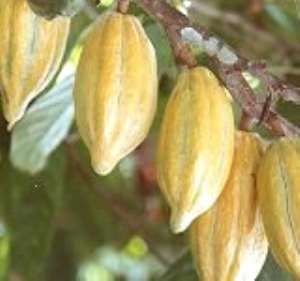
A news item in The Ghanaian Times of 17 September 2020, read:
QUOTE: Ghana cocoa risks EU market ban …over forest reserves destruction, galamsey
“The European Union has threatened to stop buying cocoa from Ghana if the continuous destruction of the country’s forest reserves, through illegal mining [galamsey] and prospecting for minerals, are not stopped.
[These practices are] “destroying the environment and forest cover and those involved must take a serious look at the matter,” the Chief Executive Officer (CEO) of COCOBOD, Mr Joseph Boahen Aidoo, disclosed ... during a courtesy call on the Western Regional House of Chiefs in Sekondi.
He said the EU was worried that the destruction of the forest reserves due to these illegal activities was contributing to climate change....Forest reserves promoted more rainfall, so illegal mining [galamsey] in forests would affect Ghana in the near future, if measures were not taken against prospecting and mining of minerals in the forest reserves. He... appealed to [the] chiefs to stand up and fight the menace.
“He said the cocoa industry was facing many challenges, in terms of the swollen shoot disease, the price, and climate change through human behaviour. [Frantic efforts were therefore being made] to improve the yield.... Mr Aidoo [also described] the use of the cutlass on cocoa farms as too tedious. So, new slashing machines had been procured for farmers [in order that they would] use lesser time and energy to gain more yield...
“The COCOBOD CEO [further revealed that] due to climate change, the rainfall pattern had reduced drastically...The President of the House [of Chiefs] Ogyeahoho Yaw Gyebi II, said the Government must give power to the traditional authorities to operate in their areas. Sometimes a chief would send for someone and that person would refuse to attend to the chief’s call. [This] was insubordination, he said.
“He blamed the Forestry Commission for issuing permits to people to operate in the [forest] reserves and urged the government to stop the Commission from issuing the permits. The President, who is the Paramount Chief of Ahwiahso, [disclosed that] the destruction of the forest was being done with the connivance of some politicians and people in authority, [with the result that] the culprits could not be reprimanded.
FROM PETER GBAMBILA, SEKONDI”
UNQUOTE
In an editorial on the issue, The Ghanaian Times pointed out that cocoa is the backbone of Ghana’s economy, generating about $2 billion in foreign exchange annually and contributing a huge part of Ghana's Gross Domestic Product....
“The country is the second-largest producer of cocoa [in the world] and the only supplier of premium beans”, the paper said. It noted that “about 850,000 farmer families in the Eastern, Ashanti, Brong Ahafo, Volta, Central and Western North and South regions, are estimated to be involved in cocoa farming and its related activities.
“It is thus shocking to learn that the European Union (EU) has threatened to stop buying cocoa from Ghana if the incessant destruction of the country’s forest reserves, as a result of illegal mining,[galamsey] was not halted. ..The EU [is] worried over the destruction of the forest reserves, due to these illegal activities – one of the factors causing climate change.
“The Ghanaian Times is concerned about the threat by the EU, because the Union does not issue empty threats and one like this would result in huge losses that should be avoided...Between 2014 and 2017, when the EU banned vegetable exports from Ghana for non-compliance with the EU standards for the export of vegetables, the country lost about US$30 million in revenue...
“It would be a costly mistake to allow an illegal activity like ‘galamsey’ to do more harm than it is already doing...The Ghanaian Times has observed that the energy with which the fight against illegal mining was intensified about three years ago has waned... It is almost as though the fight has been lost. The media continues to report seizures of equipment amongst other sanctions. But the activity seems to have intensified....River bodies are getting more polluted. [This is evident] from their golden-yellow colour.
“We... cannot give up and throw our hands in despair. The solution lies in the enforcement of the various laws....We must not disappoint the future generation....All efforts [to save cocoa production] would come to naught if we allow an illegal practice to derail these efforts. Culprits must be seen to be punished. We must endeavour to win the fight. And by all means we must win,” The Ghanaian Times added.
I hope The Ghanaian Times, through this editorial, will rekindle the interest of the other members of the Media Coalition Against Galamsey, in keeping up the struggle against those who want to destroy the sacred water-bodies bequeathed to us by our ancestors. They selected habitats for us that contained adequate supplies of water, realising (as they did) that life is not possible without good drinking water.
Yet some people, in their stupid greed, think that obtaining gold is more important than leaving their children and the children of their children, a habitat that can sustain life through the availability of water. All sane Ghanaians must therefore fight to save our water bodies for these unborn generations. Our ancestors left us water, and we have no right to destroy it. It is our duty to that we do not bequeath to our progeny, a desiccated land in which you can survive only if – you can buy bottled water, not only to drink, but to wash things, or cook food with. No-one has the right to reduce us to such a wretched state of human existence.


 Somalia president term extension 'unlawful': Supreme Court
 Nigeria court strikes down candidacy of opposition leader Abubakar
 'There are no offices for Council of State members, you carry your office in you...
 Galamsey: 'Extremists can infiltrate northern Ghana' — UDS Professor warns
 IMF reaches staff-level agreement with Ghana on first review of 36-month program...
 Don’t treat Obuasi SHTS sexual abuse claims as business as usual—NAPO
 45 tonnes of cocaine were brought in by two Gulfstream jets in 2023 under Akufo-...
 22 drug seizures under Mahama means NACOC operations improved, intelligence now ...
 'NPP withdrawal of NACOC from port inspection teams in 2018 was major cause' – A...
 'NPP not morally qualified to lecture NDC on cocaine issues' — Akwatia MP hits b...


