




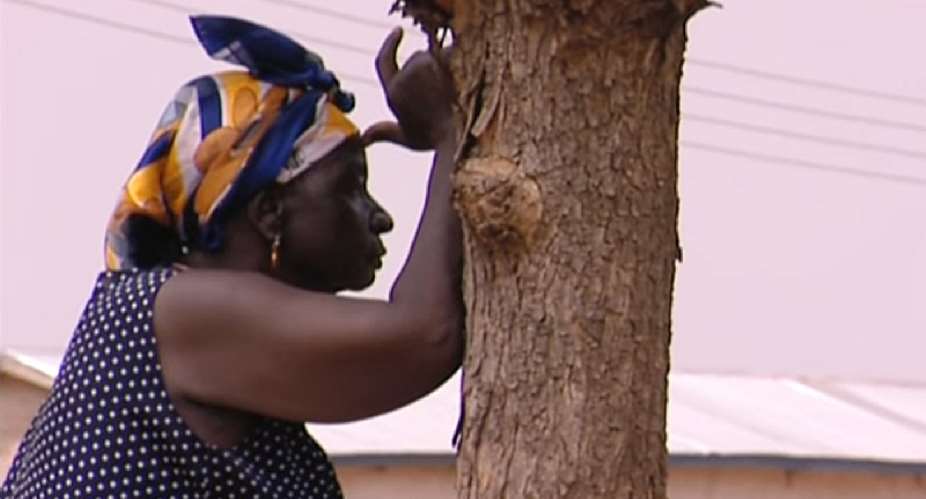
The cold-blooded murder of a 90-year-old woman, Madam Akua Denteh, at Kafaba, near Salaga, in late July 2020, has shocked many Ghanaians.
The old lady was brutally murdered – in full public view – with a video of the incident going viral – all because she was believed to be a witch.
I have little to add to the expressions of disgust, except to ask this question: What did all these justifiably horrified people expect, when, over a period of ten years, Madam Ama Hemmah, a 72-year-old woman, was similarly murdered as a watch, in broad daylight, at Tema, and yet justice has been denied to the family she left behind?
The law is there to prevent crime, as well as punish it. When something unlawful is done and it goes unpunished, people with a mentality similar to that of those who committed the crime, will convince themselves that they have nothing to fear when they too commit a similar crime. Indeed, if they are motivated – as in this case – by religious bigotry fuelled by evangelistic zealotry, the potential criminals can read into the inaction of the authorities over a crime, a secret agreement between the powers that be andthose who commit such crimes.
Thus, in committing the crime, the criminals can assure themselves that they are doing something that an amorphous group of “higher authorities” in the society would approve of, but about which the latter would keep mute, because they lacked “the guts” to go public with their views. In other words, a climate of connivance – indefinable but nevertheless real – can exist between members of society and potential criminals, without either set of people realizing that they are indeed united by “a common purpose”.
Aware of this social phenomenon and the possibility that it might cause imitative, or “mimic”, crimes to be committed, I have written and written and written about the dangers of not fully prosecuting Madam Hemma's murderers and bringing them to justice. I don't have the space to reproduce my demands for an explanation from the police about why they seem to have abandoned the prosecution of Madam Hemma's murderers. I have received no answer from the police, I am sorry to say. Nor have I heard from the Minister of the Interior, or the Attorney-General's office.
Even more bizarre is the fact although Madam Hemma's case has been extremely well publicised both at home and abroad, the Commission on Human Rights and Administrative Justice (CHRAJ) which was created in 1993 as an independent institution designed to “protect fundamental human rights and freedoms in Ghana”, has not, to my knowledge, asked the police anything about Madam Hemma's case!
If CHRAJ really “exists to build on and improve good governance, democracy, integrity, peace and social development across the nation” does it think that looking on unconcerned when acts of murder are not adequately prosecuted, can guarantee the human rights of Ghanaians? Isn't the right to life the most important of all human rights?
CHRAJ and the other organisations that often go to the aid of educatedmembers ofthe societywhose rights are trampled upon, should make their work also relevant to the disadvantagedsections of the society, for they too pay taxes.
I would like to end this article by quoting from what was originally published at the time of Madam Hemma's murder ten years ago:
Daily Graphic, 26 November 2010:
"Grandma Set Ablaze To Exorcise Witchcraft
"A 72-year-old grandmother [Nana Ama Hemmah] suffered one of the most barbaric of deaths when she was burnt alive by a mob at Tema Site 15, after being accused of being a witch.
"A student-nurse, who appeared on the scene, attempted to rescue the old woman from her ordeal but she died of her burns within 24 hours of arrival at the Tema General Hospital.
"Five people who allegedly tortured and extracted the confessions of witchcraft from Ama Hemmah before drenching her in petrol and setting her ablaze, have been arrested by the Tema Police.....
"Two of the suspects are Samuel Ghunney, a 50-year-old photographer, and Pastor Samuel Fletcher Sagoe, 55, the evangelist. The rest are Emelia Opoku, 37, Nancy Nana Ama Akrofie, 46, and Mary Sagoe, 52, all unemployed.
"Briefing the Daily Graphic on the incident, the Tema Regional Police Commander, Mr Augustine Gyening, Assistant Commissioner of Police, said about 10 a.m. on November 20, 2010, Samuel Fletcher Sagoe visited his sister (Emelia) at Site 15, a suburb of Tema Community 1, and saw Madam Hemmah sitting in Emelia's bedroom at a time Emelia had sent her children to school.
"Mr Gyening said Samuel then raised an alarm attracting the attention of the principal suspect, Samuel Ghunney, and some people in the neighbourhood.
"According to him, the suspects claimed that Mad. Hemmah was a known witch in the area and subjected her to severe torture, compelling her to confess [to] being a witch......After extracting the confession from Mad. Hemmah, Ghunney asked Emelia Opoku for a gallon of kerosene and, with the help of his accomplices, poured it all over her and set her ablaze.
"[Assistant Commissioner] Gyening said a student-nurse, Deborah Pearl Adumoah, who chanced upon the barbaric act, rescued Mad. Hemmah and sent her to the Community One Police Station, from where she was transferred to the Tema General Hospital, but she died the following day.
"In their [statement made under caution], the suspects denied the offence and explained that they poured anointing oil on the old woman and [that] it caught fire when they offered prayers to exorcise the demon from her.” UNQUOTE
http://www.Graphic.com.gh /news/page.php?news=10378
THIS IS WHAT I WROTE ABOUT THE INCIDENT AT THE TIME:
CAMERON DUODU writes:
Because the suspects are likely to be prosecuted, I cannot offer a detailed analysis of their behaviour, due to the sub judice rule that prohibits comments on cases that are yet to be decided by the courts.
But without prejudice to this particular case, I can confidently state that one thing is certain: a great number of people, particularly old women, are routinely subjected to the most excruciating physical and mental torture in Ghana in the mistaken belief that they are "witches". The lack of knowledge in the country generally about the physical and mental degeneration that occurs in certain individuals during old age, results in some people taking Alzheimer's disease and hysterical dissociation in particular, and mental illness as a whole, as signs of witchcraft.
This ignorance, fuelled by a patchy knowledge of scriptures, which causes some people to interpret the Bible literally, induces them to inflict ultra-barbaric treatment on these alleged "witches" in the mistaken belief that they are doing what The Lord Jesus Christ would have done, had these alleged "witches" been brought before Him. But Jesus did not burn witches. He showed them compassion and physically touched them with his hands, which acts, even if He were not endowed with divine healing powers, would have affected the sick people positively in psychological terms, given the enormous reputation for miraculous performances that preceded Jesus to wherever He went to preach.
Many of the latter-day evangelists who preach " in Jesus' name", are in fact religious mercenaries, some of whom are themselves, either psychotic, borderline maniacs, or drugged "false prophets". Some believe that 'it is better to be feared than to be loved' and resort to what amounts to religious terrorism in order to exercise power over the communities in which they live.
Witchcraft has long formed part of Ghanaian mythology, and to the ulearned, the mention of demons in the Bible translates only too easily into a confirmation of the existence of "witches" among communities today. So, a Ghanaian marriage breaks down, due probably to infidelity or pecuniary hardship — and the old lady in the household is held responsible.
A young, unemployed man becomes listless and shows signs of depression: an old lady wants to kill him spiritually and consume him, with her coven of witches. A lorry driver gets drunk and crashes his vehicle: an old lady shone a torch into his eyes and blinded him and his vehicle ended up in a ditch. Even simple, mundane problems like pupils failing exams, or crops withering away due to drought, or an inability to save money due to reckless spending, are laid at the door of the ubiquitous "witch."
Hence, large swathes of Ghanaian society fatalistically absolve themselves of personal responsibility in almost all things, and, armed with both traditional superstitions and the modern equivalent preached by some of the churches that specialise in demon expulsion, can easily embark on acts of brutality against helpless scapegoats, such as the old lady who was executed in public at Tema.
Evidence in support of my assertion that this is a nationwide phenomenon in Ghana is provided by another report in the Daily Graphic. This report reads:
"The Chairman of the National Commission for Civic Education (NCCE) has observed that the existence of witch camps in the country offends Chapter Five of the 1992 Constitution. Mr Laary Bimi, considered the practice as discriminatory against women and [said it was] inhuman and … prevented the victims from enjoying their rights as humans. as enshrined in the Constitution.
He wondered why there were supposed to be [male] wizards too but only women were made to endure the ordeal at the witches' camps, where they are kept against their will.
"Mr Bimi was speaking at a day's workshop organised by the NCCE in Accra to disseminate findings of a study conducted by the Research Department of the Commission on: "Witchcraft and Human Rights of Women in Ghana: Case Study of Witches' Villages in Northern Ghana". Witchcraft is considered a universal and historical phenomenon, which continues to attract a lot of interest. Suspected witches are regarded as evil and harmful and because of that, people suspected to possess such powers are sometimes killed, maltreated or banished from the communities in which they live.
"Against that background, Mr Bimi challenged Ghanaians to abide by the tenets of the constitution in a holistic manner if they wanted to be counted among the democratic people of the world.
The study was conducted in three witches camps in the Northern Region, namely the Gambaga Camp* in the East Mamprusi District, Tindanzie Camp in the Gushiegu District and the Tindang Camp in the Yendi District.
Presenting a paper on the "Objective, Methodology and Socio-demographic characteristics of Respondents", Mrs Janet Sarney-Kumah said the 1992 Constitution established that citizens were entitled to certain rights and freedoms, which include equality before the law, freedom from torture, cruelty and inhuman treatment, and human dignity.
Mrs Sarney-Kumah indicated that most of the alleged witches interviewed were very old people and said old age was a factor influencing an individual's likelihood of being accused of witchcraft.
"She, however, indicated that 7.1 per cent of the people interviewed [in the study] openly admitted possessing witchcraft.
"Mr Derek Gyamfi Yeboah, who presented a paper on "Witchcraft acquisition and conditions at the camps", said 38 per cent of the respondents indicated that witchcraft was acquired through gifts obtained from persons who were already possessed. In addition, 49 per cent stated that people acquired it through family lineage, either by inheriting it from a dying relative or handed over to them by other family members.
"Speaking on "Freedom of association, integration and conclusion", Mrs Praise Mensah said since the constitution guaranteed freedom of association for every citizen, the alleged witches, irrespective of their conditions, had the right to participate in every lawful social activity of their choice in the community.
In her welcoming address, the Director of Research at the NCCE, Mrs Getrude Zakaria-Ali, commended the personnel for a good work done and said with the findings, the Commission was better equipped to embark on an effective civic education, which the constitution mandates it to do."
http://www.Graphic.com.gh /news/page.php?news=10369
*In the UK, meanwhile, The Witches of Gambaga, a film co-produced and directed by a Ghanaian-British film-maker, Yaba Badoe, has won the 2010 Black International Film Festival Best Documentary Award. According to its Synopsis, "The Witches of Gambaga' is a haunting 55-minute documentary film about a community of women condemned to live as witches in Northern Ghana. Made over the course of 5 years, this disturbing expose is the product of a collaboration between members of the 100 strong community of 'witches', local women's movement activists and feminist researchers, united by their interest in ending abusive practices and improving women's lives in Africa.
Painful experience and insight combine to generate a uniquely intimate record of the lives of women ostracized from their communities. Told largely by the women themselves, their incredible stories and struggles are rendered comprehensible to a wide range of audiences by the director's narration.
It was completed in August 2010 by Fadoa Films Ghana and UK. It was directed by Yaba Badoe, and co-produced by Yaba Badoe and Amina Mama.
REVIEWS of The Witches of Gambaga
"A very good watch, beautifully made" Ingrid Falck, Al Jazeera
"I was gripped from beginning to end" Suzy Gillet, London Film School
"A brave and brilliant production" Hope for the African Village Child Trust
"Thank you for living up to our expectations." Netright, Ghana
"…will go a long way to promote the rights of women…" African Women's Development Fund
" .. a shocking, extraordinary film.." Michael Eaton, screenwriter
"… the unacceptable and abusive treatment of women as witches is exposed…" ABANTU FOR DEVELOPMENT
Below is a link to the trailer of the film of Youtube
The Director of the film, ABA BADOE, is a Ghanaian-British documentary film-maker and writer. A graduate of King's College, Cambridge, she worked as a civil servant in Ghana before becoming a General Trainee with the BBC. She has taught in Spain and Jamaica and has worked as a producer and director making documentaries for the main terrestrial channels in Britain. In 2009, her first novel, 'True Murder', was published by Jonathan Cape. Her TV credits include: 'Black and White', a ground-breaking investigation into race and racism in Bristol, using hidden video cameras for BBC1; 'I Want Your Sex', for Channel 4, and a six-part series, 'VSO', for ITV.
For further information contact Yaba by e-mail or on +44-(0)208 675 5978
I have no evdience that The Witches of Gambaga has, in fact, ever been shown in Ghana, and if so, what the reaction to it was.
The lackadasical, almost schizophrenic attitude to false prophets by the media, and the media's unconcern about some incidents of brutality against witches -- with a few very good eceptions -- must take its share of the blame for the continued inability of the authorities to stamp out barbaric practices, such as are discuseed in this article.

 Attorney-General appeals ruling halting trial of former Buffer Stock CEO, wife
 NAIMOS destroys 1,970 changfans, 863 Illegal mining structures in three months —...
 Let's see how Asiedu Nketia becomes NDC flagbearer with same people he conspired...
 Asiedu Nketiah opts out of NDC chairmanship race amid flagbearership speculation
 NDC insists Nkwanta North elections will proceed despite court injunction
 'My side of the story will shock you; I'm waiting for court days' – Obuasi SHTS ...
 Obuasi SHTS sexual abuse: 'GES must distant itself, allow the law to work' — For...
 Upper East: Fear grips nine Kusaug communities over mysterious fish deaths in da...
 NDC suspends Amasaman Communications Officer over 'irresponsible' remarks on Obu...
 Parliament secures religious leaders’ support to end witchcraft accusations


