




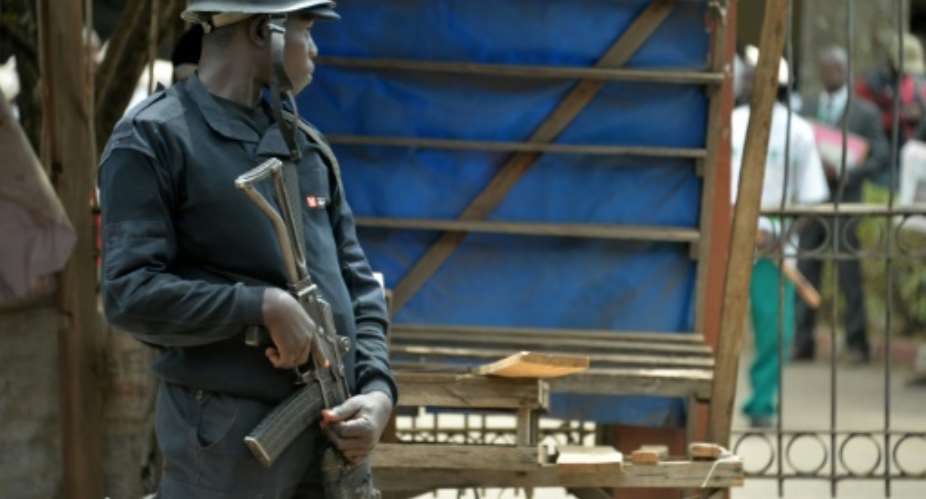
Cameroon on Wednesday blamed separatists over the killing of a US missionary, but Washington said its citizen was caught in crossfire and urged dialogue to end the African country's conflict.
Charles Wesco, 44, was travelling with his wife, son and a driver in the restive English-speaking northwest region when militants attacked security forces and a university campus, Defence Minister Joseph Beti Assomo said.
In a statement read on army radio, Beti Assomo said the American came under fire in an ambush by "a group of armed terrorists" in the town of Bambui and died later in a hospital in the regional capital Bamenda, 14 kilometres (nine miles) away.
The minister said that security forces then pursued the militants, killing four of them, with several others wounded including a soldier and a student.
His comments came amid speculation by separatist supporters on social media in the English-speaking regions -- the site of an uprising by armed secessionists -- that the Cameroon army was behind the killing.
But in Washington, State Department spokesman Robert Palladino did not blame either side and said Cameroon had promised the United States a "full investigation" into Wesco's death.
"We've been in touch with senior Cameroonian government security officials and we believe the victim was caught in the crossfire," Palladino told reporters.
Palladino urged the two sides to start "an immediate and broad-based dialogue without preconditions" to bring peace and resolve grievances.
"Both separatist fighters and government security forces have used violence against innocent civilians," Palladino said.
"We call on both sides to view the tragic death of this American citizen as an opportunity to put an immediate stop to violence and to allow unhindered access for humanitarian aid workers and health care providers in the northwest and southwest regions," he said.
Grievances by English speakers
English-speaking separatists argue that the French-language education system penalises anglophone students in the largely francophone central African nation.
The unrest has claimed the lives of more than 400 civilians and an unknown number of separatists in the year to September, according to the International Crisis Group think-tank.
On Thursday, gunmen killed a linguistics professor in the same area.
University staff said the murder of the academic, who was also in charge of administration, bore the hallmarks of the "Amba boys," or separatists fighting for an independent English-speaking state called Ambazonia.
The government has refused to engage in dialogue with anglophone separatists it brands "terrorists" and has sent forces into the area to restore order.
More than 300,000 people have fled the violence, some to neighbouring Nigeria.
The voter turnout during October's presidential election was very low in both anglophone regions, although Paul Biya won more than two-thirds of the votes cast, according to official results.
Biya, 85, has been in power since 1982 and was re-elected for a seventh term with 71 percent of the votes nationwide.

 'Otumfuo carries special spiritual powers' — Kufuor recounts how Asantehene ‘pre...
 Ghanaian prophet says he can stop rain, knows the next presidential candidates a...
 Ghana petitions AU over xenophobic attacks in South Africa
 NPP northern caucus demands resignation of Greater Accra Minister over ‘transfer...
 GES releases 2026/2027 academic calendar for basic schools in Ghana
 Mahama holds high-level talks with UAE president on energy and economic cooperat...
 Big Push: Roads Minister threatens to terminate contract on Techiman-Wenchi road...
 Seven medical staff to face disciplinary action for 'killing' Charles Amissah
 Finger chopped off, suspect arrested in Akyem Oda machete fight
 Here are areas to face 9-hour blackout over ECG maintenance exercises across thr...


