




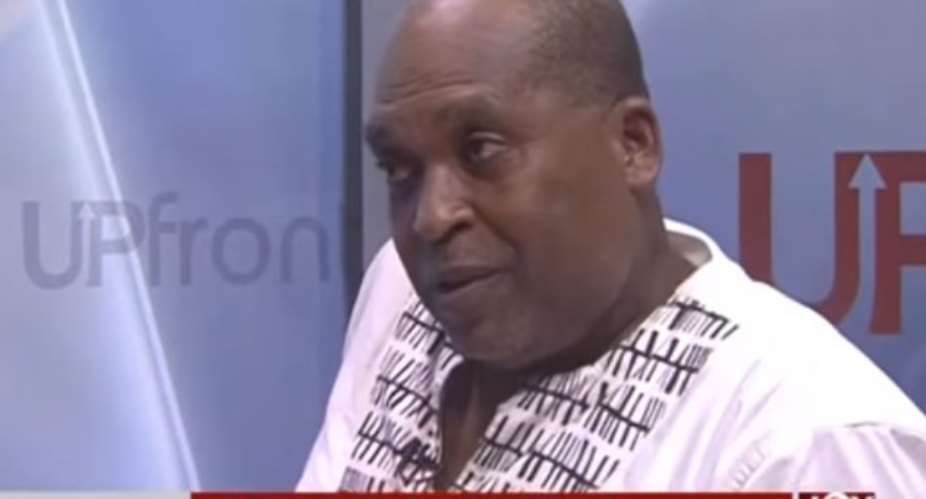
A former activist of the 4 June 1979, Uprising and 31 December1981, Revolution has said that there is no justification for the murder of eight senior army officers perceived to be corrupt.
Holding back names while speaking on Upfront on Joy News TV on Wednesday, Kwasi Adu was saddened that some of the persons who participated in the killings are the very people “grabbing properties” currently.
In 1979, General I.K. Acheampong, Major General E.K. Utuka, Rear Admiral Joy K. Amedume, Major General Kotei, General F.W.K. Akuffo, Air Vice Marshal George Yaw Boakye, Lt. Gen. Akwasi Amankwa Afrifa and Col. Roger J. Felli, were summarily executed by firing squad at the Teshie Shooting Range in Accra amidst chants of 'Let the blood flow' by some disgruntled Ghanaians.
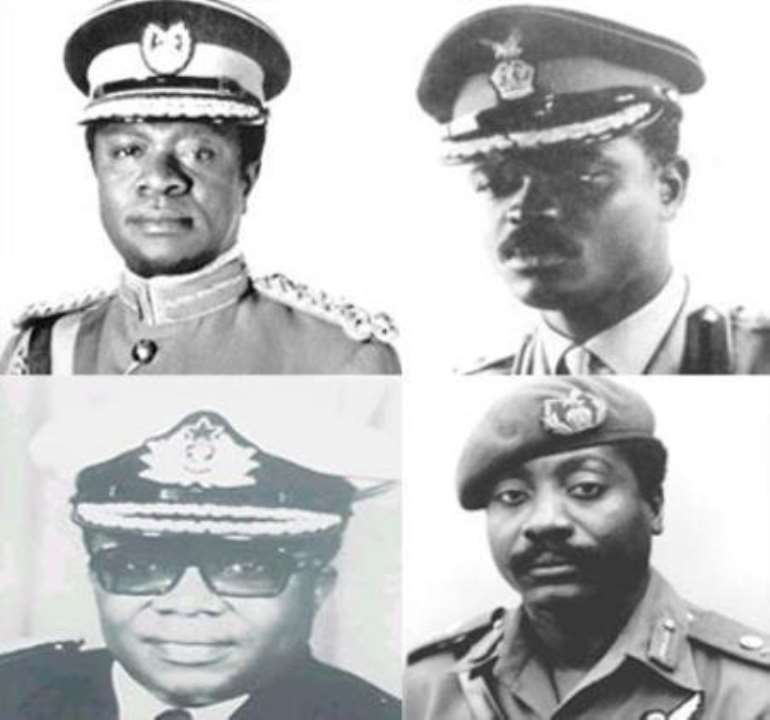
From L-R: I.K. Acheampong, Akwasi Amankwa Afrifa, Rear Admiral Joy K. Amedume and General F.W.K. Akuffo
The execution was carried out by the Armed Forces Revolutionary Council (AFRC) on June 16 and June 26, 1979, led by Flt. Lt. Jerry Rawlings. He said if the executions had not been carried out, the rank and file of the Ghanaian Army would have slaughtered the officer corps.
Read: Rawlings confesses "sacrificing" innocent commanders
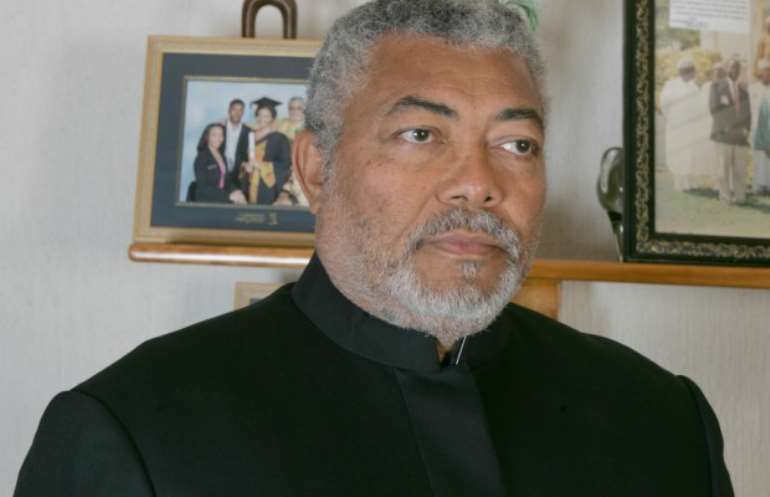
Flt. Lt. Jerry John Rawlings (Retired).
“There was a moral outrage and at that time it was considered that there was too much corruption [ Kalabule ] then [but] if you compare it to today, the offenses in those days are nothing,” stated Kwasi Adu, who served on the Housing subcommittee of the Confiscated Assets Committee of the AFRC.
Read: Rawlings 'murdered' our father - children of 'sacrificed' army general fumes
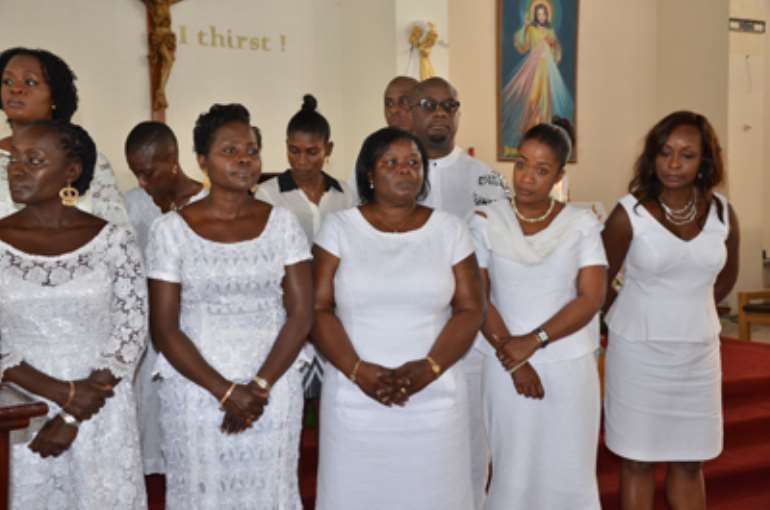 Children of the late Generals
The ‘Comrade’ Kwasi Adu also accused Jerry John Rawlings, the leader of the military junta that ruled the country briefly in 1979 and later in 1981, under the Armed Forces Revolutionary Council (AFRC) and Provisional National Defence Council (PNDC) respectively, of not living the core values of the regimes.
“Rawlings is not the same person who I thought he was. I thought he was somebody who cared for the ordinary people in the streets and would be interested that they also got to participate in decisions affecting their lives…but the time he left office [January 2000] the people were nowhere near power,” he told host Raymond Acquah.
Kwas Adu said he fell out with PNDC Chairman in 1982 because he felt he [Rawlings] was just “shouting” most of the time but was not putting any sound economic policies that were needed to bring change in the lives of the people.
39th anniversary of June 4
Addressing a rally on June 4, 2018, to climax the 39th-anniversary celebrations of the June 4 Uprising, Rawlings accused some National Democratic Congress (NDC) of not living the ideals of June 4 and 31st December- probity and accountability- upon which the NDC was formed.
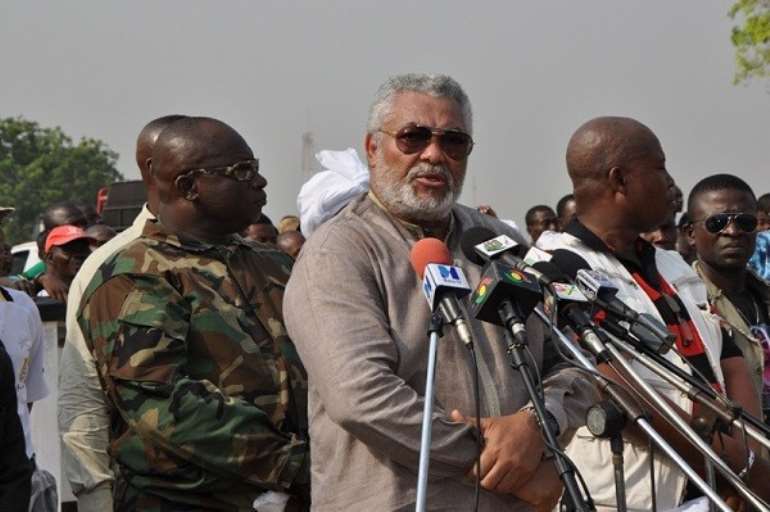
"June 4, 1979, and 31st December, 1981 were not about individuals or a small group of people. They came about as a result of a deterioration of all that Ghana stood for. The freedom and justice that we so proudly tout as our national motto had been lost on us. The ‘house-cleaning’ exercise that occurred in 1979 led to many sacrifices. Sacrifices that today some choose to distort for their selfish political ends.
“I speak of the history of June 4 because it stood for the restoration of the values of freedom and justice, probity and accountability, transparency and integrity and a dedication to the truth," he told the gathering in Ho, the Volta Regional capital.
But Kwasi Adu says the main issues that made the June 4 Uprising popular was not ‘Probity and Accountability’ but to make indigenous Ghanaians take control of the local economy which was dominated by foreign nationals then.
The use of ‘Probity and Accountability’ he suspects, is to justify some of the excesses that were recorded during Rawlings’reign as a military leader.
“These days we hear a lot about probity and accountability; the issue at that time was not [probity and accountability]. These days people find it convenient to say that the core values of June 4 [Uprising, 1979] and 31st [December Coup, 1981] were probity and accountability [but] it is not true. It is something that they picked along the way when they saw that they were going away from everything so they have to find a way of justifying themselves…,” he said.
Watch the discussion below:
Story by Ghana | Myjoyonline.com | JTM
 Massive reactions as woman allegedly snatches her daughter’s boyfriend
 Chinese factory gutted by fire in Prampram
 2026 May Day: I will let the economic growth filter down to your pockets – Maha...
 Police kill 2, arrest 4 in Upper East robbery gang bust
 China opens tariff-free trade to nearly all African countries
 UG, KNUST and UCC lecturers to withdraw services over unpaid promotion arrears
 "24-hour economy markets will transform the economy" — Hon Jerry Ameko
 Mahama begins Eastern Region tour with May Day address and key projects
 Free Zones boss alleges political sabotage in Akosombo sub-station fire
 Akosombo substation fire an opportunity to modernise power infrastructure — Maha...



Comments
The June 4th and the 31st revolutions were just myths. Rawlings just used the opportunity to steal from Ghanaian coffers. How many of the Generals he killed, educated their children overseas? It is just a pity that his actions and ruling Ghana for 19 years after the 31st, left Ghana in a very deplorable state. How many Clinics, hospitals, toilets, etc did he build in all these years other than channel Ghanaian funds through Tsatsu Tsikata to be deposited in foreign banks with the pretext tha...