




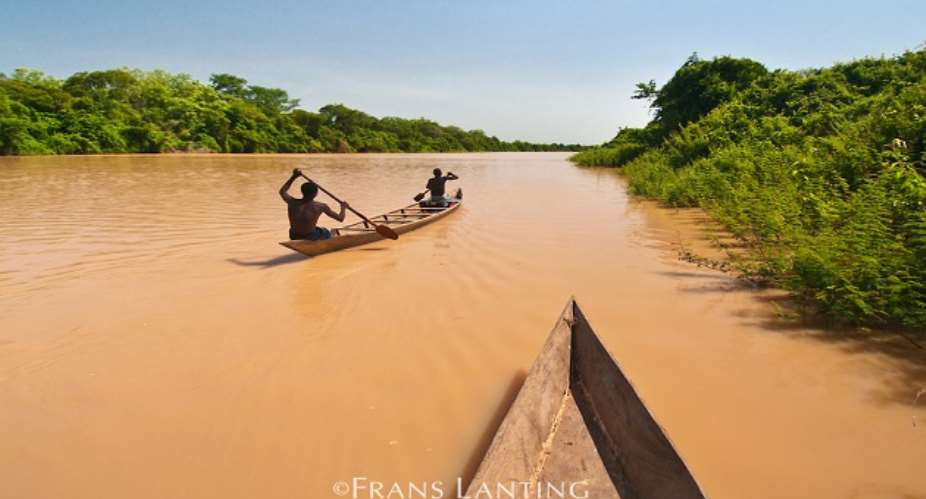
When I was attending middle school at Kyebi, in the Eastern Region, my task each morning was to go to the River Birem, where I would bathe and bring some water home.
I wasn't the only one - scores of my schoolmates from Kyebi Government School and the rival State Primary School, congregated on the Birem's banks each morning, teasing one another and swapping stories.
It never occurred to me then that River Birem could ever be destroyed. In one of those apostrophes that pay tribute to the poetry inherent their culture, the people called her ”Asuo 'Benaa” (The Tuesday-born Female River) and endowed her with all the attributes of a human being. Examples:
she was not to be visited on Tuesdays, because she would be resting from the long journey she had made from her source in the Atewa Range. She would use her rest-day to recharge her batteries and recover from the pollution that fishing and farming too close to her banks had wrought on her waters.
Hey – Birem was not to be played with! In the rainy season, she turned muddy-red: to warn everyone that she was “angry”. Where once people could tread in her, she would now be threatening their foothold with sharp currents. And her banks became soggy and slippery. So occasionally one heard
that “Birem has taken someone.”!
But because all this was known to the people, Birem generally never caused much harm. I drank her water for three solid years, and all that time, no water-borne diseases ever affected anyone that I heard about. Yet such diseases abounded elsewhere – I myself caught bilharzia while I was attending a six-week course at the Atibie Emergency Teacher Training College near Mpraeso. I had never heard of such a disease, as I went my merry way bathing in a river not too far from the College, washing my clothes in it and fetching water home to drink.
My shock at discovering at Atibie that I was urinating blood was considerable. I was lucky I wasn't in a sexual relationship because I would have concluded, in my ignorance, that my partner had infected me with a sexually-transmitted disease! One visit to the hospital confirmed it was bilharzia, a disease caused by a worm that is ejected into the water by a water-snail. The worm lodges in the human liver and blood in the urine is the signal that t has begun to attack one's liver. Fortunately, a single injection was all that was needed to cure the disease in my case.
An experience like that never leaves one, and I have therefore been extremely saddened on reading that galamseyhas so threatened the Birem that even though there is a water-pumping and treatment plant at Kyebi, the water that s pumped into the plant is so muddy that it can no longer be treated by the plant. The plant has therefore been shut down.
What will the people do, one asks. Water provided by tanker will probably be sold to them. What happens if one hasn't got money?
Even free supplies of water could create tension, for some people hate to queue up in an orderly manner!
Other massive Rivers such as the Ankobra, Offin, Oti and Pra are similarly under attack. Even Tanoh, whose purity has been acknowledged by ancient Asante fontomfromdrums (which always describe that River as”Tanoh kronkron”[Pure or Holy Tanoh] whenever its name comes up) has been gutted by galamsey.
In effect, what Ghana is witnessing today must be the worst, deliberately concerted assault on a people's water-bodies ever experienced by mankind. There have been droughts; there have been floods; yes -- both of which can contaminate water and make it unsafe to drink. But both are natural phenomena which no-one can do anything about.
Ghana's water catastrophe, on the other hand, is entirely man-made. It is being undertaken in search of gold, a metal which nurtures greed in gigantic proportions. Gold's propensity to create life-threatening tragedies was sign-posted long ago by the cautionary tale of King Midas (who died of starvation because he had asked for the power to turn everything he touched into gold – including the food he needed to eat inorder to continue to live!)
So incredible is the situation created in our country by galamsey that one person on an Internet forum
wrote: “I am against the death penalty but this is clearly a genocide in the making and I would introduce the death penalty for anyone caught destroying our water-bodies through galamsey.”
I have said before that in China, if the Government discovered anti-social behaviour in the proportions we are witnessing from galamsey, it would summarily execute the perpetrators. China is in a position at least to prevent toh-toh-toh machines (used to dredge riverbeds) from being exported to Ghana. (Yes, the Government of Ghana could stop their importation, but won't do so because it does not have the true interest of its own people at heart).
China can also easily establish what businesses its nationals in Ghana are carrying out, and order those engaged in galamsey to cease and return home forthwith, or face permanent exile. (Again, this is a duty which the Ghana Government ought to undertake but which it is too unpatriotic to contemplate.)
It is a sad day for me as a Ghanaian, to put on China's shoulders, a responsibility that devolves wholly on my own government. But China's politicians are perfectly capable of analysing and understanding exactly what is going on in Ghana. They know from their own history, for instance, that unconcerned and greedy Chinese collaborators teamed up with Westerners to devastate the people of China during the soul-destroying Opium War.
Ghana needs help of an unusual nature. I call on China once pagan to have no qualms about putting in its oar to save Ghana's threatened water-bodies. Before it is too late.

 AG withdraws charges against former buffer stock CEO Hanan and wife as EOCO re-a...
 Images and videos of military clearing lands for Accra–Kumasi expressway project
 What should give you satisfaction is that your work has helped saved Ghana from ...
 ECG announces emergency maintenance in Ashanti, Western Regions today
 Police arrest two cocoa purchasing clerks for allegedly short-changing farmers i...
 Korle-Bu doctors strike suspended, OPD services resume Tuesday
 May 5: Cedi sells at GHS12.15 on forex market, drops to GHS11.23 on BoG interban...
 NAiMOS cracks down on multinational galamsey syndicate in Mankraso
 Amin Adam runs to IMF to take action on BoG recapitalisation, gold sales and mon...
 PNDC era second gravest crime against humanity after slavery — Miracles Aboagye




Comments
The past and current governments of Ghana have contributed to the great turbidity and pollution of water bodies due to illegal mining activities by other nationals and our own people. I don't think it is so difficult to prevent and control the menace. If it is not as a result of political mischievous aggrandizement, then what is it? So many ministers and leaders yet simple management of our water bodies can't be done. The government should wake up to this.