




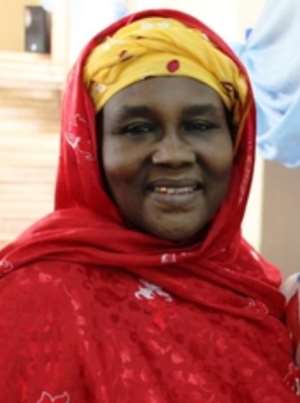
A Woman Who Wrote Her Own Story
There is a certain poetic justice in the life of Hajia Balaraba Ramat Yakubu. The same society that tried to silence her at age twelve by pulling her out of school and marrying her off to a much older man would, decades later, see her name on bookshelves across Northern Nigeria, in secondary school curricula, in Kannywood screenplays, and in international publications.
Hers is a story of a woman who took injustice and turned it into literature and in doing so, gave a voice to millions of women who had none.
She was taken out of primary school at the age of 12 to marry a man in his 40s whom she had never met before. That illiterate girl who didn't even know how to boil water, and who, one year and eight months after the wedding, was finally sent back to her father's house in disgrace, has become one of Northern Nigeria's most well-known writers and the first female Hausa-language author to be translated into English.
Roots, Family, and the Pain of Early Marriage
Balaraba Ramat Yakubu is the younger sister of General Murtala Ramat Muhammed, who briefly served as the military ruler of Nigeria from 1975 until his assassination in 1976. Growing up in Kano, she came from a family of prominence, yet that prominence did nothing to shield her from the rigid customs that governed the lives of girls in her community.
The only reason Yakubu attended primary school at all was because her mother had sent her there in secret. She was the only girl among her grandfather's 80 female grandchildren who went to primary school. When her father discovered it, his response was the arranged marriage. Her older brother Murtala, who had encouraged that schooling, was powerless to stop the wedding. He would later be assassinated when she was just 17 a loss she still finds difficult to speak about.
After her first marriage ended, rather than give up, Yakubu persuaded her father to enroll her in classes in knitting and sewing. But what she didn't tell him was that those courses were part of a centre for adult education, where she learned to read and write in Hausa. In secret always in secret, as if her own thirst for knowledge had to be hidden like contraband she built the foundation for one of the most important literary careers in Nigerian history.
Pioneer of Littattafan Soyayya
Balaraba Ramat Yakubu is a leader in the genre of littattafan soyayya “love literature" and one of the very few Hausa-language writers whose work has been translated into English. She began her career as the only woman member of the influential Kano-based writer's club Raina Kama.
When she penned her first novel in 1987, she was only the third Hausa woman author in the region, and the second one to publish a book in one of Africa's most-spoken languages. After publishing her first novel in 1987, she received letters threatening her and her children. Religious leaders preached against her. But she persevered.
That first novel, Budurwar Zuciya ("Young at Heart"), announced a bold new voice in Hausa literature. But it was her third novel that would become her most deeply personal and socially consequential work.
Wai Zai Auri Jahila? Who Will Marry an Illiterate Woman?
Her novel Wa zai auri jahila? ("Who Will Marry an Ignorant Woman?") Was published in 1990. The title, posed as a question, is both a social taunt and a challenge the very question society asked of uneducated girls, thrown back at society with a provocative irony. For by the novel's end, the real question is not who will marry an illiterate woman, but rather: who is worthy enough to marry an educated one?
The novel, set mostly between the village of Gamaji and the city of Kano, with brief detours to London, Kaduna, and Lagos, tells the story of the headstrong, bookish girl Zainab, nicknamed Abu by her family. In the first part of the novel, Abu's dreams are threatened by the pride and thoughtlessness of men.
The villain of the story, Sarkin Noma, is not simply a wicked man he is a symbol of entitlement. His insistence on marriage to Abu comes initially out of his own need to reinstate control over his three quarrelsome wives, and later out of his desire to subdue the stubborn Abu, who expresses her disgust for him every time he comes courting. His pursuit becomes a horrifying exercise in asserting power.
The book is a statement against child marriage as well as a plea for girls' education something that was not the norm during Yakubu's childhood in Kano, the largest city in Nigeria's predominantly Muslim north. Girls in her father's family were not allowed a Western education; they were sent to Quranic schools until they were ready to marry preferably before they had their first menstrual period.
But Wai Zai Auri Jahila? Is not a story of perpetual victimhood. Like its author, Abu refuses to remain a victim. Ultimately, Abu is allowed the happiness that escapes many of Hajia Balaraba's other heroines having redefined her value, not just as an illiterate girl to be given away, but as an educated woman who has much to give back to her family.
Wa Zai Auri Jahila? Challenges the stereotype of the northern woman as merely silent and oppressed and gives her an agency of her own.
From Novel to Kannywood: A Story That Demanded the Screen The themes of Wai Zai Auri Jahila? Forced marriage, the transformative power of education, the awakening of a young woman's self-worth were always cinematic in their emotional intensity.
It was only a matter of time before Kannywood, the vibrant Hausa-language film industry based in Kano, would bring the story to life.
Balaraba Ramat Yakubu has also worked as a screenwriter, producer, and director of Kannywood films.
Her involvement in Kannywood is not that of a passive rights-holder watching from a distance she is an active creative force, ensuring that the spirit of her books survives their translation to screen.
In 1996, two of her books Budurwar Zuciya (Young at Heart) and Wa Zai Auri Jahila? Were adapted. The adaptation of Wai Zai Auri Jahila? Into a movie series allowed the story to reach an entirely new audience: the millions of Hausa-speaking viewers who may never pick up a novel but gather eagerly around screens in homes, community spaces, and markets across Northern Nigeria and the broader Hausa-speaking diaspora.
This is the particular genius of Kannywood as a medium. The decline of traditional cinemas in the region pushed filmmakers to embrace YouTube and other video-on-demand platforms, keeping the industry alive and expanding its reach far beyond Nigeria's borders to Niger, Ghana, Cameroon, and Hausa-speaking communities worldwide.
The serialized format gave Wai Zai Auri Jahila? Room to breathe to develop Abu's character arc with the depth the story demands, to show not just the suffering but the slow, hard-won journey of self-reclamation, and to hold up a mirror to communities where the very conversations the novel sparked were still happening in living rooms and compounds.
The Legacy of a Literary Giant
Balaraba founded the women-only Hausa writers' club "Kallabi Writers" in July 2008. The initiative started with a membership of 38 writers, mainly from Kano, where Balaraba is revered as a mother and mentor of emerging authors. "To this day, many younger Hausa women writers call me their inspiration," she says.
In 2012, she became the first female Hausa-language author to be translated into English, (bookshy) when the Indian publisher Blaft released the English translation of her novel Alhaki Kwikwiyo Ne (Sin Is a Puppy That Follows You Home) opening her work to global readers and scholars for the first time.
Her novels, including Wai Zai Auri Jahila?, are today listed in the Northern Nigerian secondary school curriculum a remarkable vindication for a woman whose own schooling was violently interrupted. Some of her books display at every market in Kano, where female customers from veiled schoolgirls to grandmothers can be seen browsing through them.
As Yakubu herself says: "I write my stories as if I was in your house, or at your neighbors’. Women recognize them. I feel I have an obligation to society to tell those stories that otherwise would not have been told."
Why Wai Zai Auri Jahila? Still Matters
More than three decades after its publication, Wai Zai Auri Jahila? Remains urgently relevant. According to a National Literacy Survey, almost half of the women in Northern Nigeria cannot read or write in any language. Child marriage remains a lived reality for too many girls. Abu's story is not historical it is happening now.
This is why Hajia Balaraba's book-to-movie journey matters so profoundly. In a region where literature reaches some and screens reach nearly all, the adaptation of Wai Zai Auri Jahila? Into a movie series is not merely entertainment it is advocacy, delivered in the most accessible form possible. Every episode that shows Abu refusing to be diminished, choosing knowledge over submission, building a life on her own terms, plants a seed in the mind of every young girl watching.
Hajia Balaraba Ramat Yakubu did not just write a novel. She wrote a declaration that the illiterate girl forced into marriage is not the end of the story. She is only the beginning. And that question the society posed as a taunt Wai zai auri jahila? She answered it with her life, her pen, and her screen.
The answer is: she will not remain jahila for long.
Mustapha Bature Sallama.
Medical/ Science Communicator,
Private Investigator, Criminal investigation and Intelligence Analysis.
International Conflict Management and Peace Building.USIP
[email protected]
+233-555-275-880

 Accra Is Sinking Yet Again — Time to Be Truthful With Ourselves
 Fire guts rubber factory at Circle Odawna as flooding hampers firefighting effor...
 Flooding strands commuters on Winneba Cape Coast Highway
 Three feared dead after electrocution in Alajo flooding incident
 Nine missing after floods hit Awutu Senya East
 'Your mother, I should go to heaven and ask Nebuchadnezzar to stop the rain?' — ...
 Flood victim found dead along Alajo Railway track as rescue operations continue
 GMet warns more rain as flooding disrupts movement across Greater Accra
 'You sit on social media and talk nkwasiasem' — Nigel Gaisie blasts critics over...
 Osahen Afenyo-Markin accuses NDC of using GoldBod to promote illegal mining


