




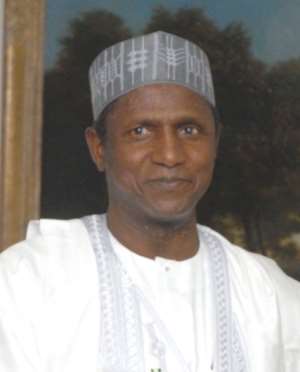
A Son of Katsina
Umaru Musa Yar’adua was born on 16 August 1951 in Katsina, into a family deeply rooted in Nigerian political and traditional life. His father, Musa Yar’adua, served as a Federal Minister during the Nigerian First Republic and held the chieftaincy title of Matawalle of the Katsina Emirate a title Umaru later inherited.
The family name was synonymous with dignity, scholarship, and service, values that Umaru would carry into the nation's highest office.
His name, Umaru, fittingly means "Prosperous" in the local dialect a name that would prove prophetic for the ideals, if not always the outcomes, of his presidency.
Education: The Making of a Scholar-Statesman
What distinguishes Yar’adua sharply from most of Nigeria's past leaders is his extraordinary academic pedigree. He studied at Ahmadu Bello University (ABU) in Zaria from 1972 to 1975, earning a Bachelor's degree in Education and Chemistry, and returned in 1978 to pursue a Master's degree in Analytical Chemistry. Before that, he attended Government College at Keffi from 1965 until 1969, and in 1971 received a Higher School Certificate from Barewa College.
Yar’adua is the first Nigerian leader in nearly three decades to hold a college degree at the time of assuming office a remarkable distinction that speaks volumes about the intellectual caliber he brought to governance. After his studies, from 1975 to 1983 he taught in various colleges and a polytechnic school before becoming a businessman, serving in management and as a director of many companies.
Governor, Reformer, Role Model
Before the presidency, Yar’adua built a sterling reputation in Katsina State. His tenure as state governor focused on socioeconomic development, particularly in the education and health sectors. His administration was described as financially prudent, reportedly clearing the huge state debt he had inherited and accumulating a $50 million surplus in the treasury.
He also set a standard for transparency that was revolutionary in Nigerian politics. He was known for his transparency, publicly declaring his assets soon after taking office, becoming the first Nigerian governor to do so. He was re-elected in 2003 a testament to his popularity among the people of Katsina.
Rise to the Presidency
In 2006, Yar’adua was selected by Nigerian president and PDP leader Olusegun Obasanjo to be the PDP's candidate in the presidential elections. Although he ran against several well-known and popular politicians and military figures, he went on to win with 70 percent of the vote in the April 2007 election. His victory, though clouded by allegations of electoral irregularities, carried enormous symbolic weight.
On May 29, 2007, he was inaugurated as Nigeria's 13th president. The ceremony had particular historical significance, as it was the first time in the country's history that an elected civilian head of state had handed over power to another. Nigeria had crossed a threshold and Yar’adua was the man standing at that threshold.
He arrived in office as a man of humility and principle. Declaring himself a servant of the people, he sought and won a government of national unity. He also divulged his personal wealth a figure of about $5 million, much of it inherited becoming the first Nigerian leader ever to provide a financial disclosure statement.
The Seven-Point Agenda: A Blueprint for Transformation
From his very first day in office, Yar’adua was clear about what he wanted to accomplish. On assumption of office on 29th May 2007, President Yar’adua rolled out his election covenant with the people of Nigeria the Seven-Point Agenda which was properly conceptualized and comprehensively articulated with implementation strategies laid out to ensure the realization of Vision 20:2020.
Launched in 2007, the Agenda focused on seven key areas: power and energy, food security and agriculture, wealth creation and employment, mass transportation, land reforms, security, and qualitative education.
Each pillar addressed a fundamental wound in Nigeria's body politic:
Power and Energy: Yar’adua recognized that without electricity, no industry, no small business, no school could truly thrive. He pursued reforms to boost generation capacity and tackle chronic power failures plaguing the nation.
Food Security and Agriculture: His administration released metric tons of food items from key grain reserves to address food insecurity, in line with the agricultural and food security component of the agenda. Credit facilities were also to be extended to commercial farmers through the Central Bank of Nigeria.
Wealth Creation and Employment: The agenda targeted job creation and poverty reduction, aiming to build an economy that worked for ordinary Nigerians, not just the elite.
Mass Transportation: Transportation was one of the four sectors prioritized due to its cross-cutting implications for the development of the Nigerian economy. Road rehabilitation and rail expansion featured prominently, with the government directing the modernization of railway lines to connect state capitals and major commercial centers.
Land Reform: Yar’adua sought to unlock the economic potential of land ownership for ordinary Nigerians, recognizing that land rights are central to wealth and dignity.
Security: Nowhere was security more pressing than in the Niger Delta. Yar’adua worked to strengthen the Niger Delta peace process and established the Amnesty Programme for militants, which helped reduce violence and restore oil production. This remains one of his most enduring achievements.
Qualitative Education: As a teacher and academic himself, Yar’adua was personally invested in educational reform, seeking to reposition Nigerian schools to produce globally competitive graduates.
The Seven-Point Agenda identified these seven sectors as the engine room for the transformation of the entire Nigerian economy, with an ambition to propel Nigeria to the 21st position in world economic development by 2020.
Rule of Law: His Guiding Compass
Beyond the agenda, Yar’adua made the rule of law his personal mantra. He was perhaps the first Nigerian head of state to speak so consistently and sincerely about the supremacy of law over political convenience. He voluntarily acknowledged that the 2007 election that brought him to power was flawed, and called for electoral reform an act of extraordinary political courage.
The Health Crisis and a Nation's Grief
Sadly, the Seven-Point Agenda was never given the full time it needed. In late 2009, Yar’adua travelled abroad first to Germany and then to Saudi Arabia for medical treatment, where officials said he was being treated for pericarditis, an inflammation of the membrane around the heart. He also had a long history of chronic kidney ailments that weakened his health significantly.
After he had been absent from Nigeria for several weeks, critics complained of a power vacuum in the country, and there were calls for Yar’adua to formally transfer power to Vice President Goodluck Jonathan. He returned to Nigeria in February 2010, but never resumed full duties.
Yar’adua died on 5th May 2010 at the Aso Rock Presidential Villa. An Islamic burial took place on 6th May 2010 in his hometown. The Federal Government of Nigeria declared a seven-day mourning period.
He was just 58 years old.
An Unforgettable Legacy
Today, the Umaru Musa Yar’adua International Airport in Katsina State and the Umaru Musa Yar’adua Expressway in the Nigerian capital of Abuja are both named in his honor. The Umaru Musa Yar’adua Foundation was also established to continue his work in promoting good governance and social development.
His legacy rests not merely on what he built, but on how he governed with humility, transparency, scholarly rigor, and a genuine love for Nigeria. In a political landscape too often defined by self-enrichment and impunity, Yar’adua stood apart as a man who came to serve, not to be served.
The Seven-Point Agenda, even in its incompleteness, remains a serious intellectual document a framework ahead of its time, authored by a president who understood that Nigeria's problems demanded more than rhetoric. They demanded a plan.
Alhaji Umaru Musa Yar’adua did not live long enough to see that plan through. But the seeds he planted in the Niger Delta, in the rule of law, in the culture of transparency continue to shape Nigeria's story. His legacy, as the people rightly say, will not be forgotten.
"I am a servant of the Nigerian people." President Umaru Musa Yar’adua, Inaugural Address, May 29, 2007.
Mustapha Bature Sallama.
Medical/ Science Communicator,
Private Investigator, Criminal investigation and Intelligence Analysis.
International Conflict Management and Peace Building.USIP
[email protected]
+233-555-275-880

 Accra Is Sinking Yet Again — Time to Be Truthful With Ourselves
 Fire guts rubber factory at Circle Odawna as flooding hampers firefighting effor...
 Flooding strands commuters on Winneba Cape Coast Highway
 Three feared dead after electrocution in Alajo flooding incident
 Nine missing after floods hit Awutu Senya East
 'Your mother, I should go to heaven and ask Nebuchadnezzar to stop the rain?' — ...
 Flood victim found dead along Alajo Railway track as rescue operations continue
 GMet warns more rain as flooding disrupts movement across Greater Accra
 'You sit on social media and talk nkwasiasem' — Nigel Gaisie blasts critics over...
 Osahen Afenyo-Markin accuses NDC of using GoldBod to promote illegal mining

Comments
Typical African writer... No one writes about any living person to be a great person until after they die.
Author's Reply
Hahahaha