




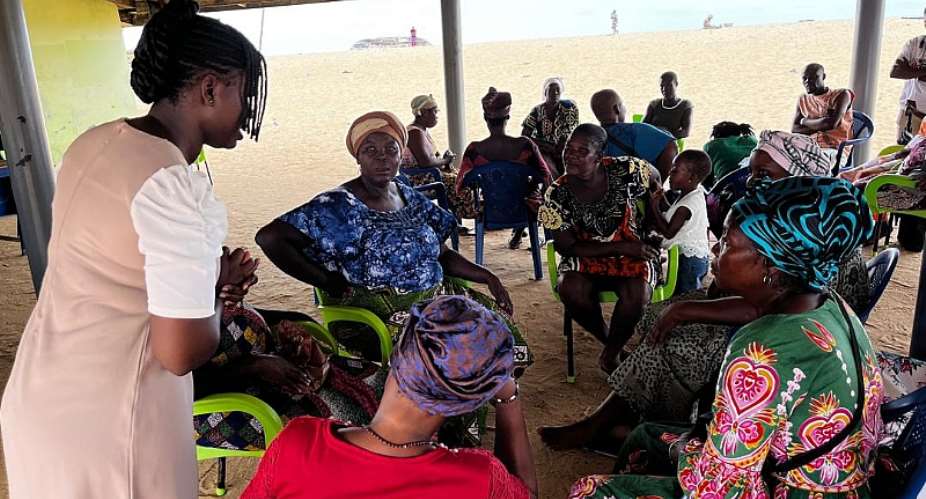
Friends of Adaklu, a non-governmental organisation based in the Adaklu District of the Volta Region, has organised a parental skills training programme for caregivers under its "Sea Works At Night" project to strengthen family relationships and improve child protection in communities affected by tidal waves.
The training formed part of the organisation's broader intervention to support 50 caregiver households in Agavedzi, Salakope, and Amutinu, whose livelihoods have been disrupted by years of coastal erosion. While the project is helping beneficiaries rebuild their economic activities through fishmongering and salt mining, it is also addressing the social challenges that have emerged within affected families.
Project Manager, Roberta Donkor, explained that the initiative is funded by SEZ Germany through Tectonic Movement, an art-based organisation registered in both Germany and Ghana. She noted that children are among the most vulnerable victims of the tidal wave disaster because financial hardship often forces parents to focus on survival at the expense of family relationships.
She explained that many caregivers continue to struggle after losing their homes, property, and sources of income to the sea. As a result, communication within families has weakened, discipline has become harsher in some homes, and children are increasingly exposed to neglect, abuse, and family separation.
According to Ms Donkor, the project is investing in parenting and caregiving skills alongside livelihood support. Caregivers are being trained in effective discipline strategies, proper child care, building stronger parent-child relationships, and active listening to help them create safe, supportive, and nurturing home environments.
She said the overall goal is to strengthen family relationships and reduce the risk of child family separation by promoting positive parenting practices and effective communication between caregivers and children. The project also seeks to encourage non-violent parenting, improve communication within households, reduce harsh discipline, and empower children to express themselves confidently and safely.
The training was facilitated by Nancy Dzidzoamenu, a teacher at Agavedzi Basic School. She described parenting as a continuous learning process that requires knowledge, patience, and commitment to raising healthy and well-adjusted children.
Mrs Dzidzoamenu explained that effective parenting is built on emotional intelligence, communication, consistency, and problem-solving. She encouraged caregivers to understand and manage their emotions while responding appropriately to the emotional needs of their children. She added that clear communication, predictable routines, and supportive guidance help children become confident, responsible, and independent.
She also educated participants on the different parenting styles and their effects on children. She recommended the authoritative parenting style, which combines warmth with clear expectations and guidance. According to her, this approach helps children develop confidence, responsibility, and self-reliance, unlike authoritarian, permissive, or neglectful parenting styles.
A major focus of the training was helping caregivers understand the difference between discipline and punishment. Mrs Dzidzoamenu explained that discipline is intended to teach children appropriate behaviour and build character, while punishment often creates fear without encouraging lasting positive behavioural change.
Participants were introduced to practical positive discipline techniques, including natural and logical consequences, redirection, collaborative problem solving, and the use of the "time in" approach to help children regulate their emotions while maintaining strong family bonds. She noted that time-outs should only be used when necessary and should always be followed by discussion and reassurance.
The facilitator also highlighted the importance of meeting children's physical, emotional, and educational needs. She encouraged parents to provide nutritious meals, maintain healthy routines, support school attendance, and create emotionally safe homes where children feel loved, respected, and free to express themselves.
She further stressed the importance of active listening, urging caregivers to give children their full attention, avoid interrupting them, and seek to understand their feelings before responding. According to her, this builds trust, improves communication, and strengthens family relationships.
Mrs Dzidzoamenu concluded by reminding participants that effective parenting is a lifelong journey rather than a destination. She encouraged them to prioritise connection, consistency, and compassion over perfection, stressing that love, patience, and presence remain the greatest gifts parents can offer their children.
The organisers expressed confidence that the training would contribute to stronger families, improved child protection, and healthier communities while complementing the broader objectives of the Sea Works At Night project to restore livelihoods and hope among households affected by the devastating tidal waves along the Volta Region coastline.


 'Suing me won’t gag me, what did you do for NDC to continue to keep you in offic...
 'Ghana is now training lawyers illegally' — Former Bar president
 Akyem Hemang residents demand justice for alleged military shooting of 29-year-o...
 Adenta-Accra morning travel time improves significantly in just 23 minutes under...
 US 'steals' Bawumia’s idea, launches America.gov for public services five years ...
 “Disband Black Stars, sack FA and let FIFA ban us for two years” – Sam George af...
 South Africa summons US ambassador for 'record' third time
 Dangote to launch $16bn refinery in Kenya
 Ghana, Luxembourg to explore visa waiver agreement
 Tullow loses $393m tax arbitration case against Ghana – Finance Minister


