




’Let’ s make a deal, you return everything, all the treasures you have stolen from the African continent and then we will forgive you. I think this is a fair equation. Wole Soyinka, Nobel Prize for Literature. (1)
‘One day two bandits entered the Summer Palace. One plundered, the other burned. Victory can be a thieving woman, or so it seems. The devastation of the Summer Palace was accomplished by the two victors acting jointly. Mixed up in all this is the name of Elgin, which inevitably calls to mind the Parthenon. What was done to the Parthenon was done to the Summer Palace, more thoroughly and better, so that nothing of it should be left. All the treasures of all our cathedrals put together could not equal this formidable and splendid museum of the Orient. It contained not only masterpieces of art, but masses of jewelry. What a great exploit, what a windfall! One of the two victors filled his pockets, when the other saw this he filled his coffers. And back they came to Europe, arm in arm, laughing away. Such is the story of the two bandits.
We Europeans are the civilized ones, and for us the Chinese are the barbarians. This is what civilization has done to barbarism.
Before history, one of the two bandits will be called France; the other will be called England.’
Victor Hugo. (2)
As readers know, the French Parliament has been discussing a new general law (loi-cadre) on restitution that was unanimously approved by the Senate and subsequently transmitted to the National Assembly, where, after amendments, a final text was prepared by a Commission Mixte consisting of members of the Senate and the National Assembly. The final law was promulgated on 10 May 2026. (3)
The new law is a partial fulfilment of the promise of French President Emmanuel Macron in his historic speech in 2017 at the University of Ouagadougou, in which he declared that it was unjust for the majority of African artefacts to be in French museums and that he wanted to ensure, within five years, that the conditions were established for the restitution of African artefacts to Africa. (4) France has taken nine years to create an essential instrument for the purpose of restitution of African artefacts. The Sarr-Savoy report on restitution (2018), commissioned by Emmanuel Macron, had also pointed out the need for such a general exception to the rule against alienation for restitution of looted African artefacts. (5)
The title of the new legislation, Law no 2026-351 of 9th May 2026 on restitution of cultural property which has been illicitly acquired, makes no mention of colonisation or of Africa. This shows that the French do not want to admit directly or indirectly that the unjust spoliations were made possible by French colonial rule. Many French are not yet ready to accept their colonial past. Sophie Taillé-Polian (MP, Val-de-Marne), the Ecological Party, said, during the discussions in the National Assembly, that they are in denial of the truth of French colonialism. (6) This is a form of continuity of denial of the brutal history of French colonisation, which many are ashamed of and would like to present as the glory of enlightenment and expansion of liberty.
Some seek to escape from colonial reality and the historic context of French spoliation by insisting that their acceptance of restitution of looted artefacts is not in repentance or in denial of the colonial past. Allegedly, they support restitution for no reason other than the desire of France for cooperation with the countries that request restitution. Restitution is presented as an act of French benevolence. In this connection, it is important to remember that the French parliament recently passed a law that specifically dealt with Nazi spoliation in 1933 and 1945 in France. The French representatives then were not afraid to mention the historical context of those racist confiscations and adopted a general law with a clear title: LAW No. 2023-650 of 22 July 2023 on the restitution of cultural property that has been the subject of spoliation in the context of antisemitic persecution perpetrated between 1933 and 1945. (7)
Why could the French legislators not indicate that the new law was for the restitution of African artefacts confiscated or stolen during the colonial period? They present the law as covering cases of spoliation in Europe, Asia, Africa, and America. But everyone knows that recent debates on restitution have been about looted African art. The avoidance of any mention of colonisation in the new law could also be a beginning of falsification of history, or at least, an
attempt to weaken the remembrance of colonial hegemony and atrocities.
The new law sets limits on its application both in terms of time and objects. The law applies only to unlawful seizures or deprivations occurring between 20 November 1815 and 23 April 1972. The Senate proposed the date of November 20,1815, the beginning of the Second Colonial Empire rather than the reference to the Congress of Vienna, which the Senate said concerned only Europe and was thus badly chosen for a text dealing with extra-European goods. In any case, by 1815 France had been ordered to return all the illegal Napoleonic confiscations to Austria, Belgium, Germany, Italy, the Netherlands, and Spain. France does not want to reopen the issue of Napoleonic seizures by this law since many of these objects have still not yet been returned. The Napoleonic seizures of Egyptian artefacts before 1815 cannot be questioned under this new law.
The UNESCO Convention on the Means of Prohibiting and Preventing the Illicit Import, Export and Transfer of Ownership of Cultural Property, adopted in Paris on 14 November,1970, came into force on 24 April 1972, but France ratified that convention much later, on 24 January 1995.
The law explicitly excludes from its purview objects acquired by the military, archaeological acquisitions under the so-called partage system and objects of public records and archives. Donations and legacies to public institutions such as museums and archives come under this law unless the donation explicitly excludes such an action. In the presence of an explicit exclusion, the consent of the donor or the successors is required for the intended restitution.
The procedure under this new law covers only demands for restitution from States, and no other entities, such as communities. However, a State may make such a demand on behalf of a group which lives on the territory of the State and whose culture and traditions are still active. It must be proven that the object was stolen or misappropriated between 20 November 1815 and 23 April,1972.
The request for restitution will be examined by an expert committee set up in consultation with the requesting State to represent the demanding State and France in a balanced manner. The committee will decide whether the demand meets the criteria required by the law, i.e. that the object originates from the demanding State and that the object had been illegally acquired through stealing, looting, cession or gift, through duress or violence. Cultural objects that are the subjects of an international agreement with France are excluded under this law.
The Government will inform the standing committees in charge of culture and foreign affairs of the National Assembly and the Senate of the creation of such a committee and its composition.
The committee will draw up a report detailing the work carried out and determine the list of cultural property that meets the required criteria. The report will be sent to the Government, to the Standing Committees on Culture and Foreign Affairs of the National Assembly and of the Senate, and to the requesting State. The report will be made public, subject to the approval of the requesting State.
At the end of this examination, the National Commission for the Restitution of Cultural Property issues a public and reasoned opinion on the request for restitution. The National Commission for the Restitution of Cultural Property will be composed of:
· Two deputies and two senators appointed respectively by the committees in charge of culture of the National Assembly and of the Senate.
· Representatives of the State.
· Representatives of local authorities.
· Representatives of the staff associations of museums.
· A member of the Conseil d’État, who presides over it and a Judge of the Cour de Cassation.
· Qualified personalities chosen because of their respective skills in history, art history, law of cultural patrimony, history of law, archaeology, ethnology, and written patrimony.
The final decision on a demand for restitution is conveyed to the demanding State in a decree of the Conseil d’État, to which the reports of the various above- mentioned entities will be sent. Whilst the National Commission and the Conseil État are permanent bodies that will develop a solid body of consistent doctrine and practice, the Bilateral Expert Committee, which changes its composition according to the countries that demand restitution, will most likely not develop any consistent doctrine. Whereas the Bilateral Expert Committee will be determining the admissibility of the demand based on serious, precise and concordant evidence that leads to the presumption that it was an object of appropriation through theft, plunder, cession or gift acquired through constraint, or violence by a person who had no authority to dispose of it, between 20th November 1815 and 23rd April 1972.
The Bilateral Expert Committee will be dealing with the provenance of the looted objects. Provenance research has thus been inserted into a procedure which previously relied on the available evidence in the museum inventories, which were considered sufficient for the purpose of restitution. Indeed, Sarr and Savoy said that there was no need for further extensive research on many of the looted African artefacts in the Musée du Quai Branly-Jacques Chirac
.This is a victory for those seeking to use the excuse of lack of provenance research to delay restitution. In France, there is an abundance of information on the looting of African artefacts.
The new French law has, on the whole, been welcomed as progress on the previous legal situation, when each demand by a State for restitution required a specific legislation from the French parliament, as was the case of the 26 Benin objects that were restituted in 2021 or the talking drum, Djidji Adjôkwé, that was returned to Côte d’Ivoire in 2025. (8)
The new law is certainly a significant improvement on the old law by the creation of a general exception to the rule against alienation of State property for restitution. This is undoubtedly a historic, legal, and great step forward. But will this law hasten the restitution of artefacts?
The new law has replaced a system with few institutions with a procedure which involves the examination of the demand for restitution by several institutions and instances. Under the old system, the demand for restitution was sent to the government, which in turn requested parliamentary approval and legislation. Under the new law, the demand will involve a bilateral committee of France and the demanding State, a permanent national scientific commission, and the Conseil d’état. Each of these instances could block a demand through delay.
We are not sure about the need for the bilateral expert committee introduced by the new law into the restitution system. African scholars/specialists may find themselves involved in a restitution process that is geared to French interests and governed by French legal rules and procedures of which they may not be fully aware. The African presence would give legitimacy to a process that otherwise might be seen as continuing the colonial policy of expropriation. If the French government feels there is a need for the special knowledge of any scholar, they could invite him or her in a personal capacity.
For the benefit of the ‘universalists ‘, we are not suggesting that Africans should not work or cooperate with former colonial masters. What we are saying is that we should avoid situations where African presence is needed merely for lending legitimacy to neocolonial schemes. Will the African members be held responsible for decisions that deny restitution of their national treasures? What happens if the demanding State refuses to appoint any members to this committee? When the artefacts were looted, nobody asked for the opinion of Africans. Why are they now required to take part in a process which could end in the denial of national treasures and thus confirm colonial decisions and practices?
Who will be the experts (‘scientifiques’) and what will be their qualifications?
Will they be mostly French or other nationalities. Who will pay their fees and other expenses for the stay in Paris? Will the experts, especially if Africans, be granted visa for Paris? Will the hearings be open to the public? Who will pay for the costs of the meetings and other services? Should African States pay at all for expenses that have arisen from French wrongdoing, through colonial policies and looting and procedures determined solely by French authorities?
Will there be one bilateral scientific committee for each item, one for Gou and another one for the divination plate of Guéd gbé or one such committee for both objects?
Under the new law, the burden of proof is on the demanding African State to prove that the requested artefact was stolen or looted by the holding French State or institution, which has all the documents and evidence. The victims of colonial confiscations must now prove their own spoliation, whilst the presence of these artefacts in the holder’s museums testifies to the forceful dislocation of the cultural artefacts.
The Sarr/Savoy report and others have suggested that, in view of the abundant evidence and documentation that most African artefacts in France were stolen, the burden of proof should be reversed; the holder must prove the legality and legitimacy of possession. This would be a revolution, but we cannot expect such a change from those who do not want even to mention the word ’colonisation’ in a law intended to alleviate some of the glaring injustices of colonial hegemony. Incidentally, France abstained from voting in the recent General Assembly resolution condemning the Atlantic slave trade as a crime against humanity. (9)
The time limits imposed will exclude treasures looted in a colonial context, such as the Egyptian artefacts stolen by Napoleon and his troops. The exclusion of military artefacts could be used to exclude artefacts that colonial troops looted during their invasion of African countries, such as the Algerian cannon, Baba Merzoug, now in Brest. and the exclusion of archaeological objects could result in the loss of many objects needed for writing authentic African history.
The exclusion of donations from the purview of the law, if the donor does not agree to restitution shows the spirit of the French legislator and his choice for protecting looted objects in preference to the restitution of the stolen object to the deprived African owner. It is as if the fact of being in a museum or public institution removes the initial opprobrium attached to the stolen object. We must remember that many European soldiers who took part in the looting of African artefacts later gave them as gifts to museums and other public institutions. Indeed, some museums started initially with such dubious donations.
The general exclusion of looted artefacts from the law against alienation of State property is praiseworthy, but the new law is inadequate to ensure any large-scale restitution of the thousands of looted African artefacts in French museums and other institutions. There is still an obvious need for a better law. We would suggest the following requirements for a new law on restitution, if France is to return in a timely fashion the many African artefacts it confiscated :
· The restitution process should be directly placed in the context of colonial violence and systematic dispossession.
· There should be no time limitations to enable restitution of any artefacts proven to have been stolen in a colonial context.
· Donations that are proven to have been stolen in a colonial context should be subject to restitution without reference to the wishes of the donor, whether he stole the object himself or acquired it from a third party.
· Reduce the number of institutions involved in the restitution process.
· The French government and the holding museums should establish a complete inventory of looted African artefacts and their locations.
· There should be no case-to-case examination of objects that were historically looted together, e.g. Dahomey Royal Treasures or the personal belongings of Emir Abdelkader and his army.
· Create an institution that will have full authority to determine and decide restitution without reference to any other body.
Since Macron’s speech in 2017, France has returned a few artefacts, and there is no sign that many more objects will be returned under the new law. Indeed, the French government has been at pains to assure the sceptical legislators that few objects will be returned under the new law. French Culture Minister, Catherine Pégard, assured the National Assembly that the restitution procedure will be strictly supervised, referring to the new bilateral committee and the new national commission that have their say in the process:
The project presented to you aims only to give the government the power, rigorously supervised and surrounded by strong guarantees, to return works. This option is regulated in two ways: the scope of the refunds – the criteria that make them possible are very strictly defined by the text; Supervision of restitution procedures – Two commissions, a bilateral expert committee and a commission in which Parliament will be represented, must give their opinion before the draft decree is itself submitted to the Council of State for its opinion, the latter having to be the guarantor of compliance with the rules laid down by the legislator. (10)
With the Culture Minister assuring the National Assembly that the procedure for restitution under the new law has been prepared, bearing in mind the universal character of French museum collections, it is no surprise that with the tight procedure and the exclusions of military artefacts, archives, archaeological, donations and the time limitations, not many restitutions will be made. Little needs to be said about the evocation of the universal museum, about which our readers are well informed. We thought the concept of universal museum had been abandoned by Western museums and their supporters, even though, in spirit, many acted as if that discredited notion was still acceptable. The notion of a universal museum is the antithesis of restitution.
What surprised me was to read that a leading African scholar still supports this concept:
The Louvre has become a truly universal museum, where there are not simply works from Europe or works considered to have paved the way for European creativity, such as Egyptian or Mesopotamian works. There are also works from the four other continents, which is why you have the Gallery of the Five Continents. (11)
The Gallery of the Five Continents is undoubtedly evidence that French imperialism looted artworks from all five continents of our planet. Is that a reason for supporting a ‘Universal Museum’ that is universal only to the extent of its area of illegal acquisition?
With all due respect to the supporters of the ‘universal museum,’ a nation that prides itself as a ‘culture nation’ cannot at the same time hold hostage the cultural artefacts of other peoples and nations and prevent them from enjoying the human right to culture. As UNESCO and Mondialcult have stated, there is a close link between culture and identity. The Ministers and Authorities responsible for the culture of UNESCO Member States have stated:
‘ We, the Ministers and Authorities responsible for Culture of UNESCO Member States and Associate Members, meeting in Barcelona on September 29, 30, and October 1, 2025’,reaffirm our collective commitment to firmly anchor culture as a component and pillar of just, peaceful, inclusive, and sustainable development, both as the human right of everyone to take part in cultural life and as a global public good.’(12)
The right to culture as an individual human right has been endorsed by the United Nations General Assembly in its 6th December 2024 Resolution 79/133. Return or restitution of cultural property to the countries of origin:
Recalling also Human Rights Council resolution 49/7 on cultural rights and the protection of cultural heritage of 31 March 2022,21 which notes, among others, that the violation or abuse of the right of everyone to take part in cultural life, including the ability to access and enjoy cultural heritage, may threaten stability, social cohesion and cultural identity, and constitutes an aggravating factor in conflict and a major obstacle to dialogue, peace and reconciliation. (13)
A resolution adopted by the Human Rights Council on 30 September 2016, 33/20, entitled Cultural rights and the protection of cultural heritage stated:
Recognising further that the violation or abuse of the right of everyone to take part in cultural life, including the ability to access and enjoy cultural heritage, may threaten stability, social cohesion and cultural identity, and constitutes an aggravating factor in conflict and a major obstacle to dialogue, peace and reconciliation.
We must note that France, like Great Britain, the Netherlands, Germany, and Belgium, has adopted an outlaw attitude towards United Nations/UNESCO resolutions since 1972, urging them to return cultural artefacts to their countries of origin.
The recent attempts by some to revive the universal museum concept are all the more surprising since by 2017, the much-criticised notorious Declaration of the Value and importance of the Universal Museums (2004) seemed to have been abandoned or at least less emphasised by its makers and supporters in the Western world. (14)
Could this attempt at revival, with the support of some African intellectuals, be part of the new attempts to re-colonise Africa, despite the strong wave of support for restitution of artefacts now felt in all Western States, including France? The question the neo-universalists must answer is whether the violence, destruction, brutality and the loss of lives and property involved in their acquisition can be justified by the resultant museums. Do morality and ethics have no role in evaluating such violent, gigantic actions as the colonial enterprise?
It has become evident, since Macron’s speech in 2017 and the subsequent Sarr-Savoy Report (2018) and the restitution of 26 artefacts to the Republic of Benin and the Martinez Report, that the French government, like the governments of Germany, the United Kingdom, the Netherlands, and Belgium, are not in any hurry to return large numbers of looted African artefacts to their African owners. What these former colonial powers are interested in is responding to whatever pressure comes from the African governments and pacifying them with some symbolic gestures. Many former colonial masters have not fully accepted that it was wrong to steal African artefacts violently.
France has made some efforts, but it was more in the spirit of the Martinez report that was commissioned by Macron in response to the criticisms of the Sarr-Savoy report, which was considered too radical by some. (15)
France returned twenty-six artefacts to the Republic of Benin and one sword to Senegal. The Netherlands and Germany have returned a number of Benin Bronzes, but no other African treasures. The Netherlands has transmitted to Ghana an inventory of Ghanaian artefacts in the Netherlands, but this has not been made available to the public. UK universities and some museums have returned Benin artefacts, but the British Museum and the Victoria and Albert Museum, apart from their dubious offers of loans to the Asante(Ghana) of their looted artefacts, refuse to restitute any of the thousands of looted African artefacts they hold. (16) We will not indulge here in comparative restitution by former colonial powers, which could show some colonial masters have done better than others and make them feel good. Our interest is to urge full and timely restitution of stolen artefacts.
Attached to the report of the Rapporteur of the new French law to the parliament, is a list of objects that have been requested for restitution or are in the process of being prepared for restitution. (17)
The list mentions demands from the following African countries:
1.Algeria, objects and personal effects of the Emir Abd El Kader, a sword and a caftan, two manuscripts of the Koran. The Baba Merzoug cannon at Brest, Musée de l’Armée, Base navale de Brest.
2. Bénin, Fa divination plate, statue of the god Gou, and two objects that belonged to the Amazons, Musée Du Quai Branly-Jacques Chirac.
3. Côte d’Ivoire, List of 148 items that have not been officially submitted, twenty-five objects are preserved in Musee du Quai Branly-Jacques Chirac.
5. Madagascar, decorative element in form of a crown of Queen Rana Valona III, Musée de l’Armée. The crown was already sent in 2020 as a deposit to Madagascar.
6. Mali, objects seized within the scope of the ethnographic Dakar-Djibouti Mission of 1931, Musée du Quai Branly-Jacques Chirac.
7. Sénégal, objects from the treasure of Ségou, necklaces, pendants, pearls and medallions, Musée du Quai Branly-Jacques Chirac, Musée de l’Armée, Musée du Havre, Bibliothèque nationale de France.
8. Tchad, general demand for restitution of 10,000 objects, Musee de Quai Branly-Jacques Chirac.
We are surprised that in the case of Côte d’Ivoire, there is list 148 items that has not been officially submitted. What does that mean? We note that the items mentioned in the above list represent only a very tiny fraction of looted African objects in French museums. Felwine Sarr and Benedicte Savoy, in their famous report The Restitution of African Cultural Heritage. Towards a New Relational Ethics estimates that there are about 90,000 objects from ‘sub-Saharan’ Africa, of which the Musée du Quai Branly-Jacques Chirac alone has at least 70,000. Claire Bosc-Tiessé, in a recent publication, estimated the total of African artefacts in France to be 150,000,with half of that number held in the Musée du Quai Branly-Jacques Chirac. (18) The real total may be probably higher. The Africa Museum in Tervuren, Belgium, has 180,000 African objects.
The Humboldt Forum, Berlin, holds 75,000 African objects. When it comes to counting looted African artefacts in Europe, we are faced with a Hegelian excision which insists that North Africa is not African and so looted artefacts from Morocco, the Sahrawi Republic, Algeria, Tunisia and Egypt are not counted. But is it right and proper that one excludes some members of the African Union from a list that is an essential element in the African struggle for Independence?
Macron’s historic contribution to restitution has been acknowledged by all. The French president is also a great manipulator, as shown by his efforts to sell the new French legislation at the Africa Forward Summit in Nairobi. Macron laid out his own contribution to restitution. He explained, in contrast to those who argued that Africans could go to the so-called universal museums in the West and see African artefacts, that African youth must not have to travel to Europe to understand their own history. He referred to the process and development of restitution in France as ‘irreversible and unstoppable’ Even if someone came to power in France who wanted to roll back restitutions, I don’t think they would succeed… not even all those who are stirring up ill winds and want to retreat into themselves,” The new law allows the government in Paris to return works of art without having to resort to passing piecemeal legislation. (19)
Macron’s statement that the new law allows the Government to return looted art without resort to new legislation is true and correct. But he did not add that the new law has built in several institutions whose consent would be necessary for restitution. Indeed, the new institutions, a bilateral expert committee and a national commission on restitution, were created to prevent the government from acting alone without parliamentary control. Equally, the statement that the process of restitution is unstoppable even if a government came to power that did not like restitution, must also be taken with caution. Even if restitution cannot be stopped in France, it can be slowed down, and the speed of present restitution gives no ground for optimism.
Macron’s statement on restitution may have been overshadowed by his impulsive behaviour in seizing a microphone to silence the excited audience that was chatting among themselves in Nairobi during the recent African Summit. Macron shouted into a microphone to the assembly of participants in the culture event: “Excuse me, everybody, hey, hey, hey. I’m sorry, guys, but it’s impossible to speak about culture, to have people like that, super-inspired, coming here, making a speech, with such a noise,” he said in English. So, this is a total lack of respect. I suggest that if you want to have bilaterals or speak about something else, you have bilateral rooms, or you go outside. If you want to stay here, we will listen to the people. And we’re playing the same game. OK? Thank you.” (20)
Most Africans will see Macron’s behaviour as a typical colonial European commanding Africans, some of whom may even have been older than he is. Above all, such behaviour from a visitor, especially a European, would have shocked many Africans who are usually polite towards visitors, especially visitors at the elevated level of a Head of State, whom they give the highest level of respect. We do not know what measures can be taken to repair the enormous damage this behaviour will cause. The goodwill visit surely has lost its possible advantages. One observer wrote:
’No African president or prime minister can go to France, UK, Germany, or any other European country and lecture the citizens of Europe about respect. No African president or prime minister would even climb the steps, take a microphone from the master of ceremonies and dare speak to Europeans or Americans without being invited to speak. Similarly, no European, British, or American president or prime minister should be permitted to lecture Africans about decorum or respect. (21)
Another African view was that ‘Macron’s arrival in Kenya was an explicit attempt to reinforce that rehabilitation, seeking friendlier inroads in East Africa with the full support of Ruto’s administration. Yet, even under more amicable milieus, the thin veil between rhetoric and values would occasionally make itself plain during moments of frustration: Macron publicly rebuked Mali’s leaders, accusing them of “ingratitude,” and chided audiences for their “lack of respect” during presentations—tonal missteps that only reinforced local mistrust over France’s diplomatic entreaties. (22)
Macron’s claim of being a true Pan-Africanist has not improved matters. Some may consider it a bad joke or wonder whether Macron knows what Pan-Africanism means and represents to us Africans. Is Macron trying to put himself on the same pedestal as Kwame Nkrumah, Jomo Kenyatta, Fanon, Dubois, Marcus Garvey, Padmore and the others? Many\ find it extremely offensive that a president of one of the imperialist countries, at the source of the sufferings of Africans, now calls himself a ‘true Pan Africanist.’ Is he mocking us, or does he not know the history of the country he is leading and its relationship with Africa? (23)
Many Africans would wonder whether Macron understands the struggles of Africans and African Americans over the centuries to free us from slavery, colonialism and imperialism. Many would think it is no wonder that in the vote on the recent General Assembly resolution declaring the transatlantic slave trade the greatest crime against humanity, France, along with Great Britain, Germany and the Netherlands, abstained from voting. Now, the leader of France describes himself as ‘a true Pan-Africanist.’
The unfortunate behaviour of the French President in Nairobi has damaged some of the goodwill that may have been gained through the new French law on restitution. His conduct underpins the impression that many Europeans do not or cannot understand why Africans are deeply hurt by the continued illegal detention of our cultural artefacts by the former colonial masters. Can the African elite explain honestly to their European friends how most Africans feel about the continued detention of our cultural treasures and stop flattering them with unfounded ideas about shared heritage and universal museums? Can the African elite explain honestly to their European friends how most Africans feel about the continued detention of our cultural treasures and stop flattering them with unfounded ideas about shared heritage and universal museums?
Those who stole our artefacts with violence now sit in judgement and ask us to prove the circumstances under which we lost our artefacts and why our cultural artefacts should be returned to us. They do this with the support of some Africans who believe our cultural objects are better preserved in the ‘universal museums’ of the West. There is no show of empathy for our loss of so many cultural objects, and indeed, most Westerners and their legislators do not show any signs of awareness that we are dealing with looted African objects. An uninformed innocent bystander may think, from their behaviour and statements, that Africans are begging for European objects, hence the arrogant and condescending postures many adopt when dealing with our artefacts. There is the constant declaration that they support restitution, not out of any repentance. But if they do not repent the colonial crimes and violence, what guarantee do we have that those violent criminal acts would not be repeated?
Empires, however, are often most dangerous when they begin speaking the language of intimacy. The genius of French paternalism in Africa has long been predicated on the country’s ability to reframe domination as stewardship. Macron’s arrival in Kenya was an explicit attempt to reinforce that rehabilitation, seeking friendlier inroads in East Africa with the full support of Ruto’s administration. Yet, even under more amicable milieus, the thin veil between rhetoric and values would occasionally make itself plain during moments of frustration: Macron publicly rebuked Mali’s leaders, accusing them of “ingratitude,” and chided audiences for their “lack of respect” during presentations—tonal missteps that only reinforced local mistrust over France’s diplomatic entreaties. (24)
Looting and stealing are of the essence of imperial hegemony, but as Bénédicte Savoy has written, an artefact can only be in one place at a time. It cannot be in the ‘universal museum’ in Paris and be at the same time in Cotonou.
‘All the protagonists must come to terms with a reality inherent in the artistic fact: the singular, original and authentic work of art exists only once in the world; it cannot be seen simultaneously here and elsewhere. Its presence in one place inevitably means its absence from another; the richness of some sometimes implies the impoverishment of others; accumulation here induces emptiness there. The universal heritage of humanity, if it is in Paris, is not in Rome. If it is in a museum, it cannot be in a church, palace, chapel or under the sky of its place of origin - and vice versa. This also applies to manuscripts, incunabula, and rare books.' (25)
An important contribution of the new French law, may well be the fact that it opens the way for clearer thinking about restitution. It will show that the rule against alienation of State property, was only one, no doubt important obstacle to restitution of looted African artefacts. We shall realise that this rule had allowed many to avoid discussing the obvious obstacle to restitution: the lack of political will on the part of the French ruling classes to return African artefacts. African States must take account of this factor in their discussions and planning for restitution of looted artefacts. We realize then that restitution is a political decision with legal consequences and not simply a legal question with political implications. Properly understood, the attainment of restitution requires the intervention of the highest political authorities of the State and should not be left to museum officials and others without political support, to secure the return of our looted artefacts.
Nowhere do I see any mention of compensation for the massive loss and destruction of lives and properties that occurred under the vicious colonial rule of decades on our continent. Are we to assume that the restitution of looted artifacts should heal the wounds inflicted through illegal confiscations and massacres? Where then is the reflection of the need for reparatory justice that we thought had been developing in the last decades? The French legislator on passed a law 22 July 2023 providing for the restitution and compensation for properties confiscated between 1933-1941 by the Nazis in France.(26) Why can a similar arrangement for Africans /African countries deprived of their artefacts and properties during French colonial rule? Why can those preaching ‘shared heritage’ not propose that we also share in the wealth extracted from African during the slavery and colonial periods?
It is to the eternal shame of African elites that after sixty-six years of Independence and countless UNESCO/United Nations resolutions on return of cultural property to their countries of origin, we still have not been able to secure the restitution of a substantive amount of our looted ancestral cultural property despite many debates dating to the period before Independence.
Former colonial powers have until recently refused to discuss or restitute African artefacts, mostly stolen with violence and kept in their citadels of loot. With this background, any measure that promises to enable restitution of our artworks must be appreciated and commended. However, a convincing assessment of progress in the restitution of looted African artefacts can only be made when substantial numbers of the artefacts have been restituted and actually returned to African countries with compensation paid for use and deprivation of use. Symbolic restitution cannot overshadow the long colonial history of violence and deprivation that our Western contemporaries do not seem to recognize. (27)
NOTES
1. https://www.youtube.com/watch?v=C6QVK9aZLDA
2. https://www.yuanmingyuan.eu/en/the-looting/victor-hugo-letter/
https://www.modernghana.com/news/203909/1/is-it-not-time-to-fulfil-victor-hugos-wish-comment.html https://unesdoc.unesco.org/ark:/48223/pf0000066926_fre
Publiée au Journal Officiel du dimanche 10 mai 2026
K. Opoku, Will new French restitution law lead to Release of Gou and others from French museums? https://www.modernghana.com/news/1426027/will-new-french-restitution-law-lead-to-release.html
K. Opoku, Louvre cements grip on looted African artefacts with the new Galerie des Cinq Continents https://www.modernghana.com/news/1469202/louvre-cements-grip-on-looted-african-artefacts.html Seneplus, Le grand flou de la loi sur les œuvres africaines pillées https://www.seneplus.com/article/le-grand-flou-de-la-loi-sur-les-oeuvres-africaines-pillees
4. Emmanuel Macron’s Speech at the University of Ouagadougou,28 November,2017. https://www.elysee.fr/emmanuel-macron/2017/11/28/discours-demmanuel-macron-a-luniversite-de-ouagadougou https://www.elysee.fr/en/emmanuel-macron/2017/11/28/emmanuel-macrons-speech-at-the-university-of-ouagadougou
5. Felwine Sarr and Bénédicte Savoy, The Restitution of African Cultural Heritage. Towards a New Relational Ethics, p.67.
7. Law No. 2023-650 of 22 July 2023 on the restitution of cultural property that has been the subject of spoliation in the context of antisemitic persecution perpetrated between 1933 and 1945.
« Biens culturels ayant fait l’objet de spoliations dans le contexte des persécutions antisémites perpétrées entre 1933 et 1945
https://www.legifrance.gouv.fr/download/pdf?id=XbMpJsRUnYeV0i8JtC6O5eZ-PkK9A6thiDb3sgQcNsM=
8. K. Opoku, France Returns Djidji Ayôkwé to Côte D’Ivoire. Will Britain Return the Pokomo Drum to Kenya? https://www.modernghana.com/news/1420912/france-returns-djidji-aykw-to-cte-divoire.html
9. BBC, UN votes to recognise enslavement of Africans as 'gravest crime against humanity' https://www.bbc.com/news/articles/cvg06q36052o The resolution called on Member States to apologise for slavery and to make contributions to a reparations fund. Western States have always refused to make the slightest apology for slavery and colonialism. It is also noticeable that during recent debates about restitution, many French politicians argued that restitution was not out of repentance i.e. they do not regret for the illegality of stealing other peoples’ artefacts with violence.
Ironically, France has its own law recognizing slavery as a crime against humanity. La loi du 21 mai 2001 reconnaissant la traite et l’esclavage en tant que crime contre l’humanité dite « loi Taubira » https://www2.assemblee-nationale.fr/14/evenements/2016/abolition-de-l-esclavage-1794-et-1848 Christiane Taubira, La mémoire de l’esclavage restera un sujet de combat https://www.lemonde.fr/idees/article/2026/05/10/christiane-taubira-la-memoire-de-l-esclavage-restera-un-sujet-de-combat_6687677_3232.html
UN Vote on Ghana's Slavery Motion: Who said no and who abstained https://www.ghanaweb.com/GhanaHomePage/NewsArchive/Breakdown-of-Vote-on-Ghana-s-UN-Slavery-Motion-The-countries-who-voted-no-and-53-who-abstained-2027431
Majority of Member States,123, voted in favour of the UN Resolution proposed by Ghana, 52 States including 27 European Union (EU) States, abstained. Argentina, Israel, and the United States (US) voted against the resolution.
11. https://restitutionmatters.org/news-item/does-the-new-french-restitution-law-open-a-pandora-box/ Beyond Restitution; Senegal Reimagining of Universal Museums.
12.https://www.unesco.org/sites/default/files/medias/fichiers/2025/09/EN_MONDIACULT_Outcome_Document%20Final%2027.09.25.pdf?hub=17116913. https://digitallibrary.un.org/record/4071341?v=pdf
13. United Nations General Assembly in its 6th December 2024 Resolution 79/133. Return or restitution of cultural property to the countries of origin
https://research.un.org/en/docs/ga/quick/regular/79f docs.un.org/A/RES/79/133
14. K. Opoku, Declaration on the Importance and Value of Universal Museums: Singular Failure of An Arrogant Imperialist Project https://www.modernghana.com/news/441891/declaration-on-the-importance-and-value-of-universal-museums.html
Defence Of “Universal Museums” Through Omissions and Irrelevancies
https://www.modernghana.com/news/620665/defence-of-universal-museums-through-omissions.html
K. Opoku, Does The Martinez Report Constitute a Pre-Announced Burial of African Cultural Artefacts in French Museums?
16. K. Opoku, Are We Receiving the Restitution We Seek?
https://www.modernghana.com/news/1123962/are-we-receiving-the-restitution-we-seek.html https://groups.google.com/g/threat_to_african_culture/c/0pYisOCODuo
K. Opoku, British Museum and Victoria and Albert Museum Loan Looted Asante Artefacts to Asante /Ghana: Where Is the Morality?
https://www.modernghana.com/news/1295729/british-museum-and-victoria-and-albert-museum-loan.html
British To Loan Looted Asante Gold Artefacts to Asante/Ghana?
https://www.modernghana.com/news/1232230/british-to-loan-looted-asante-gold-artefacts-to.html
Germany Transfers Legal Rights in Benin Artefacts to Nigeria
https://www.modernghana.com/news/1168634/germany-transfers-legal-rights-in-benin-artefacts.html
17. Liste des demandes de restitutions reçues et en cours d’examen https://www.assemblee-nationale.fr/dyn/17/rapports/cion-cedu/l17b2628_rapport-fond#
18. Felwine Sarr and Benedicte Savoy, Restituer le patrimoine Africain, Philippe Rey/Seuil, 2018, p.31. Claire Bosc-Tiess Le monde en musée’ musée : méthodes et enjeux d’un inventaire des collections d’objets d’Afrique et d’Océanie dans les musées français, in Afrique, Musées, restitutions-Le temps du retour, Ed. Saskia Cousin Kouton, La Documentation française,2026,p.110.
19. Emmanuel Macron says return of looted African art is ‘unstoppable https://iol.co.za/news/africa/2026-05-11-emmanuel-macron-says-return-of-looted-african-art-is-unstoppable/
20. Furious Macron demands silence from audience in Kenya and accuses them of ‘total lack of respect from audience in Kenya and accuses them of ‘total lack o respect’ https://www.independent.co.uk/news/world/europe/emmanuel-macron-interrupts-kenya-audience-africa-b2974846.html
21. https://twitter.com/MigunaMiguna/status/2053880160521265577?s=20
22. Macron Faces Backlash for Interrupting Kenya Summit Audience https://strasbourgcentre.com/macron-faces-backlash-for-interrupting-kenya-summit-audience/
‘It was a brief, brusque, and immediately shareable act: Emmanuel Macron, the president of France, stepped out on the stage at an event targeting young people in Nairobi, grabbed the microphone from the speakers, and called for quiet from a noisy audience. The confrontation during which he accused certain sections of the audience of having “a total lack of respect” – Emmanuel Macron rapidly went from the meeting room into global streams, with opinions divided between those who praised his act of maintaining discipline and those who condemned him for what was seen as a condescending, almost colonial, attitude.’
Macron takes the stage uninvited at Africa summit to scold crowd for total lack of respect https://www.aol.com/news/macron-takes-stage-uninvited-africa-215856741.html
23. https://twitter.com/MigunaMiguna/status/2053880160521265577?s=20
24. Africa is a country, Special Edition, May 18,2026.
25. Bénédicte Savoy, 1815, le temps du retour Restituer l’art en Europe après l’Empire Napoléonien, p. 120.Éditions La Découverte, 2025, Paris.
26. Loi du 22 juillet 2023 relative à la restitution des biens culturels ayant fait l'objet de spoliations dans le contexte des persécutions antisémites perpétrées entre 1933 et 1945 https://www.vie-publique.fr/loi/289101-restitution-des-bien-culturels-spolies-1933-1945-loi-22-juillet-2023
27. My undersdtanding of restitution includes transfer of all legal rights in the artefact to the African owner, physical transfer of the object to the owner, compensation to the African owner for loss of use of the object, and some expression of apology by the European illegal holder for the way the object was acquired in the colonial period. We exclude immediate or simultaneous loans of the objects to the colonial holder or his successor. Restitution must be separated from loans. In this connection, we urge the Nigerian National Commission of Museums and Monuments to make available to the public all agreements with Western authorities and Germany, especially, Annex 1 and Annex II of the Agreement with Germany on transfer of legal rights in the Benin Bronzes. Agreement on the Return of Benin Bronzes between Stiftung Preußischer Kulturbesitz and the Federal Republic of Nigeria https://www.preussischer-kulturbesitz.de/fileadmin/user_upload_SPK/documents/presse/pressemitteilungen/2023/Agreement_Benin_Bronzes.pdf
Our conception of restitution excludes loans of the looted artefacts to the original African owners.
The financial aspects of restitution or are gaining importance. A recent African summit stated as follows:
‘A major point of contention highlighted during the African Union summit is the stubborn resistance of certain European countries and museums.
Alemu noted that many Western institutions show little interest in surrendering outright legal ownership. Instead, they frequently offer to return Africa’s sovereign heritage purely on a “temporary loan” or “custodial trustee” basis, a patronizing condition that African policymakers are increasingly rejecting.
In response, African countries are hardening their stance. Leaders at the summit emphasized that Africa is no longer just demanding the physical return of its history but is also building a cohesive legal argument for financial Reclaiming History: African Nations Form Coalition to Repatriate Stolen Artifacts as Global Pressure Mounts https://ethiopiatoday.net/reclaiming-history-african-nations-form-coalition-to-repatriate-stolen-artifacts-as-global-pressure-mounts/
IMAGES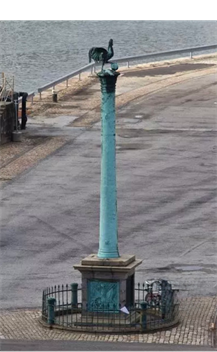
Baba Merzoug, Lucky Father, sometimes called The Consular (La Consulaire) is the name of a cannon seized in Alger in 1830 and erected as a column and fixed since 1833 at the military port of Brest. The mouth of the cannon has been sealed and the French cock put on top. Algeria and groups in France have asked for its restitution to Alger where France massacred two-thirds of the city’s inhabitants in 1852 https://www.tsa-algerie.com/baba-merzoug-un-canon-symbole-des-contradictions-francaises-avec-lalgerie/ Les questions mémorielles portant sur la colonisation et la guerre d’Algérie: Rapport Janvier2021,Benjamin Stora https://www.elysee.fr/admin/upload/default/0001/09/0586b6b0ef1c2fc2540589c6d56a1ae63a65d97c.pdf
 -
-
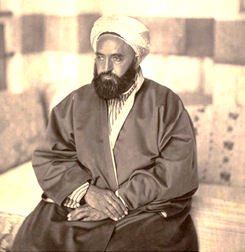
Emir Abdelkader, Algerian religious and military leader (1808–1883) legendry leader of Algerian resistance to French colonization. After his surrender in 1847, he was detained for five years in France before his release by Louis-Napoléon Bonaparte. Requests have been made for the standards of the resistance that are now in the Musée de l’Armée and in Musée de l’ Empéri, in Salon de Provence.
Hommage à l'émir Abdelkader à Amboise, en France https://www.orientale.fr/page_1243_fr_12685_Hommage-a-l-emir-Abdelkader-a-Amboiseen-France.htm
RIF France and Algeria revisit painful past in battle to mend colonial wounds https://www.rfi.fr/en/africa/20240218-french-algerian-commission- of-historians-works-to-mend-colonial-wounds
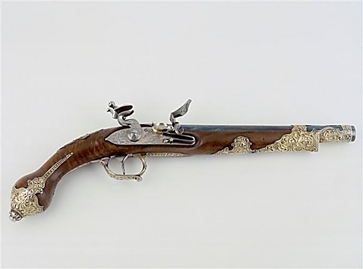
Pistol of Emir Abdelkader, now in the Musée de l’Armée, Paris, France
.
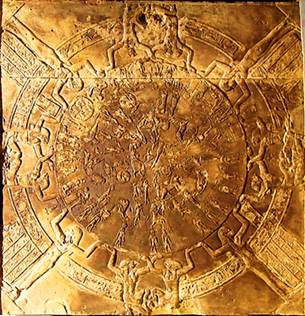
Dendera Zodia ,Egypt ,formed part of the ceiling of the Temple of Hator in Upper Egypt and is now in the Louvre ,Paris. Removed by the French during the Napoleonic invasion of Egypt in 1821. Zahi Hawass is requesting the return of this work of art to Egypt. ‘This piece came from the ceiling of a chapel for Osiris inside of a Temple for Hathor in Dendera. After the Napoleonic expedition Sebastien Louis Saulnier paid for it to be destructively removed and brought to Paris in 1821. In order to move it he had it broken into three pieces.’ https://www.hawasszahi.com/repatriation
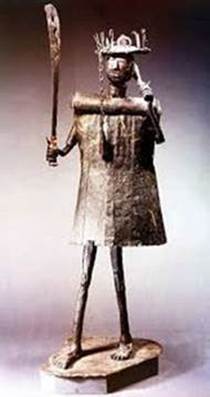
The statue of the god Gou, Bénin, now in Musee du Quai Branly-Jacques Chirac, Paris. The statue was stolen by French soldiers during the conquest of Dahomey in 1882-1883.The Gou statue may soon be returned to the Republic of Benin.
The restitution of the statue of the god Gou and the divination plate of Gold to Cotonou will be the fulfilment of the wish of the former President of Benin, Patrice Tolon who emphasised their importance to Benin during the signing of the agreement in 2021 concerning twenty-six objects to be returned to Benin:
‘But, Mr. President, Dear President, you will agree with me that the restitution of the twenty-six (26) works that we are celebrating today is but only a step in the ambitious process of equity and restitution of memorial objects exhorted from the kingdoms of the territory of Benin by France.
Mr. President, it is regrettable that this act of restitution, however appreciable, is insufficient to give us complete satisfaction. Indeed, how can you expect my satisfaction to be complete when I depart with only twenty-six works?
In contrast, the God Gou, an emblematic work that represents the god of metals and metallurgy, the Fa tablet, a mythical work of divination by the celebrated soothsayer Gedge, and numerous other works continue to be detained here in France to the great detriment of their actual owners. But is it subsequently not allowed to hope? Yes, Mr. President.
The hope of returning to our country with the works I have mentioned and many others, and the hope of their recovery in our country, is henceforth allowed, thanks to you. It is extraordinary.’ https://www.les4verites.bj/talon-reclame-a-la-france-le-dieu-gou-la-tablette-du-fa-et-dautres-objets/
https://observer.com/2021/11/benins-president-says-returned-artifacts-represent-our-soul/
The return of the statue of the god Gou to Benin will be an undoubted blow to the theory of mutation of African artefacts that gave this statue as a perfect example of an artefact that could stay in French museums as ‘ ’shared heritage.’
See K. Opoku, Does The Martinez Report Constitute A Pre-Announced Burial Of African Cultural Artefacts In French Museums?
https://www.modernghana.com/news/1230672/does-the-martinez-report-constitute-a-pre-announce.html
https://www.modernghana.com/news/1404322/can-looted-african-art-remain-in-france-because.html
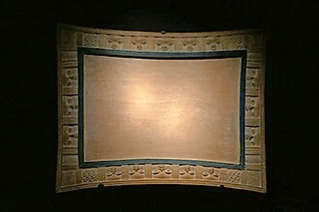
Divination plate of Gold, Fon, Republic of Benin, now in Musée du Quai Branly-Jacques Chirac, Paris. This plate may soon be returning to Benin
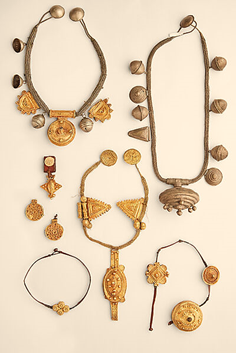
Gold, silver and leather necklaces from Segou, Mali seized as spoils of war by French Colonel Louis Archinard from palace of, Ahmadu Sheku in 1890, at the time of French conquest. on 6 April,1890, now in Musée du Quai Branly-Jacques Chirac, Paris. France. This is part of the ‘Trésor de Segou, collected by Ahmadu Sheku’s father, El Hajj ‘Umar Tal and, now spread across several French museums
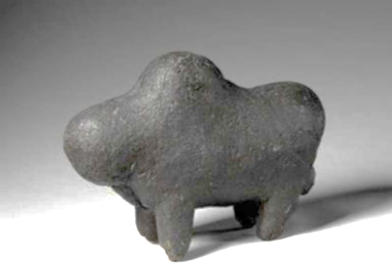
One of the three Kono Marcel Griaule and his team stole from Dogon villages. The religious object is in Musee de Quai Branly-Jacques Chirac. Is this one of the objects mentioned in the list in Annex I as being examined for possible restitution to Mali? The criminal and abusive methods of the Dakar-Djibouti Mission were simply unbelievable. This is perhaps one of the worst episodes of French colonial forceful acquisitions. Despite the refusal of the head of religion in the village, Diabougou, to sell the religious object, the French Dakar-Djibouti Expedition forceful took the object and threw to the chief twenty francs. In his diary, Michel Leiris, archivist of the mission writes:
7th September,1931.
‘Before leaving Dyabougou, we visit the village and make off with a second kono, which Griaule found by slipping surreptitiously into the special hut. This time, Lutten and I carry out the operation. My heart is beating very loudly because, since yesterday’s fiasco, I am more keenly aware of the enormity of our crime. With his hunting knife, Luten cuts the mask from the costume adorned with feathers onto which it is sewn, passes it to me to be wrapped in the cloth we have brought, and gives me, upon my request-for it is another one of those bizarre shapes that so strongly intrigued us yesterday- a sort of sucking pig, nougat made of the same brown(i.e. .coagulated blood) and weighing at least 15kilos,which I wrap up with the mask. We quickly carry the whole thing out of the village and return to our cars through the fields. When we leave, the chief wants to return the twenty francs we have given him. Luten let him keep them, naturally. But this doesn’t make things any less ugly.’
"L'Afrique Fantôme", Michel Leiris, 1934, p. 195. See also, K Opoku, Who Is Afraid of Phantom Africa? https://www.modernghana.com/news/800468/who-is-afraid-of-phantom-africa.html#
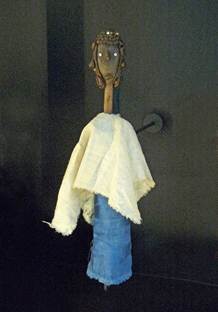
Touculor doll, brought by the notorious Dakar-Djibouti Mission,1931-33 to France, now in the Musée du Quai Branly-Jacques Chirac, Paris, France.The Mission brought to France,
3,600 objects,6.600 natural specimen,370 manuscripts,79 human remains and
6.000 photos, 20 sound recordings and
15.000 field notes.
Musee du Quai Branly Dakar -Djibouti (1931-1933):Counter investigations https://www.quaibranly.fr/en/exhibitions-and-events/at-the-museum/exhibitions/event-details/e/mission-dakar-djibouti-1931-1933-contre-enquetes
Africultures Mission Dakar-Djibouti (1931-1933) : contre-enquêtes
https://africultures.com/mission-dakar-djibouti-1931-1933-contre-enquetes/
Rfi Mission Dakar-Djibouti, une contre-enquête avec les Africains
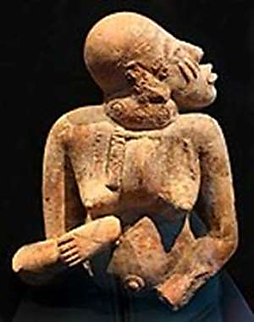
Djenne female figure, Mali, now in Musée du Quai Branly-Jacques Chirac, Paris, France.
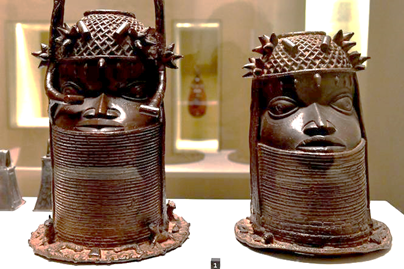
Commemorative heads of an Oba, Benin, Nigeria, looted by the British in 1897 ands later sold at auction. Now in Musee du Quai Branly-Jacques Chirac.
https://www.modernghana.com/news/437639/arts-of-nigeria-in-french-private-collections.html
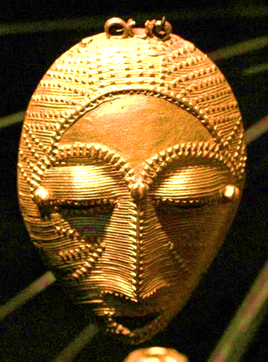
Akan, gold pendant, Côte d’Ivoire, now in Musée du quai Branly-Jacques Chirac, Paris, France.
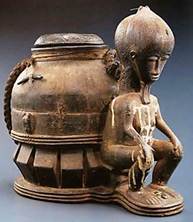
Divination box witz mice, Côte d’Ivoire, now in Musée du Quai Branly-Jacques Chirac, Paris, France.
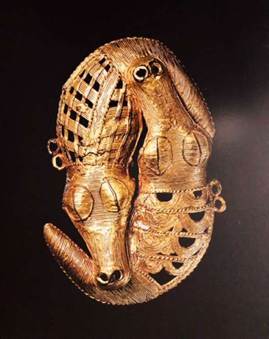
Gold jewel of two crocodiles, Akan, Baule, Ivory Coast, now in Musée du Quai Branly- Jacques Chirac, Paris, France. This Akan adinkra symbol of two linked crocodiles funtunfunefu ,denkyemfunefu, symbolises the need for unity and cooperation. On the rich cultural symbols of the Akan peoples of Côte d’Ivoire and Ghana see, Willis, W. Bruce. The Adinkra Dictionary: A Visual Primer on the Language of Adinkra.
https://www.wikiwand.com/en/Adinkra_symbols Kweku A-G Opoku ,Adi Nhyia: A book of symbols,2025.
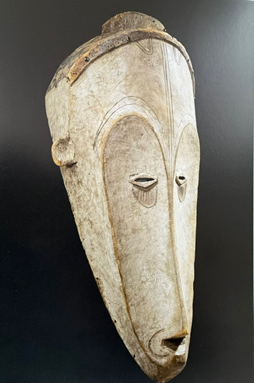
Fang mask, Gabon, now in Musée du Quai Branly -Jacques-Chirac, Paris, France.
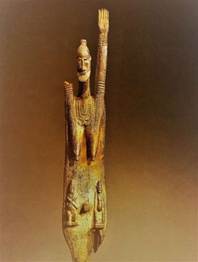
Androgynous statue, with raised hand, Djennenke style, Bandiagara Plateau, Mali now in Musée du Quai Branly-Jacques Chirac, Paris.
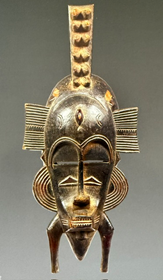
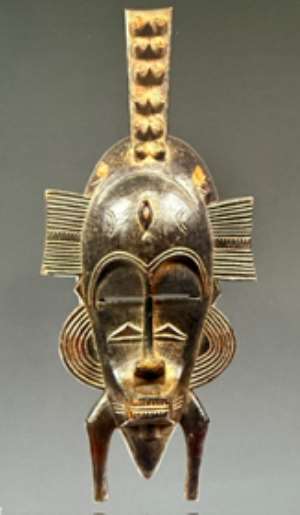
Kpelie mask,Senofou,Côte d’Ivoire,now in Musée du Quai Branly-Jacques Chirac,Paris,France.

 Techiman nurse arrested for allegedly recruiting people to circulate ‘Ghana Joll...
 NaCCA distances itself from Chinese language teacher training at UCC
 Exporters need better access to credit, infrastructure – Bawumia
 Senior nurse remanded over alleged link to ‘Ghana Jollof’ TikTok account
 ‘NDC rewriting 1992 Constitution’ – NPP rejects review approach
 $300m World Bank financing package secured to permanently end double-track by 20...
 'No piece of land is worth single human life' – Afenyo-Markin calls for peace af...
 Police declare ‘Ghana Jollof’ wanted for allegedly inciting violence
 How community watchdog group helped Police 'cobra team' arrest seven suspects fo...
 Ghana Card to become e-wallet for electronic transactions soon – NIA Boss


