




‘’In one way or another, an alien cultural heritage always alienates those who adopt it. Foreign cultural structures claiming to be universal invariably conceal an imperialistic design. It is no accident that renaissances have always been nationalistic reactions, attempts at establishing freedoms, schools ,socio-cultural models, political power and an art and a literature which further a specific view of the world".
Pathé Diagne, Introduction to African culture, Pathé Diagne, Alpha I. Sow, et al. (1)
A continuing source of deep concern in the restitution debate is the troubling support a leading African scholar and philosopher lends to French museums, actively enabling the Louvre/Musée du Quai Branly - Jacques Chirac to retain, among others, the statue of Gou, the Vodun divinity from Benin, in Paris. We have criticised the so-called theory of mutation as a convenient justification, claiming that looted African artefacts should stay in France because they are supposedly rooted there. (2) We contend that such support and such a theory serve only to impede justice and perpetuate past injustices.
We had hoped the Senegalese philosopher Souleyman Bachir Diagne would provide concrete evidence and rigorous arguments to defend this concept. Yet in his recent book, Les universels du Louvre, based on his Louvre Lectures, he offers no substantive or logically sound justifications for the contested theory.
(3) Diagne's Radio France discussions also contribute nothing more than poetic, rhythmic embellishments for French retention of the best African art.(4)
Diagne takes the subtitle of the Sarr-Savoy report, The Restitution of African Cultural Heritage: Toward a New Relational Ethics, to mean that the objects involved in these new relations, and thus objects of provenance research, should be seen in their metamorphosis. He sees them as playing a mediatory role, becoming mediators in a dialogue between the works, between the cultures they represent, and eventually between humans from the global south and the global north. (5).
We take the subtitle of the Felwine Sarr and Bénédicte Savoy report, Toward a New Relational Ethics (2018), to mean that, henceforth, relations between France and her former colonies should be based on mutual respect and agreement, rather than on the use of force, as it was in the colonial system that enabled the taking of African cultural property without consent. The new relationship was intended to be guided by ethical principles. There is nothing in the report that could justify extensive provenance research when there is already ample evidence for restitution. Provenance research functions primarily as a stalling tactic, delaying rightful restitution by prolonging the examination of thousands of African artefacts in Western museums.
Diagne knows that provenance research on looted African artefacts is a tactic devised by Western museums—especially the Germans in 2015—to justify delays in restitution. Regarding looted African artefacts in French museums, the Sarr/Savoy report clearly states that some artefacts do not require further provenance research due to their obviously illegitimate acquisition and the abundance of available material. The report recommends:
‘’Restitution in a swift and thorough manner without any supplementary research regarding their provenance or origins, of any objects taken by force or presumed to be acquired through inequitable conditions:
1. Through military aggressions (spoils, trophies), whether these pieces went directly to France or passed through the international art market before becoming integrated into collections.
2. By way of military personnel or active administrators on the continent during the colonial period (1885-1960 or by their descendants.
3. Through scientific expeditions prior to 1960.
4. Certain museums continue to house pieces of African origin which were initially loaned out to them by African institutions for exhibits or campaigns of restoration, but which were never given back.’ ( 6)
Many looted African artefacts in France do not need further provenance research beyond the Sarr-Savoy report. The report argues there is already sufficient evidence of how these objects were acquired—often without the consent of African owners. Sarr-Savoy never suggests that looted artefacts in French museums, with abundant evidence of their looting, should be studied again. If, however, France and Germany set up a € 2.1-million fund to award stipends for provenance research, appoint a board consisting of distinguished African and European scholars, and make a famous Senegalese scholar the chair, one would find enough African and European students to do the research.
(7) The presence of pro-restitution scholars on such a board might reinforce the impression some seek to assert that such research and restitution are logically linked.
Diagne’s reading of Amadou M’Bow’s famous plea defends France’s continued possession of looted artefacts, but this distorts M’Bow’s intention. M’Bow’s plea—A plea for the return of irreplaceable cultural heritage to those who created it—clearly demanded the return of artefacts to their rightful producers. He acknowledged practical difficulties for some objects entrenched abroad. M’Bow never meant his words to justify France hoarding artefacts forcibly taken from Africa or to support keeping them for French aesthetic appreciation instead of rightful religious veneration. (8)
The Senegalese philosopher often cites pro-restitution scholars such as Bénédicte Savoy, Felwine Sarr, and Amadou M’Bow to support anti-restitution positions. In a footnote in Les universels du Louvre, Diagne writes :
'F. Sarr and B. Savoy insist on the importance of this passage of the discourse when they reproduce it in Restituer le patrimoine africain (9)
Sarr and Savoy cite M’Bow to argue that demands for restitution have long existed, but Western countries have not addressed the problem, which persists to this day: Sarr and Savoy write:
‘His Appeal - For the return, to those who created it, of an irreplaceable heritage' deserves to be read and reread, so aptly and seriously does it pose the question that continues to occupy us today - as if nothing had been said and thought about for forty years.’ (10)
Sarr and Savoy sharply condemn Western States’ blatant disregard for restitution, as outlined in their book section 'Une si longue attente.' Tellingly, they avoid pinning their critique on any one paragraph in M’Bow’s appeal, even as they call it 'one of the most beautiful texts of the twentieth century on this subject.' On what foundation, then, does Diagne allege that they insist on a single passage? The authors cite part of the appeal by M’Bow that some looted artefacts may have taken root in their country of sojourn, but do not suggest that they cannot be returned or that the passage cited is determinative of any disputed issues.
Diagne exploits this construction to conveniently justify his argument for sharing in Chapter II of Les universels du Louvre' 'Partage.' For Westerners, sharing all too often means simply retaining looted African artefacts, while Western masterpieces are zealously protected. Predictably, my proposals to place some Western works in Dakar, Accra, Ouagadougou, Lagos, or Cotonou have been silently ignored—Westerners recoil in shock at the very idea. The unspoken policy could not be clearer: Mine is mine, yours is ours. Mine is inviolable, yours is negotiable.
Elementary rules of interpretation direct us to see a plea as serving a clear purpose, not as self-contradictory. M’Bow aimed to press for the return of looted artefacts to Africa, Asia, and the Americas, not to argue for their
retention in museums of former colonial powers. He acknowledged practical challenges in returning everything, since some artefacts are now rooted in other countries. M’Bow did not sharply distinguish between artefacts essential to dispossessed cultures and others since it is hard to decide. Even if such a distinction existed, former colonisers like France should not decide what is essential. For example, when Benin’s president asks for Gou’s return, and France refuses, this exposes France’s indecency in calling Gou essential to its own culture due to its influence on artists like Picasso and Apollinaire, while denying Benin’s right to the statue.
It is deeply unjust to support artefact looters while blatantly disregarding the profound religious meaning and symbolism of treasures like the Voudon god Gou, all to appease French aesthetic preferences.
It would distort history to use Amadou M’Bow’s plea as justification for keeping looted art in France. While director of UNESCO, M’Bow faced considerable hostility and resistance for defending the interests of the Third World. Using his advocacy for return as an excuse to retain looted artefacts in France would be an ironic misrepresentation. Ultimately, deciding what should be returned must involve negotiation between France and the countries of origin, underscoring that the restitution debate centres on mutual agreement rather than theoretical justifications for permanent retention by looters.
Restitution is a political act.
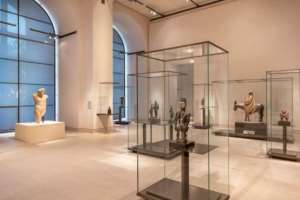
Diagne has supported France’s efforts to tighten its hold over looted African artefacts. This is clear with the new gallery at the Louvre/Pavillon de Sessions—now 'La Galerie des Cinq Continents.' Here, non-European objects are displayed with European works, supposedly to foster 'dialogue.' In practice, this arrangement does little to correct historical injustices and acts more as a show than real progress, while questions about ownership and repatriation go unanswered. A senior official’s vague answer about specific African European artistic connections further shows the emptiness of these claims:
Sometimes that dialogue, connection, and relationship can be very visible. This is the case in the room that concerns birth until death, therefore, life on Earth. The work Virgin and Child, a Spanish Blessed Virgin from the fourteenth century, depicts the Blessed Virgin with the baby Jesus on her lap. We find this image of motherhood, of the mother with her child on her lap, in several African cultures that are put here around this piece. In all the cultures of the world, this image shows filiation, the protection of the mother in relation to her child and also the idea of transmission from generation to generation. (11)
Thus, the figure of an African Dogon mother, almost naked, is placed close to that of a saintly Spanish Virgin Mary, fully clothed, holding her baby. What will a European holy woman with a baby discuss with an African mother with a baby? The one comes from a rich, colonialist background, the other comes from an impoverished Sahel territory, colonised by a European nation. What will be
the differences and similarities of conditions of life for the mother in the Sahel and her baby, and that of a saintly mother and her baby in Spain? What are the chances in life for the Sahelian baby and the Spanish baby? Or will they spend their time in mutual admiration of their babies? Will they not discuss how they came to be where they are in the Louvre? The one kidnapped or stolen? If art is life or reflects life, we will have to give it a serious purpose. Will their dialogue be more successful than the dialogue between France and her former colonies?
As our readers know, contrary to the impression some writers seek to convey, most supporters of restitution are not opposed to European museums holding African artefacts. After all, Europeans are also part of our common humanity and legitimately want to know about non-European cultures. What we object to is any museum or State holding on to artefacts that have been obtained by force or other unconscionable methods, as occurred under colonial hegemony.
Europeans can negotiate with former colonial countries the conditions for keeping artefacts from other cultures. Germany and Nigeria have done this, even though one may criticise the provisions of the agreements. France has done so with Nigeria regarding the Nok artefacts in the Louvre, even though under circumstances that were not honourable for France. (12)
We note that among the looted artefacts that moved from the Pavilion des sessions to the new Galerie des Cinq Continents, the voodoo god of metal and war, Gou, is absent. What is the explanation for the absence of this heavily contested masterpiece from the new gallery? In an interview with RFI, a senior official from the Gallery of Five Continents replies as follows:
‘The question of restitution, in a way, has been answered, since in the new presentation, we are quite transparent about the origin of the objects. On all the labels concerning the notices and objects, we have put the provenance, the origin, through which collections the object arrived, etc. In some works, we developed this concept by explaining how a particular work ended up in the collections of the Louvre Museum or the Quai Branly Museum, by putting a specific label. Afterwards, as we also welcome works from the Louvre Museum, we had to make choices and leave space. We needed large showcases to display large objects, and the god Gou returned to the Quai Branly museum. Regarding the question of the restitutions themselves, it is not at the level of the Gallery of the Five Continents that this will happen. It happens from state to state. So, it's not up to me to choose who will be present according to these claims that can be attached to an object. (13)
The absence of Gou from the new Gallery of Five Continents is surely not due to its size but to the controverses surrounding the famous metallic statue of the voodoo God. It may well be that the authorities have decided to keep it out of public view to avoid further controversy, or what we would welcome, that it is
being prepared for its eventual journey back home to Cotonou. This would mark the beginning of the end of the theory of mutation, since it would lose its most prominent artefact, often cited as an example of mutation.
Diagne mentions that the Gou statue was not among the treasures seized and carried away by General Dodds in 1893 during the seizure and looting of the palace of the Dahomeyan King Behanzin. (14) He adds that it was brought later by another French General (whom he does not name). The philosopher then adds that Gou is one of the objects that can be envisaged as shared between its country of birth and the country where it has taken root. Diagne cites Maureen Murphy, Voir autrement, in a footnote, but omits an essential part of Murphy's argument: that, even though Gou was brought by Colonel Fonssagrives a year later, in 1894, it was part of the colonial loot. (15) Diagne’s omission of the fact that Gou was among the loot captured in a colonial war supports Jean -Luc Martinet’s statement, in his report, Patrimoine partagé: universalité,
restitutions et circulation des œuvres d’art, that this finest of sculptures had been abandoned by the Dahomeyans. (16)
Quoting Bénédicte Savoy with approval, Diagne agrees that where artefacts of a people are exclusively housed in the universal museum, the people's access to their heritage is important. (17) He sees two aspects of the question: firstly, the circulation of objects between museums in the global North and the global South. Secondly, the fact that most, if not all, so-called universal museums are located in Western countries. Diagne declares that in a world of frontiers against migration from the South, one must understand the demand for human beings to have access to migrant objects, objets migrants, that they have created.
Regarding the second aspect, Diagne refers to the diasporas in the large cities where the universal museums are located. These objects have profound links to the cities and the diasporas.
Despite all the claims made about the universal museum's openness to justify its holding of looted objects, in some matters, the universal museum does not seem universal in its actions: entrance fees. Citizens of the European Union (EU) are charged €22 for entry, whereas non-EU residents must pay €32. Thus, those from Africa, the Americas and Asia will pay €10 more than those from Europe. Once again, wealth flows in the direction it has taken over centuries during slavery and colonialism: from Africa, the Americas and Asia towards Europe. Can universality allow such obvious inequality of treatment of individuals, depending on their nationality, when one bears in mind the debates about restitution and looting of artefacts? Does universalism not include equality of treatment of all persons, irrespective of nationality, race, or residence? Is this sheer insensitivity? The author of L'universalism and Les universels du Louvre will hopefully agree that a truly universal museum cannot impose different
entry conditions or prices on visitors depending on their nationality or place of residence. (18)
Those who plead for universalism should stop creating the false impression that supporters of restitution are somehow tribalists, nationalists, and cultural isolationists or that they believe that cultures are distinct entities without common links. Diagne writes:
‘There are diverse ways to take the post-colonial turn. One of these ways, which is intended to be radical, is to advocate, quite simply, cultural separation. Thus, little attention will be paid to provenance research, for example, to the history of the presence of distant arts in Western museums, in order to consider that their cultural identity alone requires their repatriation. Without further ado.
This is a travesty of the postcolonial philosophical moment into a cultural separatism that is most often expressed in the mode of performance, which is by nature closed to argumentation.' (19)
The philosopher often cites with approval Sarr and Savoy, who are pro-restitution. They express their views through writing, which he cites, not through performances. The attempt to belittle those who insist one can proceed to restitution without further research thus fails completely. Felwine Sarr.
Benedicte Savoy, Peju Layiwola, Sylvester Ogbeche, and others are writers on restitution, not performers of restitution.
In contrast to the philosopher who seems determined to find a legitimate ground for French detention of Gou in the universal museum in Paris and, for this purpose, is ready to interpret facts and the views of other writers in his direction, one is relieved to read the view of French Art historian, Bénédicte Savoy on the universal museum Louvre, where she will be occupying the Chaire du Louvre, in succession to Souleymane Bachir Diagne:
’I have serious reservations about this rhetorical construct. During the French Revolution, they didn’t speak of a universal museum; they spoke of “the most beautiful museum in the universe.” The idea of a “universal museum” only really emerged in 2002, when there was considerable pressure for restitution, and the British Museum, the Berlin State Museums, and the Louvre [and many
others, including the Met and the Prado] signed “The Declaration on the Value of Universal Museums.” It’s only about a page long and really unpleasant because it ends by saying that universal museums are open to everyone. If you’re against universal museums, you’re a particularist. But they start from the premise that the universal museum is open to everyone, whereas the universal museum is open only to people who live in London, Paris, or Berlin, or who have a visa and can come to see it. (20)
The ploy of conversations between art objects is nothing new and will not prevent Africans from reclaiming their looted objects from Western museums.
This method has been used before at the Musée du quai Branly-Jacques Chirac without any obvious success. (21)
If the French attach importance to conversations and dialogue, this should be done between the French government and the owners of the looted artefacts. Or are they better at arranging dialogue/trialogue between art objects than at arranging dialogues with those they previously colonised? Why has France not returned the statue of Gou despite many requests by the President of Benin, Patrice Talon and others? Has dialogue, as opposed to dictation, between France and President Patrice Talon not yielded any result?
For the French, as well as for Diagne, the presence of African artefacts in the Galerie des cinq continents is France's promotion and elevation of African art in this holy of holies of European/French art. Indeed, he suggests in his latest book that some African peoples might wish to have their arts admitted in this sancta sanctorum.
And on this 'great stage' where the concert of cultures is played, we can imagine that everyone wants to be present, that the settlement of the question of provenance and restitution, for example, includes the choice, for the peoples, to be represented by ambassador works...’ (22)
This reminds one of those Africans who think Benin artefacts are better placed in the British Museum rather than in the Oba’s palace, from where the British Army brutally tore them away from their destined and traditional location. Does anybody care about the people who require the looted artefacts for their traditional or religious practice? The mentality displayed here is close to that of a minister in Ghana who suggested that Ghanaians are lucky to have been colonised by the British!
Diagne has distanced himself from most recent African demands, which he describes dismissively as ‘identitaristes ’: those who demand that looted African artefacts, such as the Benin bronzes, should be restituted without any further delay once recognised as coming from a specific country or people. He is thus in a position opposed to that of most African and other writers on this point. He is definitely not following the basic principles of the Sarr/Savoy report on restitution nor the positions of pan-Africanists such as Cheikh Anta Diop. Yet it is patently clear to all that without such demands, none of the recent restitutions would have occurred. Western museums and governments only react when a demand is made and often repeatedly, in the face of their brazen denial that any demand has been made.
Diagne will have us believe that provenance research must precede restitution and vaguely creates the impression that provenance research is fundamentally linked to restitution. We know that this is not true. We have the example from
Hamburg, where provenance research showed that Benin artefacts in one museum, Kunst und Gewerbe Museum, were among the loot of 1879 but were sent to the MARKK-Museum am Rothenbaum.Kulturen und Künste der Welt. Moreover, there is no example of restitution made in the absence of thorough provenance research that later proved the work had been sent to the wrong people. Thus, the importance of provenance research cannot be based on its relevance to restitution. It is ironic that colonialists stole African artefacts without any provenance research apart from identification, but when asked to return them, they insist on the necessity of research and are supported by some Africans.
The theory of mutation does not attach much value to the concept of justice in the colonial and decolonial contexts. It treats the oppressors and the oppressed as if they were on the same level regarding stolen property in Western museums; otherwise, how could one transfer the owner's right of guardianship to the looter without any compensation?
One remarkable aspect of the theory of mutation of artefacts is that it appears to be applicable only to the statute of Gou. We have not seen an attempt to apply it to any of the thousands of looted African artefacts in France. The theory was certainly not applied to the Royal Dahomeyan treasures that have been restituted to Benin in 2021. Is this a theory specifically tailored for Gou? Apart from Picasso and Apollinaire's admiration for this metal sculpture, is there evidence that this god had established roots in France?
The new Galérie des cinq continents cannot offer any new additional legitimacy or justification to France for holding looted artefacts than they had in the Pavillion des sessions. Neither a theory of the mutation of artefacts nor a reference to Amadou Mahtar M’Bow’s famous A plea for the return of an irreplaceable cultural heritage to those who created it can justify France's continued illegal holding of looted African artefacts. The simplest and most acceptable way would be for France to negotiate terms and conditions for their prolonged stay.
Ethics, justice, apology, compensation and reparation seem to be concepts unknown to the theory of mutation now propagated to support the further imprisonment of African artefacts in France, based on a universalism that in effect seems to have been manufactured in Paris and ignores the enduring devastating pains and damage inflicted on African peoples by the French imperialists who are now to be awarded the treasures they stole with violence. The theory of mutation surely runs counter to all United Nations/UNESCO resolutions on the return of artefacts to their countries of origin, as well as to all Pan-African, OUA/African Union decisions and resolutions on the restitution of
cultural property. Can an unfounded and non-demonstrable theory gain ascendancy over all the past efforts to resolve issues of restitution?
The really important question on looted African artefacts in France is not whether particular artefacts are important or indispensable for a particular society or people. No society produces artefacts that its people do not consider to be important. The more serious question is whether the structure or framework for the discussion of looted artefacts should be constrained by the criterion found in M’Bow’s plea. The question should rather be whether it is morally or legally legitimate in our time for the former colonial power to keep artefacts it had stolen decades ago with military violence from colonies and refuses to restitute them when the former colony and its people request return. We must ask how, instead of bowing down and asking for forgiveness and pardon, in the sense of Our Father and The Ten Commandments, some former colonial powers have the courage and arrogance to demand that the deprived peoples justify their demands for the restitution of treasures Europeans stole.
Will military power and lack of respect for the rule of law become the hallmarks of our times so that even intellectuals do not see anything wrong in asking Africans to justify why they seek the return of their looted artefacts, some of which are now lying in Western museums and their storage facilities?
How can anybody seriously accept the argument for the need for provenance research when we demand restitution? What have the Western States and museums been doing for the hundred years they have kept the thousands of looted articles? How long must we wait until they have finished their research? Should we suspend our religious and cultural practices until they are ready?
How long must we endure the intolerable situation in which the thief has the privilege of determining under what conditions he will return looted items? If African philosophers and other scholars are now speaking in favour of France, who will speak in favour of Africa? The theory of artefact mutation lacks explanatory power and probative evidence. African artefacts can stay in
France under an agreement between France and the relevant African state. The Gallery of Five Continents can survive without any particular theory, whilst France and other States hold a dialogue to settle differences under rules and conditions set by both parties.
In the last hundred years, France has restituted only twenty-nine looted artefacts to Africa: twenty-six to Benin, one to Senegal, one to Côte d’Ivoire, and one to the Malagasy Republic. At this rate, how long will it take France to return the 97,000 looted African artefacts in France? But who is really interested in the mathematics of restitution?
The British Museum, on the other hand, has made it clear that it has no intention of restituting any looted African artefacts, apart from making fake loans that
appear to the British to be a very innovative approach. Indeed, fake loans of looted Egyptian and Greek artefacts by the British Museum to Chhatrapati Shivaji Maharaj Vastu Sangrahalaya (CSMVS) museum in Mumbai, India, were presented as ’ decolonisation’.(23)
The Dutch have handed over to Ghana an inventory of Ghanaian artefacts in Dutch collections compiled by the World Museum in Leiden to enable Ghana to make its demands for restitution. (24) After all, Western countries are better placed to prepare a list of African artefacts they are holding rather than Africans who may not receive the necessary visa to visit Europe. It is remarkable that many African States still have no list or complete list of their demands for restitution of looted artefacts from Western museums, even though there are many institutions such as AFRIMUHERE that are willing to assist in the production of such documents(25)
‘’Truth must be repeated constantly because error is being repeatedly preached round about all the time, and not just by a few, but by the masses. In the
periodicals and encyclopedias, in schools and universities, everywhere error prevails, being confident and comfortable in the feeling that it has the majority on its side.”
Johann Wolfgang von Goethe. (26)
NOTES
1. Introduction to African culture by Pathé Diagne, Alpha I. Sow, et al. https://lesen.amazon.de/kp/kshare?asin=B08VW19QQ2&id=f4nvx4g2yzdwhap ma6h6kc3iju
2. K. Opoku, Can Looted African Art Remain In France Because Of Alleged ‘mutation’? https://www.modernghana.com/news/1404322/can-looted-african-art-remain-in-france-because.html
Souleymane Bachir Diagne, Restitueur pour partager, https://journals.openedition.org/hommesmigrations/14941Souleyman Bachir Diagne, Museotopia. Reflections on the future of museums in Africa, https://www.college-de-france.fr/en/agenda/symposium/museotopia-reflections-on-the-future-of-museums-in-africa/opening-conference
3. Souleymane Bachir Diagne, Les universels du Louvre, Albin Michel/Musée du Louvre,2025
4. https://www.radiofrance.fr/franceculture/podcasts/le-cours-de-l-histoire/souleymane-bachir-diagne-penser-l-universel-5099743
5. Les universels du Louvre, pp. 18-19.
6. Felwine Sarr and Bénédicte Savoy, The Restitution of African Cultural Heritage. Toward a New Relational Ethics,p.61 https://www.unimuseum.uni-
tuebingen.de/fileadmin/content/05_Forschung_Lehre/Provenienz/sarr_savoy_en
.pdf,
K. Opoku, Do French museums still need to study looted African treasures? https://www.modernghana.com/news/1315012/do-french-museums-still-need-to-study-looted-afric.html Will provenance research delay restitution of Looted African Artefacts? https://www.modernghana.com/news/1067847/will-provenance-research-delay-restitution-of-loot.html Germany's funding of provenance, a distraction on return of looted African artefacts https://www.africanartswithtaj.com/2018/05/germanys-funding-of-provenance.html
7. Franco-German Research Fund on the provenance of cultural objects from sub-Saharan Africa
https://provenanceresearchfund.org/en/ https://provenanceresearchfund.org/en/provenance-research-fund-two-new-open-calls-for-projects-for-2025/
Le Monde, France and Germany launch joint fund to find provenance of African artifacts
https://www.lemonde.fr/en/culture/article/2024/01/19/france-and-germany-launch-joint-fund-to-find-provenance-of-african-artifacts_6446499_30.html RM-Restitution Matters,
Franco-German Research Fund on the Provenance of Cultural Objects from sub-Saharan Africa
https://restitutionmatters.org/event/franco-german-research-fund-on-the-provenance-of-cultural-objects-from-sub-saharan-africa/
8. Amadou M’Bow, ‘Plea for the return of an irreplaceable cultural heritage to
those who created it’.
Museum, XXXI, 1, p.58
Wikidata, https://www.wikidata.org/wiki/Q111992332
See Annex below
9. Les universels, p.72. Sarr and Savoy, Restituer le patrimoine africain, op.cit., p.38.
10. Restituer le patrimoine Africain (2018), p.37.
11. https://www.louvre.fr/galerie-des-cinq-continents https://www.quaibranly.fr/fr/collections/toutes-les-collections/la-galerie-des-cinq-continents
12. K. Opoku, Revisiting looted Nigerian Nok terracotta sculptures in Louvre / Musée Du Quai Branly, Paris https://www.modernghana.com/news/339922/revisiting-looted-nigerian-nok-terracotta-sculptures-in-louv.html K. Opoku, Nok once more, https://www.modernghana.com/news/367489/nok-oK.Opokunce-more.html K Opoku, A blank cheque to plunder Nok terracotta? https://www.modernghana.com/news/158516/a-blank-cheque-to-plunder-nok-terra-cotta.html K. Opoku, Endangered artefacts - Icom issues Red List of West African Cultural Objects At Risk https://www.modernghana.com/news/749936/endangered-artefacts-icom-issues-red-list-of-west-african.html
13. « Sur un pied d’égalité » : le musée du Louvre ouvre la Galerie des cinq
continents https://www.rfi.fr/fr/culture/20251203-sur-un-pied-d-
%C3%A9galit%C3%A9-le-mus%C3%A9e-du-louvre-ouvre-la-galerie-des-cinq-continents
14. Diagne, Les universels du Louvre, p.84.
15. Maureen Murphy, Voir autrement. Panthéon Sorbonne, Editions de la Sorbonne, 2022, p.66.
16. K. Opoku, Does The Martinez Report constitute a pre-announced burial of African cultural artefacts in French museums? https://www.modernghana.com/news/1230672/does-the-martinez-report-constitute-a-pre-announce.html
https://www.culture.gouv.fr/presse/communiques-de-presse/Remise-du-rapport-Patrimoine-partage-universalite-restitutions-et-circulation-des-aeuvres-d-art-de-Jean-Luc-Martinez
17. Les universels du Louvre, p.218.
18. Smithsonian Magazine , After a Brazen Heist, the Louvre Increases Ticket Prices for Non-E.U. Visitors by 45 Percent. Officials say the fee hike will help fund a much-needed overhaul of the museum’s security systems and infrastructure https://www.smithsonianmag.com/smart-news/weeks-after-a-
brazen-heist-the-louvre-increases-ticket-prices-for-non-eu-visitors-by-45-percent-180987793/
19. Les universels du Louvre, p.71. Il existe différentes manières de prendre le tournant du post-colonial. L’une de ces manières, qui se veut radicale, consiste à prôner, tout bonnement, la séparation culturelle. On fera ainsi peu de cas de la recherche de provenance, exemple, donc de l’histoire de la présence des arts lointains dans les musées occidentaux, pour considérer que leur seule identité culturelle commande leur rapatriement. Sans autre forme de procès. Il s’agit là d’un travestissement du moment philosophique postcolonial en un séparatisme culturel qui s’exprime le plus souvent sur le mode de de la performance, par
nature fermée à l’argumentation.’
20. The Burgled Louvre’s Stolen-Art Expert | The New Yorker, December 21,2025. https://www.newyorker.com/culture/the-new-yorker-interview/the-burgled-louvres-stolen-art-expert
21 K. Opoku, What are they really celebrating at the Musée Du Quai Branly, Paris? https://www.modernghana.com/news/689178/what-are-they-really-celebrating-at-the-muse-du-quai-branly.html Beyond Compare Art from Africa in the Bode Museum o Museum Island Berlin. https://artsandculture.google.com/story/beyond-compare-bode-museum-staatliche-museen-zu-berlin/NQWR3o1oSaFuLg?hl=en K. Opoku, Humboldt Forum and selective amnesia: Research instead of Restitution of African artefacts. https://www.modernghana.com/news/824314/humboldt-forum-and-selective-amnesia-research.html22. Et sur cette ‘grand scène’ où se joue le concert des cultures, on peut imaginer que tous veuillent être présents, que le règlement de la question de la provenance et des restitutions, par exemple, inclue le choix, pour les peuples, d’y être représentés par des œuvres ambassadrices…’ Les universels, p.217.
23. Netherlands hands over inventory of Ghanaian artefacts in major step toward restitution’
https://www.myjoyonline.com/netherlands-hands-over-inventory-of-ghanaian-artefacts-in-major-step-toward-restitution/
Tourism Minister engages Netherlands Ambassador Jeroen Verheul on Artefact restitution
https://www.modernghana.com/news/1466824/tourism-minister-engages-netherlands-ambassador.html
https://gna.org.gh/2026/01/ghana-netherlands-strengthen-cooperation-on-reparations-artefact-restitution/
24. Emiline Smith, British Museum Launches Farcical “Decolonizing” Loan Program https://hyperallergic.com/british-museum-launches-decolonizing-loan-program/
25. https://www.afrimuhere.org/ https://restitutionmatters.org/connected-minds/afrimuhere/ https://www.youtube.com/watch?v=GHFJ3tHLDfw
As we go to press, we have received information that the French Senate unanimously adopted on Wednesday January 28, 2026, the draft bill to facilitate the restitution of looted artefacts without requiring new legislative approval each time a demand for restitution is presented. This is a welcome development, but we will have to wait until the final approval of the bill by the French National Assembly.
France 24, French Senate approves draft bill to simplify return of colonial-era artefacts https://www.france24.com/en/france/20260129-french-lawmakers-approve-framework-law-facilitate-return-colonial-artefact
Le Monde, French Sénat adopts a bill to ease the return of colonial-era artifacts to their countries of origin https://www.lemonde.fr/en/international/article/2026/01/29/french-senate-adopts-a-bill-to-ease-the-return-of-colonial-era-artifacts-to-their-countries-of-origin_6749912_4.html
rfi, En France, le Sénat vote à l'unanimité la loi sur la restitution des biens culturels africains https://www.rfi.fr/fr/france/20260129-en-france-le-s%C3%A9nat-vote-%C3%A0-l-unanimit%C3%A9-la-loi-sur-la-restitution-des-biens-culturels-africains
26. ‘‘Und denn, man muss das Wahre immer wiederholen, weil auch der Irrtum um uns her immer wieder gepredigt wird, and zwar nicht von einzelnen, sondern von der Masse. In Zeitungen und Enzyklopädien, auf Schulen und Universitäten, überall ist der Irrtum oben auf, und es ihm wohl und behaglich, im Gefühl der Majorität, die auf seiner Seite ist‘‘
Goethe am 16.December 1828 Johann Peter Eckermann, Gespräche mit Goethe in dem letzten Jahre seines Lebens, Seite 311, Reclams Universal Bibliothek, Nr.2002.Stuttgart,2006.
ANNEX I
A Plea for the return of an irreplaceable cultural heritage to those who created it: an appeal by Mr. Amadou-Mahtar M'Bow, Director-General of
UNESCO,1978, The Unesco Courier, 31, Juli 1978, S. 4-5’.
https://translanth.hypotheses.org/ueber/mbow https://unesdoc.unesco.org/ark:/48223/pf0000046054.locale=en
One of the most noble incarnations of a people’s genius is its cultural heritage, built up over the centuries by the work of its architects, sculptors, painters, engravers, goldsmiths and all the creators of forms, who have contrived to give tangible expression to the many-sided beauty and uniqueness of that genius.
The vicissitudes of history have nevertheless robbed many peoples of a priceless portion of this inheritance in which their enduring identity finds its embodiment.
Architectural features, statues and friezes, monoliths, mosaics, pottery, enamels, masks and objects of jade, ivory and chased gold in fact everything which has been taken away, from monuments to handicrafts were more than decorations or ornamentation. They bore witness to a history, the history of a culture and of a nation whose spirit they perpetuated and renewed.
The peoples who were victims of this plunder, sometimes for hundreds of years, have not only been despoiled of irreplaceable masterpieces but also robbed of a memory which would doubtless have helped them to greater self-knowledge and would certainly have enabled others to understand them better.
Today, unbridled speculation, fanned by the prices prevailing in the art market, incites traffickers and plunderers to exploit local ignorance and take advantage of any connivance they find. In Africa, Latin America, Asia, Oceania and even in Europe, modern pirates with substantial resources, using modern techniques to satisfy their greed, spoil and rob archaeological sites almost before the scholars have excavated them.
The men and women of these countries have the right to recover these cultural assets which are part of their being.
They know, of course, that art is for the world and are aware of the fact that this art, which tells the story of their past and shows what they really are, does not speak to them alone. They are happy that men and women elsewhere can study and admire the work of their ancestors. They also realize that certain works of art have for too long played too intimate a part in the history of the country to which they were taken for the symbols linking them with that country to be denied, and for the roots they have put down to be severed.
These men and women who have been deprived of their cultural heritage therefore ask for the return of at least the art treasures which best represent
their culture, which they feel are the most vital and whose absence causes them the greatest anguish.
This is a legitimate claim; and UNESCO, whose Constitution makes it responsible for the preservation and protection of the universal heritage of works of art and monuments of historic or scientific interest, is actively encouraging all that needs to be done to meet it.
The return of cultural assets to their countries of origin nevertheless continues to pose particular problems which cannot be solved simply by negotiated agreements and spontaneous acts. It therefore seemed necessary to approach these problems for their own sake, examining both the principle underlying them and all their various aspects.
This is why, on behalf of the United Nations Educational, Scientific and Cultural Organization which has empowered me to launch this appeal,
I solemnly call upon the governments of the Organization’s Member States to conclude bilateral agreements for the return of cultural property to the countries from which it has been taken; to promote long-term loans, deposits, sales and donations between institutions concerned in order to encourage a fairer international exchange of cultural property, and, if they have not already done so, to ratify and rigorously enforce the Convention giving them effective means to prevent illicit trading in artistic and archaeological objects.
I call on all those working for the information media – journalists of press and radio, producers and authors of television programmes and films – to arouse worldwide a mighty and intense movement of public opinion so that respect for works of art leads, wherever necessary, to their return to their homeland.
I call on cultural organizations and specialized associations in all continents to help formulate and promote a [5] stricter code of ethics with regard to the acquisition and conservation of cultural property, and to contribute to the gradual revision of codes of professional practice in this connexion, on the lines of the initiative taken by the International Council of Museums.
I call on universities, libraries, public and private art galleries and museums that possess the most important collections, to share generously the objects in their keeping with the countries which created them, and which sometimes no longer possess a single example. I also call on institutions possessing several similar objects or records to part with at least one and return it to its country of origin, so that the young will not grow up without ever having the chance to see, at close quarters, a work of art or a well-made item of handicraft fashioned by their ancestors.
I call on the authors of art books and on art critics to proclaim how much a work of art gains in beauty and truth for the uninitiated and for the scholar, when viewed in the natural and social setting in which it took shape.
I call on those responsible for preserving and restoring works of art to facilitate, by their advice and actions, the return of such works to the countries where they were created and to seek with imagination and perseverance for new ways of preserving and displaying them once they have been returned to their homeland.
I call on historians and educators to help others to understand the affliction a nation can suffer at the spoliation of the works it has created. The power of the fait accompli is a survival of barbaric times and a source of resentment and discord which prejudices the establishment of lasting peace and harmony between nations.
Finally, I appeal with special intensity and hope to artists themselves and to writers, poets and singers, asking them to testify that nations also need to be alive on an imaginative level.
Two thousand years ago, the Greek historian Polybius urged us to refrain from turning other nations’ misfortunes into embellishments for our own countries. Today when all peoples are acknowledged to be equal in dignity, I am convinced that international solidarity can, on the contrary, contribute practically to the general happiness of mankind.
The return of a work of art or record to the country which created it enables a people to recover part of its memory and identity, and proves that the long
dialogue between civilizations which shapes the history of the world is still continuing in an atmosphere of mutual respect between nations
Annex ll
Requests for restitution received by France (some of which may be regulated by law subject to the adequacy of its provisions and the results of the investigation of the cases. From ÉTUDE D’IMPACT PROJET DE LOI relatif à la restitution de biens culturels provenant d’États qui, du fait d’une appropriation illicite, en ont été privés
https://www.legifrance.gouv.fr/contenu/Media/files/autour-de-la-loi/legislatif-et-reglementaire/etudes-d-impact-des-lois/ei_art_39_2025/ei_micb2517755l_cm_30.07.2025.pdf
See also Felwine Sarr and Bénédicte Savoy, Felwine Sarr and Bénédicte Savoy,
The Restitution of African Cultural Heritage. Toward a New Relational Ethics,
for a complete list of African artefacts in Musée du Quai Branly,2018,pp.128-129
| Country | Objects concerned | Museum/Venue | Date of application | Legal status | Remarks |
| Algeria | Object and personal effects of Emir Abd El Kader, burnous, cannon The Consular/Baba Merzoug | Musée de l'Armée, commemorative column in Brest | 2021 (burnous), 2022 (canon) | Restitution requested | |
| Benin | Fa calendar, statue of the god Gou, two objects of the Amazons | MQB-JC | Follow-up to initial applications | ||
| Côte d’Ivoire | Talking drum Djidji Ayokwe des Ebriés, 25 other items | MQB-JC | 2019 | Restitution effected, law adopted and promulgated on July 16, 2025 | Material handover to be arranged within one year |
| Ethiopia | Not specified | 2019 | General request | Needs to be specified | |
| Italy | 7 archaeological objects | Louvre | 2018, 2022 | Probably looted, restitution possible if evidence is provided | Acquired between 1982 and 1998 |
| Nepal | 2 Nepalese sculptures | Guimet | For several years | Request to the museum | Acquired in 1985 and 1986 | ||||
| Country | Object(s) | Museum/Institutio n | Date of applicatio n | Status/Remark s | |||||
| Kazakhstan | Candlestick element made in the fourteenth century to order from Emperor Tamerlane | Louvre | 2020 | 2020 Application | |||||
| Madagascar | Decorative element in the form of a crown of the canopy of Queen Ranavalona III (+ other Malagasy property) | Musée de l'Armée | 2020 | Deposit pending restitution since 2020, upcoming meeting of the joint committee | |||||
| Mali/Senega l | Objects from the Ségou Treasure, taken in 1890 | MQB-JC, musée de l’Armée, muséum du Havre, BnF | Senegal: 2019, Mali: 2022 | Included in the 2019 Senegal and Mali 2022 request | |||||
| Mali | Objects from the Dakar-Djibouti ethnographi c mission of 1931 | MQB-JC, other museums? | 2022 | 2022 Application | |||||
| Poland | Dutch painting by Van Goyen that disappeared from the Wroclaw Museum during the Second World War, acquired by bequest in 1997 | Louvre | 2021 | 2021 Application, Documented |
| Chad | Not specified | Not specified | 2019 | Generalist request that needs to be specified |
IMAGES
The Gallery of the Five Continents, in the background the head of a Moai sculpture,
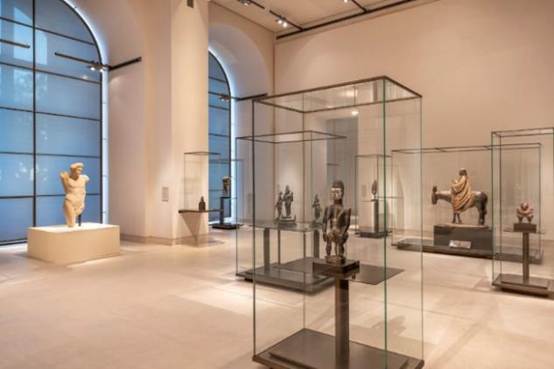 The Gallery of the Five Continents, Louvre, Paris. How can we explain to the French that putting our looted artefacts into a new environment will not prevent us from seeking their restitution?
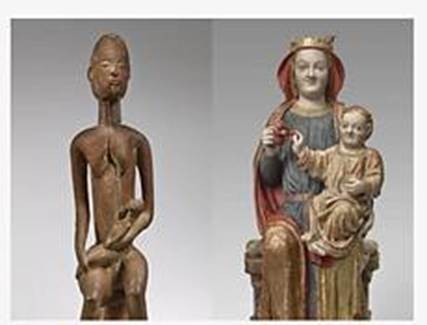
Dogon, mother and child figure, Blessed Virgin Mary with the baby Jesus.
Where is Gou? Can looted African art remain in France because of alleged ‘mutation’? https://www.modernghana.com/news/1404322/can-looted-african-art-remain-in-france-because.html
https://www.wikiwand.com/fr/articles/Sculpture_d%C3%A9di%C3%A9e_%C3
https://mondafrique.com/loisirs-culture/serie-patrimoine-africain-la-restitution-du-dieu-gou-au-coeur-du-voyage-demmanuel-macron/
https://sapere.page/a-la-decouverte-dune-oeuvre-dakati-ekplekendo-sculpture-dediee-a-gou/
https://www.rfi.fr/fr/culture/20210416-dieu-gou-le-retour-d-une-statue-ou-comment-sortir-d-un-d%C3%A9bat-de-sp%C3%A9cialistes
Mureen Murphy, Du champ de bataille au musée : les tribulations d’une
sculpture fon
https://journals.openedition.org/actesbranly/213
Nimba shoulder mask, Guinea, now in Galerie des cinq continents, Louvre, Paris, France.
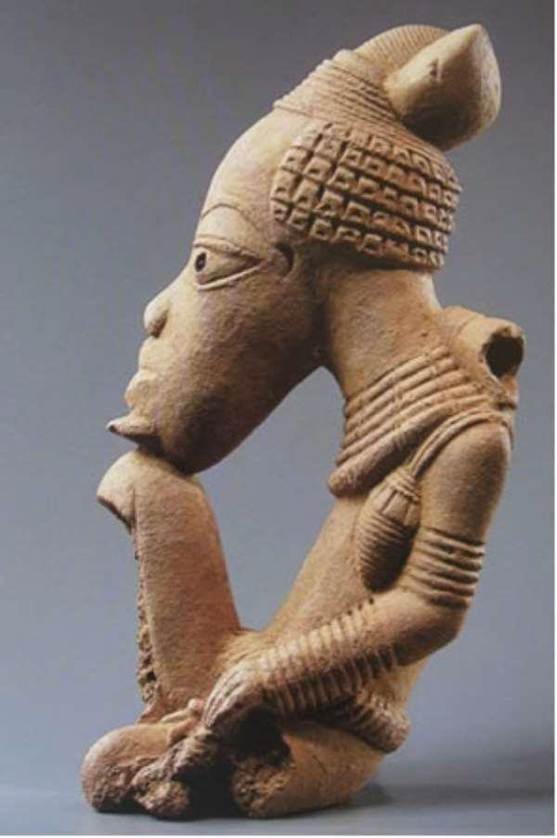
Seated Nok figure, Nigeria, now in Galerie des cinq continents Louvre ,one of three sculptures illegally exported and bought by France now with post-factum consent of the Nigerian government.
One of the three Nok sculptures illegally exported from Nigeria.
. Wikimedia Commons.
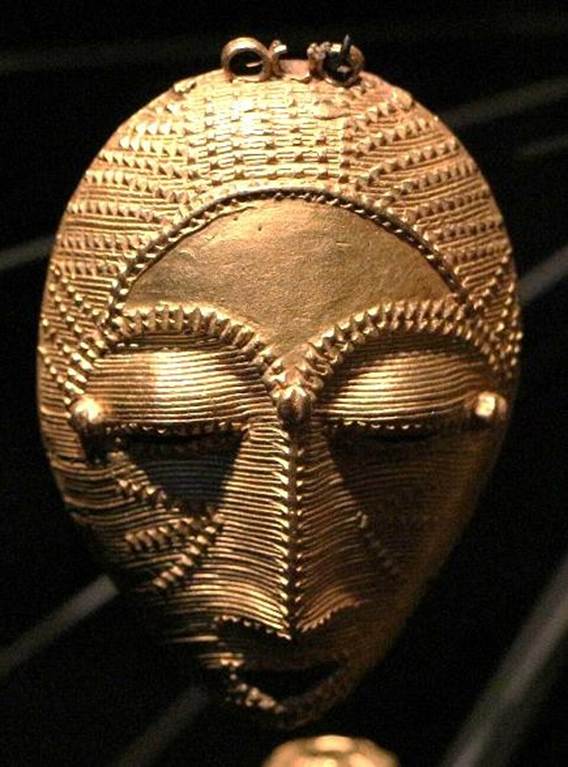
Akan gold pendant ,Ivory Coast, now in Musée du Quai Branly- Jacques Chirac, Paris. Wikimedia Commons.


 Investors favour 364-day treasury bill as bids hit GH¢474m
 Police probe three children found dead in abandoned vehicle boot at Tamale zoo
 Mahama will win fight against waste in one year — Mahama Ayariga
 'Ghana’s rape law does not recognise men as rape victims' — Young Lawyers Associ...
 Boakye Agyarko urges NPP members to close ranks after national delegates confere...
 Four injured in alleged military brutalities in Bunkpurugu
 Ayariga questions change from ‘24 hour markets’ to ‘district model markets’
 Ayariga challenges BoG to cite law behind arrests over cedi money bouquets
 Trump targets tax-free diesel as Republicans approach midterms
 Manhyia South MP charged over alleged GH¢9.85m loss to SIC Life


