




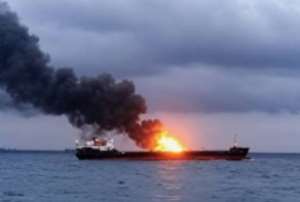
The official American account is straightforward: the crew of the MT Settebello repeatedly ignored warnings from US forces, persisted in attempting to transport Iranian oil in violation of Washington's naval blockade of the Strait of Hormuz, and were struck as a consequence a precision munitions hit to the engine room, calculated to disable rather than sink. Three men died. Twenty-one were rescued. The US Central Command released thermal imagery of the disabled vessel and stood by its account.
The vessel's managers say that account is a lie.
Dubai-based IOS Marine FZE, manager of the Palau-flagged tanker, issued a public statement directly contradicting CENTCOM, saying: "We categorically reject claims that the Motor Tanker SETTEBELLO ignored warning calls, communications, or instructions." More pointedly, the company went further disputing not merely the vessel's response to warnings, but whether any warnings were ever received at all.
"To the best of our knowledge and based on information available to us, no warning call, message or communication was ever successfully established with the vessel prior to the actions taken against it. No contact whatsoever was made," the company stated. IOS Marine said the Settebello held no affiliation whatsoever with Iran or Iranian oil and was engaged in legitimate commercial operations at the time of the strike.
The company unequivocally held the United States Navy responsible for the actions that led to the deaths of three people connected to the vessel ) and called for a full international investigation.
Two versions. Three dead men. No independent arbiter.
What CENTCOM Says Happened
The US maritime blockade against Iranian oil exports went into effect on April 13, 2026. Since that date, according to American military officials, US forces have disabled eight non-compliant vessels, redirected 134 ships, and allowed 42 vessels carrying humanitarian aid to pass through the Strait.
US Central Command accused the Settebello of violating the ongoing naval blockade of Iran, saying in a statement that the engine room of the Palau-flagged tanker was fired on after the crew "repeatedly failed to comply with directions from American forces." CENTCOM published footage of the strike, presenting the action as a targeted, proportional enforcement measure within the parameters of the blockade.
The vessel struck on June 9, 2026, carried twenty-four Indian seafarers. Three of them did not survive: deck cadet Aditya Sharma, engine fitter Shivanand Chaurasiya, and Chief Engineer Patnala Suresh.
The Ship Manager's Counter-Narrative
The dispute between IOS Marine and CENTCOM turns on two central questions: whether warnings were issued, and whether the Settebello was in fact carrying Iranian oil.
On the first question, the gap between the two accounts could not be wider. CENTCOM says the crew repeatedly failed to comply. IOS Marine says no communication was ever successfully established. If the ship manager's account is accurate, it transforms the incident entirely from an enforcement action against a non-compliant vessel into a strike carried out against a ship that had no meaningful opportunity to respond, crewed by civilian workers who had no understanding of why they were being targeted or any means of stopping it.
On the second question, the picture is complicated by independent maritime intelligence. Analytics firm Windward cited six flag changes in six years, a fraudulent registry, the absence of known marine insurance, and repeated AIS spoofing that it said was used to conceal cargo operations at Iran's Bandar Mahshahr port, describing the vessel as a "dark fleet" tanker used exclusively to transport Iranian fuel oil and heavy crude.
Tanker tracking firm TankerTrackers.com was separately reported to have identified the Settebello as having carried Iranian oil for at least five years, though it had not been sanctioned by the US Treasury. IOS Marine did not address those claims.
The picture that emerges is murkier than either party's public statement allows. A vessel may have been used by Iranian oil interests without the knowledge or at least claimed ignorance of its current commercial operators. Warnings may have been broadcast but not received, whether through technical failure, language barriers, frequency mismatch, or operator error on the military side.
In a conflict zone where American aircraft are enforcing a blockade over one of the world's most congested maritime corridors, the margin for catastrophic miscommunication is not merely theoretical. It has now been demonstrated at the cost of three lives.
The Dead Men's Families Ask the Same Question
For the families receiving the news in India, the geopolitical complexity of the dispute provided no consolation whatsoever.
Sharma's grandfather told the Press Trust of India: "We want to know the full truth of what happened. Our hearts are shattered." The family has since called for a full investigation and demanded accountability. The Indian Express reported that Aditya had told his father the ship received two warnings from the US Navy in the two weeks before the strike took place suggesting, if accurate, that the crew was aware of the vessel's exposure but continued to operate under commercial direction they had no power to countermand.
Shivanand Chaurasiya's father, Ramji, had spoken to his son the morning before the strike. His son told him everything was fine. When Reuters asked him what information he had subsequently received, he told his family he had gone to sea about nine months ago and had told his father earlier this week that everything was fine. He could not finish the sentence.
Chief Engineer Patnala Suresh leaves behind a wife, Bhargavi, and two sons aged thirteen and ten. He was days from home, preparing to celebrate fifteen years of marriage. His father spent Thursday morning making a single appeal to authorities: please send us a photograph of the recovered body so we can know it is our son.
India's Escalating Fury
The deaths have generated the strongest diplomatic language New Delhi has directed at Washington since the Iran conflict began in February 2026. Indian foreign ministry spokesperson Randhir Jaiswal told reporters: "These attacks must cease and end. We also call for dialogue and diplomacy so that we can have an early return to peace and stability in the region."
India summoned the US chargé d'affaires in New Delhi to convey its "deepest concerns." The Indian National Congress, the main opposition party, used the incident to criticize Prime Minister Narendra Modi's government, arguing that New Delhi must do more to protect Indian nationals working aboard merchant vessels in the Gulf.
The Forward Seamen's Union of India described the attack on a vessel carrying 24 Indian seafarers as a "matter of serious concern" and urged "swift and coordinated action to ensure the safety of the crew, provide support to their families, and uphold the security of seafarers at sea."
India has one of the largest merchant navy workforces in the world. At any given moment, tens of thousands of its citizens are crewing commercial vessels transiting the Gulf the same Gulf that has now become an active military enforcement zone. The Settebello deaths are, as one maritime publication noted, the first confirmed seafarer fatalities linked to enforcement of Washington's blockade of Iran. They are unlikely to be the last.
The Accountability Gap
The most troubling element of this incident is not the dispute over facts disputes are inevitable in a fog-of-war environment but the absence of any mechanism through which accountability can be compelled. The US military is enforcing a unilateral blockade in international waters, under no UN Security Council authorization, with no independent monitoring body, no grievance channel for affected civilian shipping, and no process by which a vessel manager can challenge a targeting decision before or after force is used.
When a precision munition hits a commercial ship and kills three civilians, the party who fired it releases its own account of events, publishes its own footage, and then waits. The bereaved families wait too for an investigation that may never come, for a truth that sits, undisclosed, in a CENTCOM targeting file somewhere above the Gulf of Oman.
Aditya Sharma was a cadet. Shivanand Chaurasiya was a fitter. Patnala Suresh was an engineer going home for his anniversary. Whether their ship was carrying Iranian oil or not, whether warnings were issued or not any of that retroactively justifies the absence of a credible, independent accounting of how they died and who bears responsibility for their deaths.
Their families deserve that accounting. The world's merchant mariners navigating the same waters need it.
Mustapha Bature Sallama.
Medical/ Science Communicator,
Private Investigator, Criminal investigation and Intelligence Analysis.
International Conflict Management and Peace Building.USIP
[email protected]
+233-555-275-880

 Ghana to challenge Canada over Thomas Partey visa denial ahead of World Cup Open...
 Ashaiman Police arrest suspects in two separate robbery incidents within hours
 Govt announces transitional measures for LLB graduates under new legal education...
 Two midwives remanded over disappearance of newborn at Salaga Municipal Hospital
 'They razed everything': Ivorians lose homes in murky operation
 US, Iran signal peace deal is close after Trump lashes out at ‘dishonorable’ Ira...
 Nigeria's Ex-Jihadists Seek New Lives After Vocational Training
 BTU in Turmoil: GTEC rejects finance director appointment amid degree verificati...
 Twifo Praso Pra River commuters appeal for govt intervention to stop galamsey


